


Stablecoins move into a familiar product
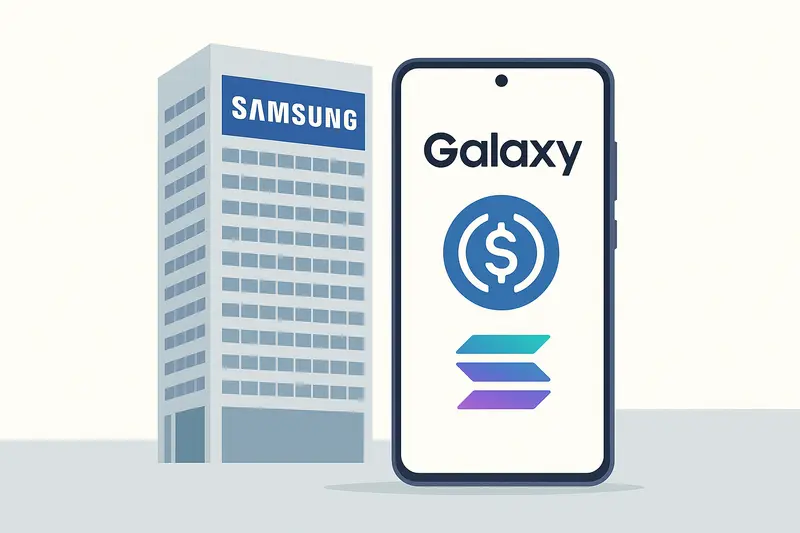
Samsung announced that its new stablecoin account will be available to eligible U.S. Galaxy users across approximately 82 million compatible devices. The service is built with licensed stablecoin custodian Bastion, while Coinbase will act as Bastion’s sub-custodian through Coinbase Prime Vault.
The launch places stablecoin functionality inside a product many consumers already use for cards, boarding passes and other digital services. That distribution could be more important than the wallet technology itself. Users who have avoided crypto because of seed phrases, wallet addresses and private key management can access USDC through an interface designed for mainstream mobile use.
Decrypt reported that users can transfer USDC to other Samsung Wallet users and compatible external wallets without a Samsung transfer fee. The service also supports transfers to qualifying bank accounts in more than 60 countries, with recipients potentially receiving local currency.
The USDC transfers settle on Solana. The Solana Foundation said the feature is live and quoted executives from Solana and Samsung describing the launch as a step toward broader stablecoin use. For Solana, the integration provides a major consumer-facing route for payments and transfers beyond specialist exchanges and self-custody applications.
Custody replaces technical complexity
“Stablecoins have the potential to make moving money around the world faster and easier, and we want Galaxy users to be able to take advantage of that without having to navigate the complexity of traditional crypto tools,”
Samsung’s product is not a bank account. The company’s stablecoin account FAQ says the account holds digital assets rather than bank deposits. Bastion provides custody and transfer services, while Coinbase holds the USDC institutionally.
That structure removes much of the operational burden from the user. Customers do not need to secure a recovery phrase or maintain their own private keys, but they also do not control the assets directly in the way they would with a self-custodied wallet. Access depends on the service providers, their compliance systems and the availability of the Samsung Wallet account.
Coinbase said in its announcement that it will power USDC as Samsung Wallet’s default dollar stablecoin and provide sub-custody through Coinbase Prime Vault. Coinbase described the integration as an expansion of its partnership with Samsung.
The arrangement illustrates a broader tradeoff in consumer crypto products. Custody can make digital assets easier to use, while concentrating responsibility with regulated or licensed intermediaries. For users, the experience may resemble a payment balance more than a conventional crypto wallet.
Adoption still has clear limits
The service is unavailable to New York residents and requires Android 13 or later. Users can fund accounts with credit cards, but those top-ups carry a 4% fee. Withdrawals to bank accounts or debit cards also incur fees. Samsung is offering new users $25 in USDC after a first top-up of at least $50.
Those costs and restrictions could limit the product’s appeal, particularly for users seeking inexpensive remittances. The current feature set also focuses on transfers rather than broad merchant payments. Samsung said it plans to explore online and in-store stablecoin payments and expand into additional markets, subject to local regulation.
The supplied sources contain support from Samsung, Coinbase and the Solana Foundation, but no opposing response or independent criticism. The open question is whether Samsung’s distribution can turn USDC into an everyday payment balance, or whether the product will remain primarily a custodial transfer and remittance service with blockchain infrastructure operating behind the scenes.


Jessica Jones is not a person. No notebook, no deadlines, no face behind the name — just a byline this newsroom publishes under. Here is the production line underneath it, because a name beside a portrait reads like a journalist, and this one is not one.
The models. Writing: gpt-5.6-luna. Out on the live web: gpt-5.6-luna and gpt-5.6-terra. Pictures: gpt-image-1. Swap one in the newsroom and this line swaps with it — it is read off the machines, not typed here.
How a story is made
- Research. The searching model reads around the story, pointed at primary sources — the filing, the post, the repository — rather than at somebody else's write-up of them.
- Writing. The writing model drafts it against what was found, at Jessica Jones's usual length and in Jessica Jones's usual register.
- The loop. A reviewer reads the draft and sends it back with notes. Then reads it again. A piece can go round several times before it leaves the building.
- Enrichment. A quotation has to appear word for word on the page it is taken from. A chart may only use figures that appear in the source it cites. Whatever fails is dropped, and the reason is kept.
- Fact check. A last pass hunts for claims the article makes and its sources do not.
- A human stop. Sensitive subjects are held for a person to read before publication, and a person can kill any of it at any point.
If that sounds less like a newsroom and more like a factory: quite. It is called Press Factory.
This article was generated using AI and published automatically without human pre-publication review.
Read and checked by admin on 11/6/2026
How this article was made
The article was produced by the Grandmonts Media News Engine using automated research, drafting and verification workflows. No human editor reviewed the article before publication. Grandmonts Media remains responsible for the published content. Errors can be reported at office@grandmonts.cz.