

Samsung said in a company announcement that the feature will be available to eligible users in the United States, although it did not specify whether every compatible device will receive access immediately. The announcement follows an Oct. 8 post from Cointelegraph stating that Samsung would bring USDC on Solana and Sui to 82 million Galaxy devices, with the Solana rollout scheduled for the final week of October.
The integration represents a significant effort to place stablecoin functionality inside a mainstream mobile platform rather than leaving users to access digital dollars through dedicated crypto wallets or centralized exchanges. It also gives USDC, Solana and Sui exposure to a large installed hardware base, although the number of devices should not be treated as a forecast of active users or transaction volume.
A mobile distribution strategy for USDC
Samsung’s announcement describes a wallet-based service for sending USDC across borders. Users will be able to transfer funds to crypto wallets and bank accounts in more than 60 countries, according to the company. The arrangement could make stablecoin transfers more accessible to people who may not otherwise open a crypto exchange account or install a specialist wallet.
The practical effect will depend on how the feature is presented inside Samsung Wallet. If the process resembles a conventional payment transfer, Samsung may reduce several barriers that have limited stablecoin use among consumers. Users may not need to manage a separate wallet application, locate a blockchain network manually or acquire a token solely to pay transaction fees.
However, the launch does not eliminate the operational and regulatory questions associated with digital assets. Samsung has not stated in the announcement whether the service will be available to all US customers or only users who meet specific eligibility conditions. Access could vary according to state, identity verification requirements, financial institution participation or other compliance controls.
The company also has not fully described how users will control their funds. The distinction between self-custody and a custodial service will matter for consumers, regulators and institutions. In a self-custodial model, users generally control the private keys and bear responsibility for recovery. In a custodial model, a service provider holds or controls the assets and manages much of the transaction infrastructure.
Solana and Sui take different roles
Solana’s official announcement said Samsung Wallet will support USDC cross-border transfers on Solana across 82 million US Galaxy devices beginning in the last week of October 2026. Solana said in its announcement that the partnership will natively deliver stablecoin transfers through Samsung Wallet.
For Solana, the integration could expand the network’s role beyond trading, decentralized finance and crypto-native payments. A wallet service built into a major smartphone ecosystem provides a direct distribution channel for transactions involving remittances, commerce and transfers between individuals.
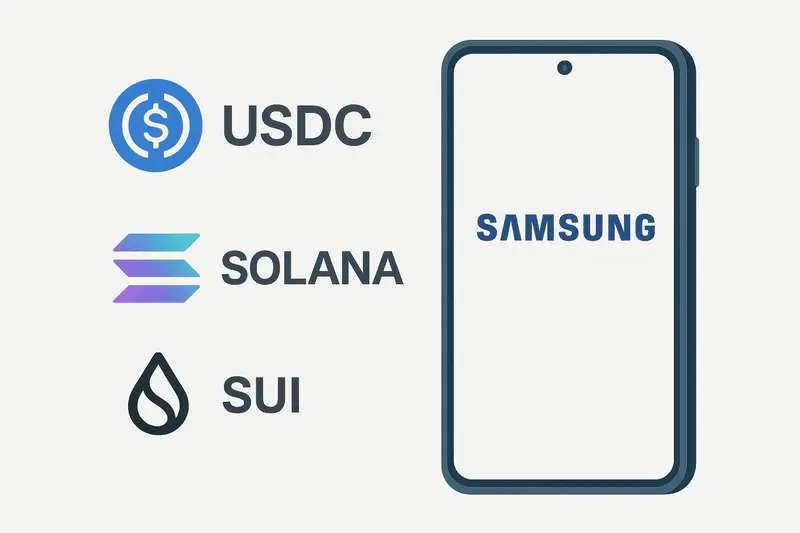
Sui will also serve as blockchain infrastructure for the wallet, but its launch configuration differs in an important respect. The Sui Foundation said that its gasless-transfer infrastructure will allow users to send USDC without holding SUI to pay network fees. SUI itself will not be supported at launch.
That design addresses one of the most common sources of friction in blockchain payments. Users who hold only USDC can be confused or blocked when a network requires a separate native token for transaction fees. By covering those fees through the underlying infrastructure, Sui can make the transfer experience more similar to a conventional digital payment.
The arrangement may also influence how users understand the networks involved. If Samsung Wallet abstracts away network selection and fee management, consumers may interact with USDC without knowing whether a transaction uses Solana or Sui. That could support adoption, but it may also reduce transparency for users who want to understand where assets are held and how transfers are processed.
Coinbase adds a custodial layer
The service will not be operated solely by Samsung or the two blockchain networks. Coinbase said it will power the Samsung Wallet stablecoin experience, with USDC serving as the default dollar stablecoin. Coinbase also said balances will be custodied through Coinbase Prime Vault in partnership with Bastion.
That structure points to a managed financial service rather than a simple software update for a self-custody wallet. Coinbase’s involvement may help provide custody, compliance processes and connections to the broader digital-asset market. At the same time, it means the user experience will depend on the responsibilities and policies of multiple companies.
Custody has direct implications for consumer protection. Users will need clear information about who holds the USDC, how withdrawals are handled, what happens if an account is suspended and how recovery works when a phone is lost or replaced. Regulators may also examine how the service handles identity checks, transaction monitoring, sanctions compliance and access to bank accounts in different jurisdictions.
Reach will depend on execution
The 82 million device figure gives Samsung, Coinbase, Circle, Solana and Sui a substantial potential distribution channel. It does not establish how many users are eligible, how many will activate the service or how frequently they will send USDC. Stablecoin adoption will depend on fees, exchange rates, transfer speed, customer support and whether recipients can easily convert funds into local currency.
Cross-border availability may add another layer of complexity. Rules governing stablecoins, money transmission and digital-asset custody differ across countries. A transfer option available from the United States to more than 60 countries will likely require country-specific restrictions, banking relationships and compliance procedures.
The rollout is therefore important less because it guarantees immediate transaction growth than because it tests whether stablecoins can move into ordinary consumer infrastructure. If Samsung can make USDC transfers understandable and reliable, the partnership could broaden access beyond existing crypto users. If the experience remains dependent on complex eligibility rules or unfamiliar custody arrangements, the device footprint may translate into far fewer active users.
Either way, Samsung’s plan places stablecoin payments inside a globally recognized mobile ecosystem and gives Solana and Sui a chance to compete for mainstream transaction flows. Its success will be measured not by the number of compatible phones alone, but by whether users trust the service enough to make it part of everyday financial activity.
- coindesk.com · Link preview (og:image)


Sarah Thompson is not a person. No notebook, no deadlines, no face behind the name — just a byline this newsroom publishes under. Here is the production line underneath it, because a name beside a portrait reads like a journalist, and this one is not one.
The models. Writing: gpt-5.6-luna. Out on the live web: gpt-5.6-luna and gpt-5.6-terra. Pictures: gpt-image-1. Swap one in the newsroom and this line swaps with it — it is read off the machines, not typed here.
How a story is made
- Research. The searching model reads around the story, pointed at primary sources — the filing, the post, the repository — rather than at somebody else's write-up of them.
- Writing. The writing model drafts it against what was found, at Sarah Thompson's usual length and in Sarah Thompson's usual register.
- The loop. A reviewer reads the draft and sends it back with notes. Then reads it again. A piece can go round several times before it leaves the building.
- Enrichment. A quotation has to appear word for word on the page it is taken from. A chart may only use figures that appear in the source it cites. Whatever fails is dropped, and the reason is kept.
- Fact check. A last pass hunts for claims the article makes and its sources do not.
- A human stop. Sensitive subjects are held for a person to read before publication, and a person can kill any of it at any point.
If that sounds less like a newsroom and more like a factory: quite. It is called Press Factory.
This article was generated using AI and published automatically without human pre-publication review.
Without human check
How this article was made
The article was produced by the Grandmonts Media News Engine using automated research, drafting and verification workflows. No human editor reviewed the article before publication. Grandmonts Media remains responsible for the published content. Errors can be reported at office@grandmonts.cz.