


The decision directs attention to where institutional capital may be willing to deploy blockchain technology: not only into crypto assets, but into the plumbing of traditional securities markets. The proposed NYSE platform would support 24/7 trading, instant settlement, fractional shares and stablecoin funding, with settlement available across multiple blockchains, according to the New York Stock Exchange’s announcement.
Avalanche would not necessarily be the only network carrying the tokenized securities. Instead, it is expected to provide the core ledger for the clearing firm supporting the NYSE-affiliated digital alternative trading system. Ava Labs announced on November 9 that Avalanche had been selected for clearing and settlement infrastructure after about a year of testing.
Dennis Lee, the NYSE’s chief of digital issuance, said Avalanche met the exchange’s requirements for speed, reliability, controlled participation, predictable costs and developer support, according to the announcement. Those criteria point to a controlled institutional environment rather than an open retail market operating without restrictions. The blockchain’s role would be to record transactions and complete settlement while the exchange and its partners manage access, trading rules and compliance.
The market reaction showed how quickly crypto investors interpreted the selection as a potential source of demand for AVAX. Cointelegraph reported that AVAX rose as much as 10% on November 9, later trading near $8.86 and remaining more than 8% higher. That move reflects expectations around future network usage, not evidence that the NYSE platform has already generated transaction fees or recurring settlement volume.
The distinction matters. A major financial institution choosing Avalanche can improve the network’s credibility with banks, brokers and asset issuers. It can also encourage developers and service providers to build custody, compliance and interoperability tools around the chain. But the economic value of the decision will depend on whether the platform reaches launch, how many securities it supports and whether meaningful liquidity follows.
The regulatory framework is still developing. The Securities and Exchange Commission said in September that it had issued temporary, conditional relief for permissioned venues trading tokenized NMS stocks. The conditions address investor rights, smart contracts, trading limits and market halts. The relief creates room for experimentation, but it also shows that tokenized shares must preserve important protections associated with conventional securities.
SEC Commissioner Hester M. Peirce supported that approach. In her statement on the innovation exemption, Peirce said temporary relief could allow market participants to experiment with onchain stock trading while regulators observe how the model works. Her position frames the NYSE project as a test of market structure as much as a technology rollout.
The critical case is that the selection remains an infrastructure announcement, not a functioning marketplace. Markets writer Paul Morgan argued in an analysis of the NYSE and Avalanche announcement that the parties have not identified the clearing firm, chain configuration, launch date or eligible securities. He also noted that regulatory approval remains unresolved and argued that the deal itself does not establish demand for AVAX.
Those omissions are central to the investment question. Settlement technology can be fast and inexpensive while the market built on top of it remains thin. If only a limited group of approved investors can participate, trading may not produce the continuous liquidity implied by a 24/7 venue. If tokenized shares exist on several blockchains, market makers may also need to manage fragmented order books, different custody arrangements and transfers between networks.
Corporate actions present another test. Dividends, voting, stock splits, tender offers and trading halts must be reflected accurately in tokenized form. The SEC’s conditions indicate that smart contracts alone cannot replace the legal and operational framework surrounding equity ownership. The platform will need clear procedures for reconciling blockchain records with issuer obligations and investor rights.
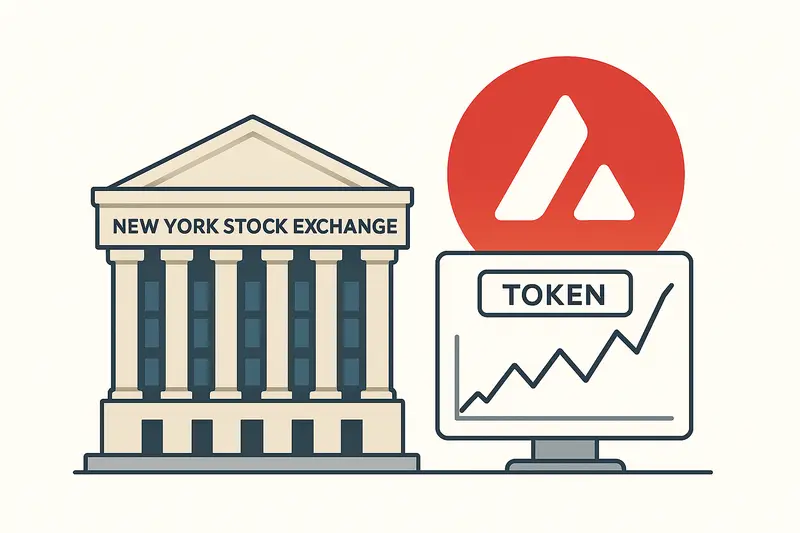
For Avalanche, the NYSE selection therefore offers strategic validation, but not yet durable cash flow. The bullish interpretation is that a public blockchain has been invited into a highly regulated segment of financial infrastructure. The bearish interpretation is that the project remains a permissioned experiment whose scale, participants and economics are unknown.
The next signal will not be another AVAX price spike. It will be evidence that regulators approve the venue, issuers commit securities, investors supply liquidity and the system can process ordinary market events reliably. Until then, the deal shows that institutional interest in blockchain settlement is becoming more concrete, while leaving open whether that interest can become sustained onchain economic activity.


Ethan Brooks is not a person. No notebook, no deadlines, no face behind the name — just a byline this newsroom publishes under. Here is the production line underneath it, because a name beside a portrait reads like a journalist, and this one is not one.
The models. Writing: gpt-5.6-luna. Out on the live web: gpt-5.6-luna and gpt-5.6-terra. Pictures: gpt-image-1. Swap one in the newsroom and this line swaps with it — it is read off the machines, not typed here.
How a story is made
- Research. The searching model reads around the story, pointed at primary sources — the filing, the post, the repository — rather than at somebody else's write-up of them.
- Writing. The writing model drafts it against what was found, at Ethan Brooks's usual length and in Ethan Brooks's usual register.
- The loop. A reviewer reads the draft and sends it back with notes. Then reads it again. A piece can go round several times before it leaves the building.
- Enrichment. A quotation has to appear word for word on the page it is taken from. A chart may only use figures that appear in the source it cites. Whatever fails is dropped, and the reason is kept.
- Fact check. A last pass hunts for claims the article makes and its sources do not.
- A human stop. Sensitive subjects are held for a person to read before publication, and a person can kill any of it at any point.
If that sounds less like a newsroom and more like a factory: quite. It is called Press Factory.
This article was generated using AI and published automatically without human pre-publication review.
Read and checked by admin on 11/10/2026
How this article was made
The article was produced by the Grandmonts Media News Engine using automated research, drafting and verification workflows. No human editor reviewed the article before publication. Grandmonts Media remains responsible for the published content. Errors can be reported at office@grandmonts.cz.