

Ethereum’s next scaling debate may not be about block space, gas fees or another layer 2 network. It may be about what a validator needs to remember.
Vitalik Buterin’s “Extremely Lean” proposal takes aim at one of the least glamorous but most consequential parts of Ethereum’s consensus machinery: the persistent validator state that nodes carry forward while tracking rewards, penalties, activation status and other balance-related changes. The design described by Buterin would shift much of that burden away from the chain itself and full nodes to validators. Instead of regularly applying balance updates across the validator set, validators would submit a daily zero knowledge STARK proof in place of per-epoch balance updates.
The Block reported that the broader two-step proposal could eventually reduce validator state to roughly six bytes per validator and may allow consensus to scale to millions of validators; it described phase 1 as shrinking onchain state to a few bytes per validator. The same report characterized the work as a long-term redesign that could take three to four years to develop.
That headline is easy to read as a simple compression story. It is not.
A daily proof does not eliminate the work of calculating rewards and penalties. It moves that work into a proving process. Nor does a proof eliminate Ethereum’s need for honest participants, available data, credible recovery paths or economically secure fork choice. It changes where those requirements live and how visibly the protocol expresses them.
The practical question is therefore not whether a STARK can verify a large computation more cheaply than every validator can repeat it. In general, that is the point of a validity proof. The deeper question is whether Ethereum can move toward near-zero consensus state without creating a new class of operational gatekeepers: the actors that retain data, build witnesses, generate proofs and coordinate recovery when the system does not behave as planned.
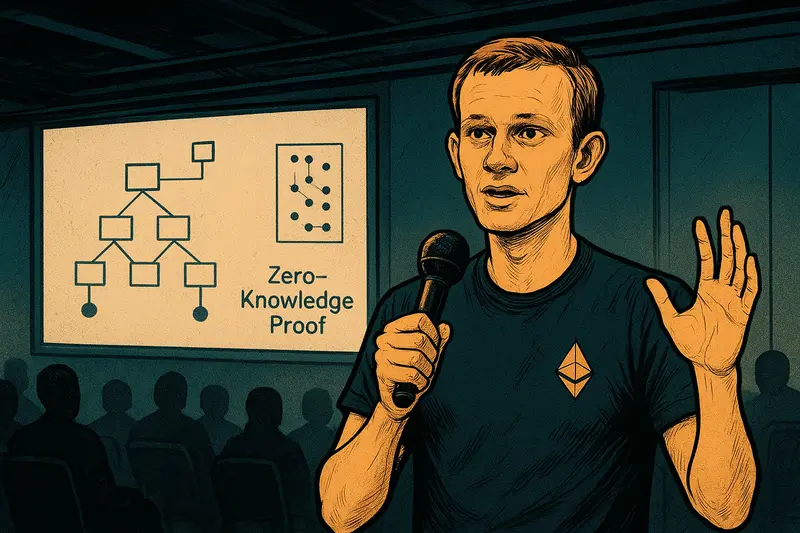
From every node doing bookkeeping to one proof attesting to it
In today’s broad model, Ethereum’s consensus participants process a continuing stream of events. Validators propose and attest to blocks. The protocol tracks who is active, who participated, who missed duties and whose balances should move up or down. That process is not just accounting. Balance changes affect future voting weight, rewards, penalties and the security incentives that keep participants online and honest.
The current approach has a straightforward virtue: nodes can retain and independently process the state needed to determine whether a block is valid. A node does not need to trust a separate accounting service that says the numbers are correct. It follows the protocol rules and reconstructs the result.
The cost is that validator state grows with the validator set. A system designed to welcome very large numbers of validators must confront the storage, bandwidth and processing implications of holding detailed records for all of them. Even if each record is modest, the aggregate can become substantial. More importantly, every additional record becomes part of the data path clients must manage correctly.
The Extremely Lean approach changes the unit of verification.
Rather than rely on one prover to replace validator-side balance processing with a single aggregate transition proof, validators would submit daily ZK-STARK proofs. The cited report does not specify a single shared proof that all validators verify before accepting one new compact validator-state commitment.
In a simplified form, the statement being proved might be:
- This was the previous committed validator state.
- These were the protocol-relevant events during the accounting period.
- The reward, penalty and status rules were applied exactly as specified.
- This is the resulting committed validator state.
- No invalid event was included, omitted or counted twice.
If the proof verifies, a validator does not need to reproduce the entire calculation to know that the claimed transition satisfies the circuit or program expressed in the proof system.
That is a major change in the chain’s architecture. Verification becomes deliberately cheap and uniform. Proving becomes specialized, data-intensive and potentially expensive.
The most important distinction is between the witness and the proof.
The witness is the full body of information used to demonstrate that a statement is true. In this case, it could include the detailed record of validator events, balance inputs, membership information, status changes and any other data required by the transition logic. The proof is a compact cryptographic artifact derived from that witness. It lets a verifier check correctness without receiving or processing the full witness itself.
This is why the proposal can reduce what ordinary validators retain. The witness does not have to sit in every validator’s local state if the proof securely attests to the computation.
It is also why the proposal does not make the witness disappear. Somebody must assemble it.
What near-zero validator state actually means
The phrase “near-zero state” can sound as if Ethereum would cease to know who its validators are. That is not the useful interpretation.
A consensus system must still have a way to identify valid voting power, distinguish eligible participants from ineligible ones, apply slashing and penalty rules, and determine which chain has the relevant support. The proposal is better understood as an attempt to replace detailed, continuously stored validator records with concise cryptographic commitments and proofs.
The Block reported that phase 1 would replace per-epoch balance updates with daily ZK-STARK proofs, while the broader two-step plan was described as eventually targeting roughly six bytes of validator state.
That six-byte figure should be treated as an architectural target, not as a complete description of all data an Ethereum ecosystem participant would ever need. A validator client, a block explorer, a staking operator, an institutional custodian, a liquid staking protocol and a forensic service do not all have identical information needs.
A chain can minimize its canonical consensus state while an ecosystem still keeps richer offchain indexes, archives and local records. The central promise is that this richer data no longer needs to be replicated as consensus-critical state by every validator simply to verify the next transition.
That distinction matters for decentralization.
If the protocol can safely verify a state root and proof while keeping only a compact residual state, then more people may be able to run validators on ordinary hardware. Lower resource requirements can reduce the advantage held by large operators with specialized infrastructure. They can also make client development simpler in some areas because the canonical state that must be handled correctly becomes smaller.
But an architecture becomes more decentralized only if the work removed from ordinary validators does not become controlled by a small group elsewhere.
A proof system can improve verifier decentralization while weakening prover decentralization. It can make it cheap for thousands of people to check an answer, but difficult for anyone except a few well-capitalized actors to construct the data set and calculate the answer in time.
That is the tension at the heart of Extremely Lean Ethereum.
The daily proof is a new production pipeline
A useful way to think about the design is as a daily settlement cycle for validator accounting.
During the day, blocks are proposed, attestations are made, duties are missed, and protocol events occur. These events create the inputs to the balance and status transition. At the end of the accounting period, validators submit daily proofs containing the relevant data. The report does not specify an aggregate prover or group of provers producing a network-wide transition proof.
The network then verifies the proof and accepts the result if it satisfies the consensus rules.
The important word is “produces.” In the existing mental model, every validator is a processor of a detailed transition. In the proposed model, the network may depend more directly on proof production being timely, competitive and recoverable.
There are several possible operating models:
Self-proving validators: Each validator or staking operation builds its own witness and proof. This maximizes independence, but may be inefficient if millions of participants repeat closely related work.
Open prover market: Specialized actors compete to produce the daily proof. Anyone can verify the winning proof, while multiple parties can attempt to generate it.
Delegated proving: Validator operators outsource witness construction and proof generation to service providers, much as many organizations already outsource parts of infrastructure operations.
Protocol-sponsored fallback proving: A client team, foundation-backed public good or large ecosystem operator runs a reliable emergency prover when ordinary market activity fails.
Each model has different implications. The first favors sovereignty but could impose a high hardware burden. The second can be efficient, but only if entry remains feasible and the winning prover cannot censor relevant data. The third may be commercially attractive, but it can introduce service concentration. The fourth improves reliability in a crisis, but creates a politically sensitive dependency on identifiable institutions.
Proof verification is not proof production. That distinction should shape any claim that the system will support millions of validators.
What the proof must commit to
A ZK proof is only as meaningful as its public inputs and its circuit rules.
For the daily STARK to be useful, the proof’s public inputs would need to bind the calculation to the consensus history rather than merely certify an arbitrary accounting exercise. At a high level, the public inputs should include a prior state commitment and a new state commitment. They may also need to commit to the relevant block range, the event set or event root, the accounting period and protocol parameters that determine how rewards and penalties are calculated.
Without those anchors, a proof could establish that some transition is valid without establishing that it is Ethereum’s required transition.
Consider a simple analogy. An auditor can confirm that a company’s spreadsheet adds up correctly. That does not prove the spreadsheet included every invoice. To reach the stronger conclusion, the audit process must bind the spreadsheet to source records and establish that the source-record set is complete.
A daily validator-state proof has the same requirement. It must show both arithmetic correctness and input completeness according to the protocol’s rules.
This is where the design becomes more than a compression mechanism.
The circuit needs a precise definition of what counts as a relevant event. It needs a deterministic rule for ordering and aggregating those events. It needs commitments that prevent a prover from selecting a convenient subset. It needs to connect balance changes to the same chain history that validators use for fork choice. And it needs a defined response when the expected proof is late, unavailable or invalid.
The proof does not replace consensus. It becomes part of consensus.
The advantage is that a well-designed proof can compress an enormous amount of deterministic work into an object that clients verify quickly. The risk is that an omission or ambiguity in the circuit design becomes systemic. If the proof attests to the wrong computation, perfect cryptography only proves the wrong thing perfectly.
This is not an argument against ZK systems. It is the standard by which they should be evaluated. The hard work moves from duplicated execution toward circuit specification, witness availability, implementation diversity and operational resilience.
“Verified” is not the same as “recoverable”
The cleanest way to assess the proposal is to separate two statements that are often blurred together.
First: the proof verified.
This means the verifier checked the cryptographic proof against its public inputs and found that the circuit constraints were satisfied. If the proof system is sound, the verifier can be confident that a valid witness exists for the stated computation.
Second: the network can safely recover and challenge the claimed state.
This requires more. It requires that honest participants can obtain the data needed to reconstruct the witness, independently regenerate the proof if needed, detect an incorrect input commitment, handle software bugs and continue operating if a primary prover disappears.
A proof may be valid while a network is operationally fragile.
Suppose a single large proving service generates the daily proof. The proof is mathematically correct. Every validator can cheaply verify it. But then that service has an outage, loses access to its data pipeline or becomes subject to a legal order. If nobody else can reconstruct the witness promptly, the chain must have a protocol answer.
It might pause the accounting update while continuing other functions. It might accept a delayed proof. It might permit a fallback path where nodes process a more data-heavy transition directly. It might allow alternate provers to publish competing valid proofs. Or it might have a precommitted emergency state recovery mechanism.
Each choice has tradeoffs.
A strict requirement for a daily proof creates a liveness risk. A permissive fallback can create complexity and may reopen the very resource burden the system intended to remove. A centralized emergency service improves uptime but can make governance and censorship concerns more acute.
This is why data availability remains central even in a proof-first design.
A STARK can prove that a witness exists. It does not, by itself, distribute that witness to the people who may need it later. If an honest independent prover cannot access the event data, it cannot compete. If a client team cannot obtain data after a bug, it cannot easily reproduce the state. If a validator cannot inspect the underlying transition, it must rely on the proof system and the availability architecture around it.
The protocol can address these risks, but it must address them explicitly.
Fork choice cannot be an afterthought
Ethereum’s fork choice is how the network decides which chain history to follow when competing branches exist. In a lean-state world, the proof needs a clear relationship with that choice.
If a daily state proof is attached to a specific chain history, then a competing fork may require a different proof because its underlying validator events differ. That creates a timing issue. A branch can attract votes before the day’s accounting proof is complete, while later balance changes influence the voting power used in future decisions.
The protocol must define which state is authoritative at every point.
One approach could treat the daily proof as a checkpointed accounting layer. The chain uses a previously accepted state commitment for ordinary consensus decisions, then incorporates the next state commitment when the proof is finalized. That limits the frequency of expensive state changes but creates a lag between behavior and its balance consequences.
Another approach could make the proof a condition for certain forms of finality or for advancing across a defined boundary. That strengthens the link between correct accounting and the chain’s progression, but makes liveness more sensitive to proof availability.
Neither model is automatically right. The key is that the protocol cannot simply say, “a proof arrives once per day,” and leave the rest to implementation. It must specify what happens if two candidate proofs reference different histories, if a proof arrives after a reorganization, if a valid proof is withheld, or if a bug causes honest provers to disagree about the expected state root.
The honest-majority assumption also does not disappear.
Ethereum’s economic security depends on assumptions about the behavior and incentives of the entities controlling voting power. A validity proof can establish that a specified balance update was computed correctly. It cannot stop a sufficiently powerful set of validators from coordinating around an undesirable chain history, censoring transactions or withholding participation.
What it can do is make certain forms of state verification less dependent on every participant holding a large local database. That is a meaningful engineering improvement, but it is distinct from the social and economic problem of who controls the validators.
The economics: cheap verification, expensive proving
The business case for the architecture begins with asymmetry.
Verification is intended to be light enough that ordinary validator operators can perform it with minimal hardware. Proving is intended to be much heavier, because it processes the complete witness and generates the cryptographic evidence. The system gains efficiency when one costly proof can replace a vast amount of replicated computation.
That trade can be excellent. It is already the logic behind many validity-rollup systems. A network can use expensive proving work to give many users and verifiers confidence in a transition without requiring all of them to perform it.
But Ethereum’s consensus layer is not simply another application. It is the system that determines who gets to participate in securing everything else. Its prover market therefore needs unusually strong guarantees.
A healthy market would have multiple independent implementations, geographically distributed operators, accessible data feeds, transparent performance measurements and incentives sufficient to reward reliable capacity. It would also have a way for a new entrant to reconstruct the witness without receiving permission from the incumbents.
If the proving pipeline requires proprietary hardware, exclusive data access or years of accumulated operational knowledge, the network may merely exchange one scaling bottleneck for another.
The critical metrics will not be limited to proof verification time. Developers and users should ask:
- How long does a full witness take to assemble?
- How many independent operators can generate a proof within the required window?
- What hardware and memory footprint does proving require?
- Can an operator begin proving from publicly available data without a privileged relationship?
- Is there a practical second implementation of the circuit and prover?
- How quickly can the network recover after a faulty proof or missing proof?
- What is the cost of storing enough data to reproduce historical transitions?
The proposal’s decentralization claim should be measured against those questions, not against validator count alone.
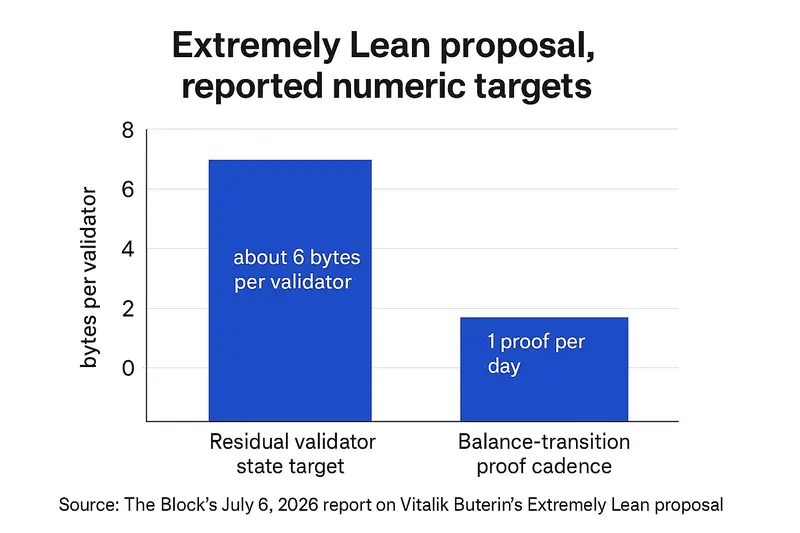
The chart is intentionally modest because the public reporting provides a target state footprint and proposed proof cadence, not a complete benchmark suite for proving hardware, latency or operating cost. Those missing numbers are themselves part of the story. A redesign of this scale should be judged through adversarial testing and reproducible performance data, not only through an elegant target architecture.
Millions of validators, with an important qualifier
The potential to support millions of validators is compelling because it speaks directly to Ethereum’s aspiration of broad participation. A network where a larger number of independent parties can validate consensus may be more resistant to capture, outages and concentrated infrastructure risk.
Yet “can support” and “will be decentralized” are different claims.
Millions of validator identities do not guarantee millions of independent decision makers. Large staking providers can operate many validators. Institutional custodians can aggregate client stakes. Shared cloud services can create correlated failure points. Delegation relationships can concentrate policy decisions even where key material remains distributed.
Extremely Lean Ethereum could still help. If reduced validator state lowers the cost and complexity of operating a validator, it may widen the pool of viable operators. It could benefit hobbyists, small businesses, local infrastructure providers and new client teams. It could also lower barriers for regional operators that cannot justify maintaining large stateful systems.
But the same architecture can create a new focal point around proving. The design is most decentralizing when anyone can validate cheaply and a broad, competitive group can also reconstruct the witness and produce the proof.
The design is less decentralizing if lightweight validators become passive proof checkers while a small number of industrial operators control the data pipeline. In that version, the chain has many verifiers but few actors capable of keeping it live.
That distinction is not theoretical. It should influence protocol incentives from the beginning. Provers may need direct rewards, redundancy incentives, open-source reference implementations and penalties or market mechanisms that discourage withholding. Data dissemination may need to be engineered as carefully as proof verification. Client diversity may need to extend beyond consensus clients into witness builders and provers.
A better way to evaluate the proposal
The promise of Extremely Lean Ethereum is not that it makes state management vanish. It is that it can make the chain’s most widely replicated tasks smaller, more auditable and more scalable through cryptographic proof.
That is a serious idea. It aligns with a wider industry shift in which validity proofs turn expensive computation into compact, independently checkable claims. It also fits Ethereum’s long-running effort to reduce the hardware burden of participating in the network without weakening security.
The Block described Lean Ethereum as a broad redesign spanning consensus, data and execution, with the Extremely Lean proposal focused on reducing the Beacon Chain’s state burden through recursive STARKs.
The proposal deserves attention precisely because it is not a narrow optimization. It redraws the boundary between the chain and its supporting infrastructure.
For users, the ultimate benefit could be a network whose validators are easier to run and whose consensus state is less cumbersome to manage. For builders, it could create new markets in proving software, witness construction, hardware optimization, data availability and client tooling. For staking businesses, it could alter the operational stack, shifting costs from routine state processing toward proof and data pipelines. For Ethereum itself, it could create a path to scale participation without allowing validator bookkeeping to become the limiting resource.
But the architecture should be tested against a simple standard: could a technically capable independent operator verify the proof, obtain the underlying data, regenerate the proof and help the network recover during a failure?
If the answer is yes, then a daily STARK could be more than an elegant compression layer. It could reduce the burden of consensus while preserving meaningful independence.
If the answer is no, Ethereum may have made validation lighter while making liveness depend on a new, less visible center of gravity.
That is the real design challenge. In a near-zero-state chain, the state may be small. The responsibility for keeping it honest cannot be.
Jessica Jones is not a person. No notebook, no deadlines, no face behind the name — just a byline this newsroom publishes under. Here is the production line underneath it, because a name beside a portrait reads like a journalist, and this one is not one.
The models. Writing: gpt-5.6-luna. Out on the live web: gpt-5.6-luna and gpt-5.6-terra. Pictures: gpt-image-1. Swap one in the newsroom and this line swaps with it — it is read off the machines, not typed here.
How a story is made
- Research. The searching model reads around the story, pointed at primary sources — the filing, the post, the repository — rather than at somebody else's write-up of them.
- Writing. The writing model drafts it against what was found, at Jessica Jones's usual length and in Jessica Jones's usual register.
- The loop. A reviewer reads the draft and sends it back with notes. Then reads it again. A piece can go round several times before it leaves the building.
- Enrichment. A quotation has to appear word for word on the page it is taken from. A chart may only use figures that appear in the source it cites. Whatever fails is dropped, and the reason is kept.
- Fact check. A last pass hunts for claims the article makes and its sources do not.
- A human stop. Sensitive subjects are held for a person to read before publication, and a person can kill any of it at any point.
If that sounds less like a newsroom and more like a factory: quite. It is called Press Factory.
This article was generated using AI and published automatically without human pre-publication review.
Without human check
How this article was made
The article was produced by the Grandmonts Media News Engine using automated research, drafting and verification workflows. No human editor reviewed the article before publication. Grandmonts Media remains responsible for the published content. Errors can be reported at office@grandmonts.cz.