


The OCC announced the rule on October 21, the same day a post from crypto news account Watcher.Guru said the United States had officially finalized new stablecoin regulations under the act. The agency’s announcement covers issuers and activities under its jurisdiction, including requirements related to reserves, redemptions, risk management, reporting, supervision, applications and the transition of certain state-authorized issuers. The OCC announced the final rule on October 21.
The rule takes effect on January 18, 2027. That date gives issuers, banks, exchanges and financial service providers a defined period to determine whether their products and operations fall within the new framework, and to prepare for the requirements that will apply once compliance begins.
The OCC’s action is narrower than a single set of rules covering every stablecoin activity in the U.S. market. It applies to payment stablecoin issuers and certain custody activities within the agency’s supervisory authority. The scope includes national banks, federal savings associations, foreign issuers, qualifying nonbank issuers and certain state-qualified issuers.
The agency’s operative bulletin describes the categories of firms and activities covered by the final rule, as well as requirements involving reserve assets, redemptions, audits, reporting, custody, applications, capital and operational backstops. The OCC’s final-rule bulletin outlines the scope and requirements.
Those provisions address the infrastructure behind a dollar-pegged token rather than simply its market price. Reserve rules are intended to determine what assets support a stablecoin and how those assets are managed. Redemption requirements govern how holders can exchange tokens for the referenced currency. Audit and reporting obligations provide regulators with information about an issuer’s financial position and operations.
The framework also places emphasis on risk management and continuity. Capital, liquidity and operational backstops can affect whether an issuer is able to meet redemption requests or maintain services during periods of market stress. Custody provisions are relevant to banks and other institutions that hold reserve assets or support stablecoin operations.
For banks, the rule provides a formal route to participate in payment stablecoin issuance and related services under federal supervision. For nonbank companies, the qualification and application requirements may determine whether they can operate directly, partner with a regulated institution or seek authorization through another route.
The OCC has also addressed the position of existing issuers. Under separate application guidance, issuers that are already operating may seek waivers while their applications are pending. However, the guidance says issuers must comply with the applicable requirements beginning January 18, 2027. The OCC’s application and waiver guidance explains the transition process.
Applications must address matters including reserves, issuance and redemption procedures, risk management, capital, liquidity, anti-money-laundering and Office of Foreign Assets Control controls, and auditing. The requirements mean that authorization is not limited to demonstrating that a token is backed by dollars or other permitted assets. Applicants will also need to show that they have systems for managing financial, operational and compliance risks.
The effective date will therefore be important for companies that have marketed stablecoins before the final rule was published. Issuers will need to establish whether their products qualify as payment stablecoins under the framework, identify the relevant regulator and determine whether their existing governance, reserve and reporting systems are sufficient.
The rule may also influence how stablecoin services are structured internationally. Foreign issuers are included within the OCC’s stated scope in certain circumstances, which could affect firms that issue dollar-linked tokens outside the United States but serve U.S. users or interact with U.S. financial institutions. The exact consequences will depend on how the rule is applied to individual business models and how other U.S. agencies implement the broader act.
The announcement has not resolved every policy question surrounding stablecoins. The Blockchain Association said Treasury’s broader GENIUS Act rollout still needed clearer rules on decentralized finance, foreign issuers, trading liability and checks on the location of digital wallets. The Block reported the association’s criticism before the OCC announcement. No opposing industry view was identified in the sources reviewed for this article.
That criticism points to a distinction between finalizing a rule within one regulator’s authority and completing the wider implementation of a federal stablecoin regime. The OCC has now published requirements for the institutions and activities it supervises, but market participants may still need further guidance on how those requirements interact with other agencies, cross-border activity and decentralized protocols.
The practical test will begin before the January 2027 deadline. Issuers will have to prepare applications and compliance systems, while banks and platforms will need to review relationships with stablecoin companies. Consumers and businesses, meanwhile, may gain clearer information about who is authorized to issue a token, what supports it and how redemption is supposed to work.
The GENIUS Act’s impact will ultimately depend on those details. A clearer authorization pathway could support institutional use of stablecoins for payments, settlement and other financial services. At the same time, reserve, audit, capital and compliance obligations could raise the cost of entry, particularly for smaller issuers. The OCC’s final rule establishes the next stage of that process, with implementation and supervision now set to determine how the framework operates in practice.
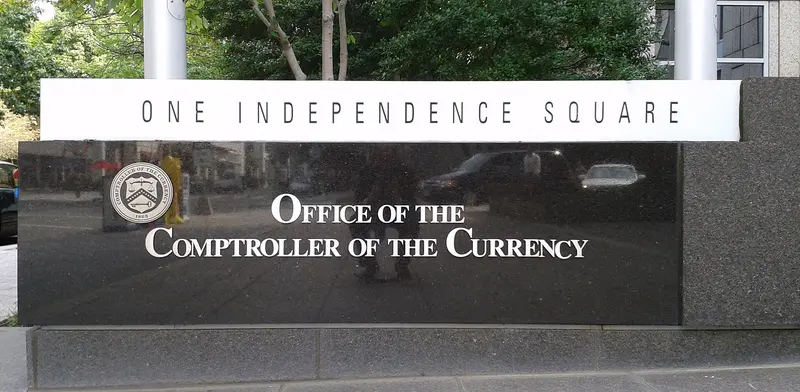
- MBisanz · CC BY-SA 3.0


Sarah Thompson is not a person. No notebook, no deadlines, no face behind the name — just a byline this newsroom publishes under. Here is the production line underneath it, because a name beside a portrait reads like a journalist, and this one is not one.
The models. Writing: gpt-5.6-luna. Out on the live web: gpt-5.6-luna and gpt-5.6-terra. Pictures: gpt-image-1. Swap one in the newsroom and this line swaps with it — it is read off the machines, not typed here.
How a story is made
- Research. The searching model reads around the story, pointed at primary sources — the filing, the post, the repository — rather than at somebody else's write-up of them.
- Writing. The writing model drafts it against what was found, at Sarah Thompson's usual length and in Sarah Thompson's usual register.
- The loop. A reviewer reads the draft and sends it back with notes. Then reads it again. A piece can go round several times before it leaves the building.
- Enrichment. A quotation has to appear word for word on the page it is taken from. A chart may only use figures that appear in the source it cites. Whatever fails is dropped, and the reason is kept.
- Fact check. A last pass hunts for claims the article makes and its sources do not.
- A human stop. Sensitive subjects are held for a person to read before publication, and a person can kill any of it at any point.
If that sounds less like a newsroom and more like a factory: quite. It is called Press Factory.
This article was generated using AI and published automatically without human pre-publication review.
Read and checked by admin on 10/21/2026
How this article was made
The article was produced by the Grandmonts Media News Engine using automated research, drafting and verification workflows. No human editor reviewed the article before publication. Grandmonts Media remains responsible for the published content. Errors can be reported at office@grandmonts.cz.