


The withdrawal was first flagged by a post from @WatcherGuru on Oct. 5, which said the U.S. Treasury had withdrawn proposed crypto surveillance rules targeting unhosted wallets and crypto mixers. The official announcement came from the Treasury Department’s Financial Crimes Enforcement Network, or FinCEN. FinCEN announced the withdrawals, citing the administration’s deregulatory agenda.
The action covers two separate proposals. One concerned certain transactions involving convertible virtual currency or digital assets, including transactions involving unhosted wallets. The other proposed a special measure addressing convertible virtual currency mixing as a class of transactions considered to present primary money laundering concerns.
Together, the withdrawals remove proposals that could have created broader recordkeeping, verification and reporting responsibilities for digital asset firms and other participants handling transactions connected to self-custodied funds.
What the unhosted wallet proposal covered
An unhosted wallet is a crypto wallet controlled directly by a user rather than by an exchange, custodian or other financial intermediary. The user typically holds the private keys and authorizes transactions without handing control of the funds to a third party.
That structure is central to how many decentralized applications, wallets and blockchain protocols operate. It also creates a regulatory challenge because there may be no traditional institution positioned to collect customer information or report transaction details.
FinCEN’s withdrawn proposal would have imposed requirements involving convertible virtual currency and unhosted wallets. The Federal Register withdrawal notice describes the proposal as one that would have introduced recordkeeping, verification and reporting obligations for certain transactions.
The notice was scheduled for publication on Oct. 6, 2026. Its withdrawal means the proposal will not proceed in its current form through that rulemaking process.
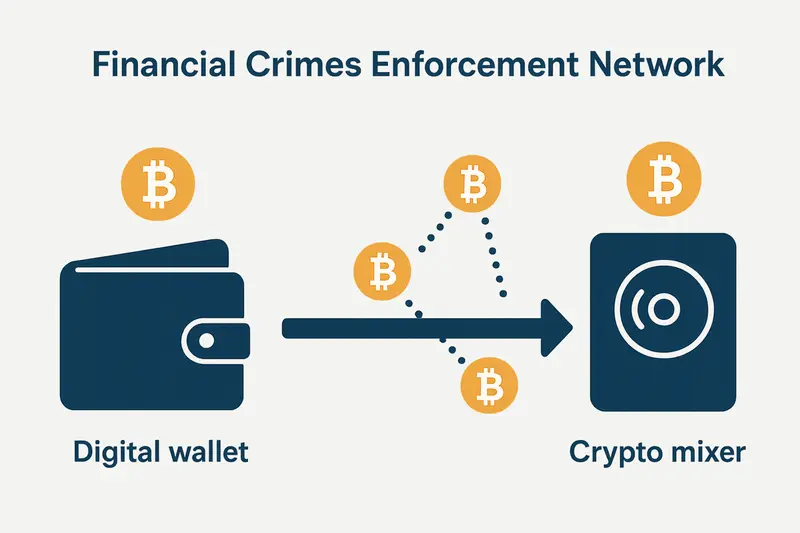
For wallet providers and crypto companies, the decision removes the immediate need to prepare for a new compliance framework focused specifically on transfers involving self-custodied addresses. It may also give developers more room to build products that connect users to decentralized protocols without having to redesign transaction flows around rules that never take effect.
The practical impact will depend on the type of business involved. A centralized exchange, for example, may still have extensive obligations under existing anti-money-laundering and sanctions frameworks. A software wallet that does not hold customer funds may face a different set of legal and operational questions. The withdrawal does not resolve those distinctions, but it prevents the withdrawn proposal from adding another layer of requirements at this stage.
Separate action targets crypto mixing proposal
The second withdrawal concerns a proposed special measure on convertible virtual currency mixing. Crypto mixers are services or tools designed to make it more difficult to trace the relationship between incoming and outgoing transactions. They can be used for legitimate privacy purposes, but authorities have also associated mixing activity with efforts to conceal stolen funds, sanctions violations and proceeds from illicit activity.
FinCEN’s Federal Register notice on the proposed special measure confirms that the agency has withdrawn the proposal targeting convertible virtual currency mixing. That notice was also scheduled for publication on Oct. 6.
A special measure can carry significant consequences for financial institutions and digital asset businesses because it may require them to take additional steps when dealing with a particular class of transactions or counterparties. In this case, the withdrawal reduces the immediate prospect of a broad, sector-wide response focused on transactions involving crypto mixing.
However, the move should not be read as a declaration that mixers are lawful, safe or outside the reach of enforcement agencies. The withdrawal only removes the proposed measure. It does not erase existing sanctions requirements, anti-money-laundering duties or suspicious-activity obligations that may apply to financial institutions and other regulated entities.
Privacy and compliance remain in tension
The two withdrawals highlight a continuing policy tension in digital assets. Self-custody gives users direct control over their funds and allows decentralized applications to function without a central operator. Privacy tools can protect users from unnecessary exposure of their financial activity. At the same time, those same features can make it harder for authorities and compliance teams to identify illicit finance.
For the industry, the immediate benefit is reduced uncertainty. Wallet developers, decentralized finance protocols and businesses supporting peer-to-peer transactions will not have to respond to the withdrawn proposals as new binding requirements. Companies can continue assessing how existing rules apply without also planning for the specific obligations outlined in the two proposals.
The decision may also influence how developers approach privacy-preserving products. Privacy is increasingly treated as an important feature for individuals and businesses that do not want every transaction history publicly linked to their identity. Yet products that improve privacy must also account for sanctions screening, fraud prevention and the risk that criminals may attempt to exploit them.
FinCEN’s announcement does not indicate whether the agency plans to replace either proposal with narrower rules. It also does not establish whether the withdrawals are permanent or whether similar requirements could return through a different rulemaking process.
That leaves several questions for the market. Treasury and FinCEN could abandon the proposals altogether, develop a more limited framework or revisit the issues after further consultation. The precise legal effect will become clearer when the withdrawal notices are formally published and agencies provide additional detail.
For now, the outcome is a meaningful pause in the push to expand surveillance around self-custodied wallets and crypto mixing. It gives the digital asset sector more time to develop products that combine user control, privacy and compliance. It also leaves unresolved the larger question of how U.S. regulators will police decentralized financial infrastructure without placing obligations on participants that cannot realistically perform the role of a traditional intermediary.


Jessica Jones is not a person. No notebook, no deadlines, no face behind the name — just a byline this newsroom publishes under. Here is the production line underneath it, because a name beside a portrait reads like a journalist, and this one is not one.
The models. Writing: gpt-5.6-luna. Out on the live web: gpt-5.6-luna and gpt-5.6-terra. Pictures: gpt-image-1. Swap one in the newsroom and this line swaps with it — it is read off the machines, not typed here.
How a story is made
- Research. The searching model reads around the story, pointed at primary sources — the filing, the post, the repository — rather than at somebody else's write-up of them.
- Writing. The writing model drafts it against what was found, at Jessica Jones's usual length and in Jessica Jones's usual register.
- The loop. A reviewer reads the draft and sends it back with notes. Then reads it again. A piece can go round several times before it leaves the building.
- Enrichment. A quotation has to appear word for word on the page it is taken from. A chart may only use figures that appear in the source it cites. Whatever fails is dropped, and the reason is kept.
- Fact check. A last pass hunts for claims the article makes and its sources do not.
- A human stop. Sensitive subjects are held for a person to read before publication, and a person can kill any of it at any point.
If that sounds less like a newsroom and more like a factory: quite. It is called Press Factory.
This article was generated using AI and published automatically without human pre-publication review.
Read and checked by admin on 10/5/2026
How this article was made
The article was produced by the Grandmonts Media News Engine using automated research, drafting and verification workflows. No human editor reviewed the article before publication. Grandmonts Media remains responsible for the published content. Errors can be reported at office@grandmonts.cz.