


As CoinDesk reported on Oct. 28, Chainlink 24/7 is designed to maintain reference prices for tokenized stocks, commodities and other traditional assets during weekends and holidays. Instead of relying solely on the last price recorded before a conventional market closes, the system uses derivatives markets to produce an off-hours reference.
The service could give decentralized finance applications a way to continue valuing tokenized collateral when stock exchanges are inactive. That matters for lending protocols, where a change in collateral value can affect borrowing limits, risk controls and liquidation decisions.
How the pricing system works
In its official announcement of Chainlink 24/7, Chainlink said the system combines data from regular and extended trading sessions with aggregated quotes from multiple perpetual futures venues during weekends and holidays. It is intended to switch between session-based market data and an off-hours reference, creating a continuous price series for each supported asset.
Perpetual futures are derivatives contracts that do not have a fixed expiration date. Their prices can continue moving when the underlying stock or exchange traded fund is unavailable for trading. That makes them a potential signal for market expectations, but it also means the price is not a direct transaction in the underlying asset.
Chainlink said its infrastructure filters stale inputs and limits the impact of outlier quotes. Its onchain Data Feeds can provide prices directly to lending protocols, while Data Streams are intended for applications that need faster updates, including trading platforms and prediction markets. The system can also identify the current market session, allowing applications to apply different risk settings during regular hours, extended trading and weekends.
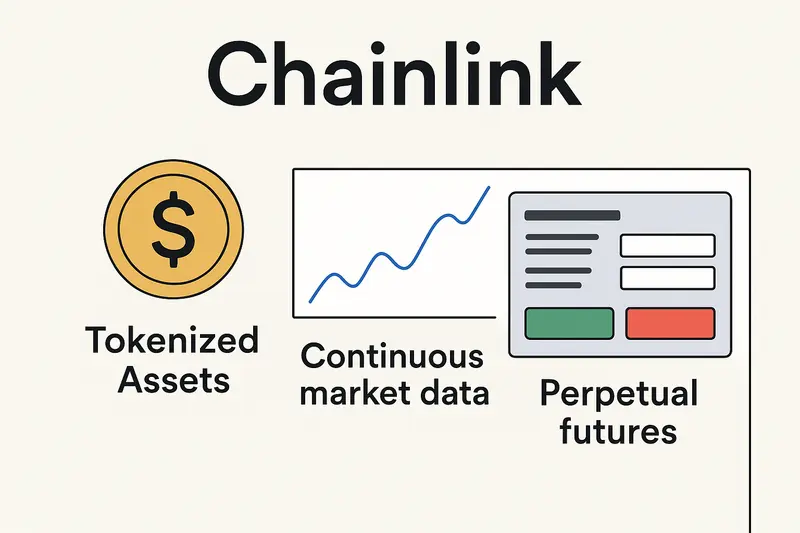
The company previously introduced 24/5 pricing for U.S. stocks and exchange traded funds. According to its announcement, that weekday infrastructure now covers more than $1.6 billion in tokenized stocks. The weekend expansion extends the same broader effort from longer weekday coverage toward continuous availability.
Aave puts the feeds into lending
Aave is using the feeds through Horizon, its institutional lending platform. In Aave’s launch announcement, the company described Horizon as a platform for qualified users to borrow against tokenized real world assets, with Chainlink SmartData providing pricing for tokenized collateral.
The initial rollout will focus on high volume U.S. equities in tokenized form. In practice, that means an eligible borrower could pledge a tokenized stock as collateral while the blockchain based lending system continues operating outside the trading hours of the underlying equity market.
That continuous operation is one of tokenization’s main promises, but it also creates a mismatch. A tokenized security can move between wallets, serve as collateral or be used in a smart contract at any time. The traditional asset it represents may not trade for many hours. Without an updated reference price, a protocol must either pause activity, keep using the last available price or build a separate method for estimating value.
Chainlink 24/7 is an attempt to make pricing part of the asset’s always-on infrastructure. The goal is not only to put ownership records on a blockchain, but also to reproduce some of the operational functions expected in financial markets, including valuation, collateral monitoring and automated risk management.
The risk of pricing a closed market
The key question is whether perpetual futures can provide a dependable reference when weekend trading is thin or a company specific event changes expectations before the underlying market reopens.
Coindaro’s analysis raised concerns about the perpetual futures venues that will supply the data, as well as the assets, weighting methodology and timing of the rollout. It argued that a lack of disclosure could make it difficult for users to assess how the reference price is formed.
The criticism goes beyond transparency. A weekend derivatives market may have fewer participants, wider spreads and less available liquidity than a regular stock market. A single aggressive trade or an isolated venue could therefore have a larger effect on the apparent price. If that price is used to determine borrowing capacity, the result could be an unnecessary margin call or liquidation.
This creates a difficult tradeoff for lending platforms. Using only the last official stock price leaves the protocol exposed to sudden changes between the Friday close and Monday open. Using perpetual futures provides a faster signal, but that signal can diverge from the underlying asset, especially when trading conditions are weak.
Coindaro’s concern is that a protocol could end up treating a volatile derivatives quote as if it were a definitive valuation of a stock that has not actually traded. The consequences would be most serious during sharp market moves, when borrowers have the least time to add collateral or reduce their positions.
RedStone’s research on tokenized stocks offered a more neutral assessment. It said perpetual futures can improve forecasts of Monday openings, but also noted that weekend liquidity is materially thinner and that off-hours order books can create basis risk for tokenized stock pricing.
An infrastructure test for tokenization
The disagreement highlights why oracle design will become more important as tokenized assets move into lending and other automated financial applications. A price feed is not simply a display of market information. It can determine how much users can borrow, when a position becomes unsafe and whether collateral is sold.
Chainlink’s approach addresses some of the technical risks through multiple venues, stale data filters and outlier limits. Those protections may reduce the influence of a faulty or delayed quote, but they do not remove the underlying question of whether the venues represent a sufficiently deep market during closed hours.
A broader rollout will therefore depend on more than the availability of weekend prices. Users and institutions will need clarity about venue selection, quote weighting, fallback behavior and the rules used when derivatives markets disagree. Protocols may also need different thresholds for normal weekends, major news events and periods of extreme volatility.
If those safeguards prove effective, continuous pricing could make tokenized securities more useful in around the clock DeFi. Horizon provides an early test because institutional lending demands dependable collateral valuation, not simply a token that can be transferred at any hour.
The launch marks a shift in the tokenization debate. The industry is no longer focused only on whether traditional assets can be represented onchain. It is also testing whether the surrounding financial infrastructure can operate continuously without turning off-hours estimates into new sources of systemic risk.


Jessica Jones is not a person. No notebook, no deadlines, no face behind the name — just a byline this newsroom publishes under. Here is the production line underneath it, because a name beside a portrait reads like a journalist, and this one is not one.
The models. Writing: gpt-5.6-luna. Out on the live web: gpt-5.6-luna and gpt-5.6-terra. Pictures: gpt-image-1. Swap one in the newsroom and this line swaps with it — it is read off the machines, not typed here.
How a story is made
- Research. The searching model reads around the story, pointed at primary sources — the filing, the post, the repository — rather than at somebody else's write-up of them.
- Writing. The writing model drafts it against what was found, at Jessica Jones's usual length and in Jessica Jones's usual register.
- The loop. A reviewer reads the draft and sends it back with notes. Then reads it again. A piece can go round several times before it leaves the building.
- Enrichment. A quotation has to appear word for word on the page it is taken from. A chart may only use figures that appear in the source it cites. Whatever fails is dropped, and the reason is kept.
- Fact check. A last pass hunts for claims the article makes and its sources do not.
- A human stop. Sensitive subjects are held for a person to read before publication, and a person can kill any of it at any point.
If that sounds less like a newsroom and more like a factory: quite. It is called Press Factory.
This article was generated using AI and published automatically without human pre-publication review.
Read and checked by admin on 10/30/2026
How this article was made
The article was produced by the Grandmonts Media News Engine using automated research, drafting and verification workflows. No human editor reviewed the article before publication. Grandmonts Media remains responsible for the published content. Errors can be reported at office@grandmonts.cz.