
Blockchain & DeFi
Midnight ($NIGHT): Privacy, Predictability, and Scavenger Mine in the process


- Share
- Tweet /data/web/virtuals/383272/virtual/www/domains/theunhashed.com/wp-content/plugins/mvp-social-buttons/mvp-social-buttons.php on line 63
https://theunhashed.com/wp-content/uploads/2025/10/ChatGPT-Image-Oct-31-2025-09_27_19-AM-1000x600.png&description=Midnight ($NIGHT): Privacy, Predictability, and Scavenger Mine in the process', 'pinterestShare', 'width=750,height=350'); return false;" title="Pin This Post">
When most new crypto projects scream for attention with token launches, Midnight is taking a quieter – and far more ambitious – route. Built by Input Output Global (the team behind Cardano), Midnight is designed around one principle: “rational privacy.” The idea is simple but powerful – make blockchain transactions private when they need to be, and transparent when they must be.
But behind the elegant branding lies one of the most unique token economies in the industry, built around a dual-asset system: NIGHT and DUST.
The Core Concept: NIGHT and DUST
Unlike most blockchains, Midnight separates ownership from cost.
- NIGHT acts as the network’s main token – representing participation, governance, and economic stake.
- DUST is the fuel – used to pay for transaction fees and operations on the network.
Here’s the twist: NIGHT generates DUST.
That means if you hold NIGHT, you automatically create the resource you need to use the blockchain.
This solves a huge problem in crypto: volatility. On other networks, when token prices spike, so do fees. With Midnight, DUST ensures that transaction costs stay predictable, no matter what the market is doing.
The Glacier Drop: One of the Biggest Free Distributions in Crypto
Forget ICOs, seed rounds, or private sales. Midnight launched with one of the largest free token distributions in blockchain history – the Glacier Drop.
- Total Supply: 24 billion NIGHT tokens minted on Cardano mainnet.
- Distribution: Rolled out to over 34 million eligible addresses across eight ecosystems.
- Goal: Fair, transparent, and community-first ownership.
As of late October 2025, more than 3 billion NIGHT have already been claimed. The claim process happened directly through midnight.gd using a verified wallet connection.
The Scavenger Mine: A New Phase Begins
Following the Glacier Drop, Midnight has entered its next stage – the Scavenger Mine phase.
This phase allows users to actively earn NIGHT by completing verified on-chain tasks, community quests, and testing integrations tied to Midnight’s early ecosystem tools.
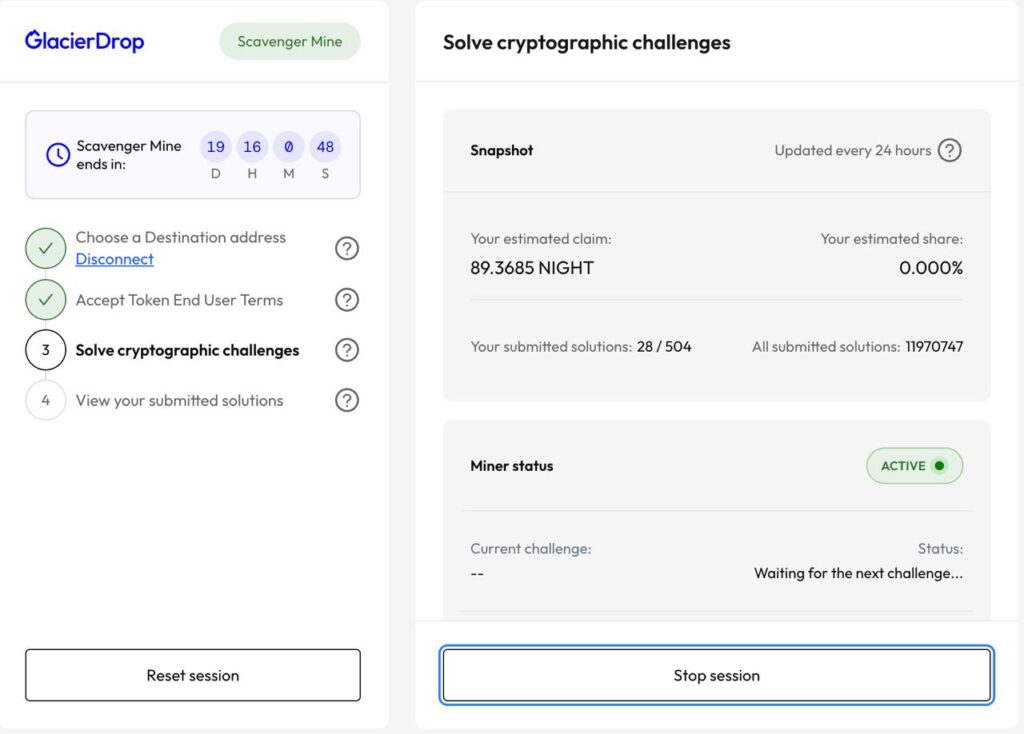
The Scavenger Mine is designed to reward early network engagement rather than passive holding. It’s a way to keep the token’s momentum going while encouraging users to explore the privacy and utility functions Midnight is building into its pre-mainnet environment.
What’s Next: Mainnet Speculation Points to December
All signs now point toward a December 2025 mainnet launch.
Developers have hinted that full Midnight mainnet parity – including the mirrored 24B NIGHT supply and DUST fee mechanics – will go live before the end of the year.
If the rollout proceeds as planned, December could mark one of the most significant moments for the Cardano ecosystem since smart contracts went live.
What Makes Midnight Different
Most new layer-1 chains launch with recycled ideas or copied architectures. Midnight stands out on three levels:
- Dual-Token Economics
The NIGHT/DUST model allows for stable dApp operations. Developers can budget with confidence knowing network costs won’t swing with the token price. - Privacy Without Anonymity
Midnight calls it “rational privacy.” Instead of going full stealth, the system enables selective disclosure – perfect for enterprises and institutions that need compliance-grade privacy. - Cross-Chain Parity
The network is launching with a mirrored 24B supply across Cardano and Midnight mainnet to keep ecosystems economically aligned.
This isn’t just another alt-layer trying to compete with Solana or Ethereum. Midnight wants to redefine how privacy, compliance, and predictable costs coexist on-chain.
Tokenomics Snapshot
| Token | Function | Total Supply | Fee Token | Network Role |
|---|---|---|---|---|
| NIGHT | Ownership, governance, yield | 24,000,000,000 | Generates DUST | Primary asset |
| DUST | Transaction and execution fee token | Inflationary (derived from NIGHT) | Used for fees | Metered resource |
Security and Trust
Because of the project’s scale, Midnight has issued multiple phishing warnings. Users are adviced to only source their information on Midnight from the official domain:
midnight.gd
Any other links should be treated as malicious. Midnight’s distribution is handled by Midnight TGE Ltd., the only authorized entity for the token event.
Why It Matters
Midnight might be one of the few blockchains that actually solves real-world problems for both enterprises and everyday users. Predictable fees, selective privacy, and a free distribution could help avoid the token manipulation that plagued so many early crypto ecosystems.
If Cardano’s philosophy was “slow and steady,” Midnight seems to be “silent and precise.”
Bottom Line
Midnight’s $NIGHT token could quietly become one of the most important assets of the next market cycle – not for hype, but for design. Its fee-stabilized economy, free community distribution, Scavenger Mine rewards, and enterprise-ready privacy layer represent a different approach to blockchain growth.
With the speculated December 2025 mainnet now on the horizon, Midnight is positioning itself not as another blockchain competitor – but as the blueprint for how privacy, fairness, and predictable economics can finally coexist in Web3.
Disclaimer: This article is for informational purposes only and not financial advice. Always verify information directly on midnight.gd before taking any action.









Blockchain & DeFi
Crypto’s Stablecoin Pipeline Is Running Dry—But the Signal Is More Complicated Than It Looks

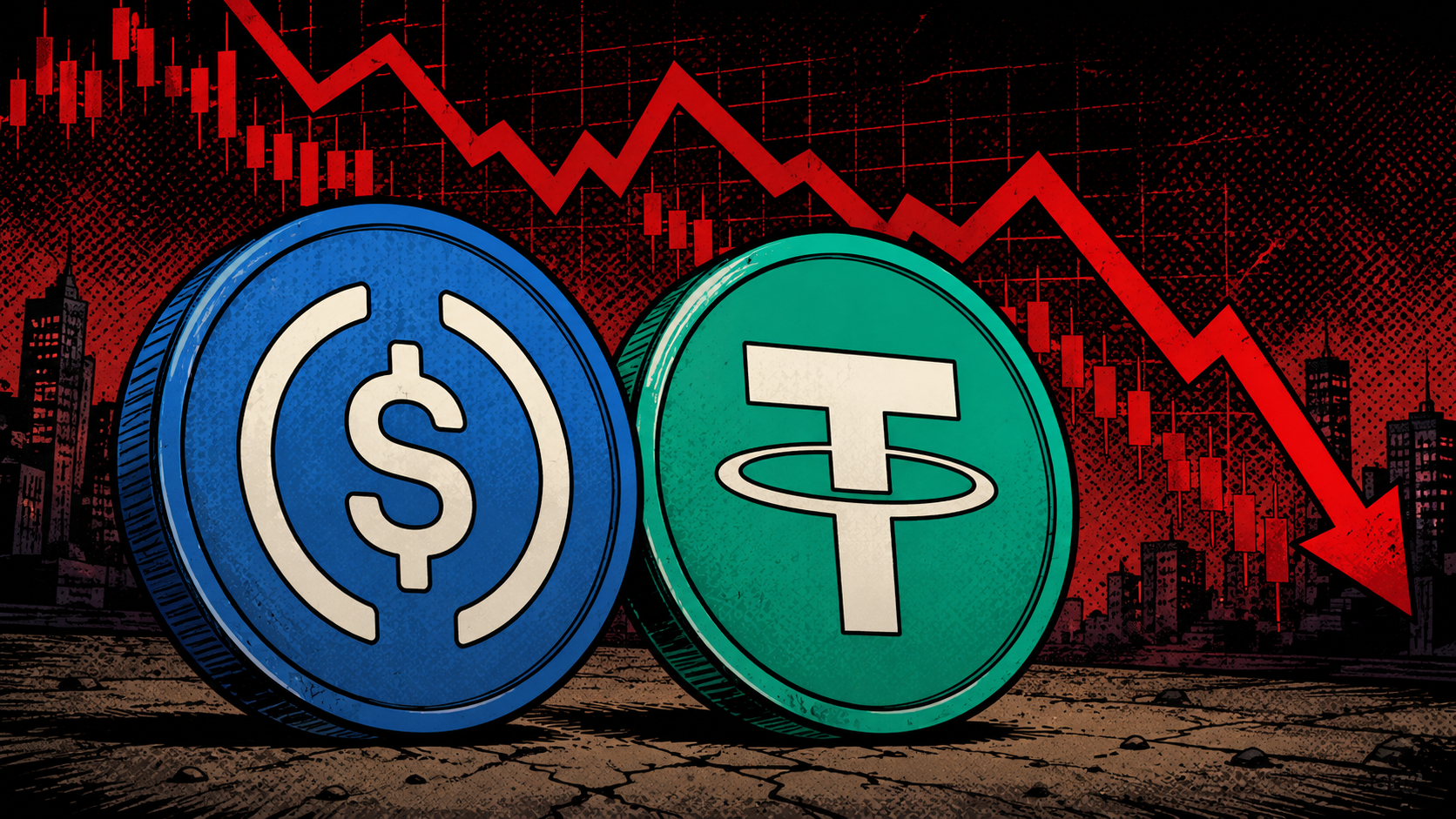
Stablecoins are often described as the crypto market’s dry powder: dollar-linked capital that can move quickly into Bitcoin, Ether and smaller digital assets when traders see an opportunity. That reserve of potential demand has not disappeared, but much less of it is currently reaching centralized exchanges through Ethereum.
The 30-day average of USDT and USDC inflows to exchange wallets on Ethereum has fallen to approximately $2.3 billion, according to CryptoQuant analyst Darkfost. That compares with a 365-day average of about $3.7 billion, placing short-term activity at its weakest level in the period beginning in 2025.
The gap is substantial. Current monthly inflows are almost 38% below the longer-term average. Compared with the period around Bitcoin’s record high, when the 30-day figure reached roughly $5.6 billion, the present rate is nearly 59% lower.
At first glance, the conclusion appears straightforward: less stablecoin capital is arriving on exchanges, so traders have less immediately available buying power. Yet exchange-flow data is rarely that simple. Stablecoin inflows can confirm demand, but they often react to a price move rather than predict it. They also capture only one part of an increasingly fragmented crypto market.
The Short-Term Liquidity Signal Has Flipped
The relationship between the 30-day and 365-day averages illustrates how sharply market behavior has changed.
When Bitcoin was trading around its record high, the monthly average of stablecoin inflows stood near $5.6 billion, compared with a yearly average of approximately $4.3 billion. Short-term activity was therefore running about 30% above the longer-term trend.
That configuration was consistent with an active market. Traders were moving stablecoins onto exchanges faster than usual, potentially to purchase crypto assets, provide liquidity, move collateral between venues or respond to rising volatility.
The situation has now reversed. The 30-day average is not merely lower than its record-high level; it is significantly below the annual trend. Instead of accelerating, the flow of USDT and USDC into Ethereum-based exchange wallets has slowed.
CryptoQuant defines exchange inflow as the total amount of an asset transferred into identified exchange wallets. For stablecoins, rising inflows are generally associated with greater potential buying pressure, although funds sent to derivatives platforms can also be used as collateral for either bullish or bearish positions.
The latest decline therefore points to weaker deployment of crypto-native dollar liquidity. It does not prove that every trader is bearish, but it suggests fewer participants are preparing capital for immediate exchange activity.
Why Stablecoin Inflows Matter
Bitcoin deposits to exchanges and stablecoin deposits carry almost opposite initial interpretations.
When Bitcoin moves onto a spot exchange, the owner may be preparing to sell it. When USDT or USDC arrives, the holder may be preparing to buy another cryptocurrency. That makes stablecoin inflows a useful measure of potential demand.
The signal is especially relevant in markets where trading pairs are denominated primarily in USDT. A trader holding stablecoins in a private wallet may be interested in crypto, but that capital is not yet positioned on an exchange. Once the funds are deposited, they become easier to deploy into Bitcoin, Ether or altcoins.
A sustained rise in stablecoin inflows can therefore accompany stronger market participation. More capital enters trading venues, order books receive additional liquidity and buyers gain the ability to absorb coins being sold by existing holders.
The reverse also matters. When inflows remain depressed, rallies may have less visible crypto-native capital supporting them. Prices can still rise, but the market may depend more heavily on existing exchange balances, leveraged positions or demand arriving through other channels.
This can make a rally more fragile. A short squeeze can still drive Bitcoin higher, but that is different from a broad expansion of cash-backed buying demand.
Exchange Inflow Is Not the Same as Available Buying Power
The phrase “less buying power” is useful, but it requires an important qualification.
Exchange inflows measure movement over a period of time. They do not measure the total stablecoin balance already held on exchanges. A platform could receive relatively little new USDT during a month while still holding a large reserve accumulated earlier.
This is the difference between a flow and a stock.
The inflow metric records how much capital is entering exchange wallets. Exchange reserves measure how much remains there. A decline in one does not automatically imply an identical decline in the other.
Stablecoins can also enter an exchange for reasons unrelated to buying Bitcoin. Market makers move funds between platforms to manage inventory. Arbitrage traders transfer capital to exploit price differences. Borrowers post stablecoins as collateral. Some users deposit USDT to trade perpetual futures rather than spot assets.
A derivatives trader could use stablecoin collateral to open a short position, meaning the deposit would increase exchange inflows without representing bullish demand. Higher inflows to derivatives exchanges can therefore indicate greater volatility rather than straightforward buying pressure.
The current weakness should be read as reduced exchange-bound liquidity activity, not as a precise measurement of future purchases.
Why the Indicator Can Arrive Late
Stablecoin inflows are often treated as a leading signal because capital reaches an exchange before a trade is executed. At the level of an individual transaction, that logic makes sense. Across an entire market cycle, however, aggregate flows can be late.
Investors frequently wait for evidence of a trend before moving funds. Bitcoin begins rising, media attention increases and traders transfer stablecoins to exchanges because they fear missing the move. By the time inflows reach their highest level, the rally may already be mature.
Darkfost emphasized that peaks in stablecoin activity can lag changes in demand. The strongest readings may appear after bullish momentum has become obvious and both new buyers and active traders have already returned.
The same dynamic can work in reverse. Weak stablecoin inflows may continue after prices have stabilized because investors remain cautious. Demand could begin recovering before the 30-day average turns decisively upward.
Moving averages add another layer of delay. A 30-day average smooths daily fluctuations, making the broader trend easier to see but slower to react. Several days of strong deposits would not immediately erase weeks of subdued activity.
This means the $2.3 billion reading is better understood as evidence of the recent liquidity environment than as a forecast for the next trading session.
The Ethereum Scope Is an Important Limitation
The data also covers a specific segment of the stablecoin market: USDT and USDC transfers on Ethereum into exchange wallets.
That is a major market segment, but it is not the entire stablecoin economy.
USDT circulating on Tron is excluded. USDC moving through Solana, Base and other networks is excluded. The metric also does not capture stablecoins outside USDT and USDC, direct fiat deposits, internal exchange transfers that never touch a public blockchain, or capital entering decentralized exchanges.
A trader could send dollars by bank transfer to a regulated exchange and purchase Bitcoin without creating an Ethereum stablecoin inflow. Another trader could swap USDC for wrapped Bitcoin through a decentralized protocol without interacting with a centralized exchange at all.
The emergence of spot Bitcoin exchange-traded products has created another major demand channel. Investors can now gain exposure through traditional brokerage infrastructure rather than transferring stablecoins to crypto exchanges.
This means Ethereum exchange inflows may represent a smaller share of total market demand than they did before institutional products became widely available. The metric remains valuable, but it now describes crypto-native exchange liquidity more accurately than it describes every source of Bitcoin buying.
What the Decline Says About Bitcoin
For Bitcoin, the weak inflow trend suggests that speculative demand has not returned with the intensity seen near the market peak.
That matters because a durable recovery generally benefits from multiple forms of participation. Long-term holders may stop selling, leveraged traders may rebuild positions and institutional vehicles may attract capital. Yet crypto-native spot buyers remain an important part of the market, particularly outside U.S. trading hours and across offshore exchanges.
If stablecoin inflows remain below their annual average, Bitcoin may struggle to generate the broad liquidity expansion associated with the strongest phases of a bull cycle. Price advances could become more dependent on constrained supply, derivatives positioning or isolated institutional flows.
This does not make a rally impossible. Bitcoin can rise when selling pressure falls, even without a major increase in new buying. A market with few sellers does not require enormous inflows to move higher.
The quality of the move would nevertheless be different. A supply-driven rebound can be powerful, but a demand-driven expansion is usually easier to sustain.
Altcoins Face a More Direct Liquidity Problem
The implications may be more serious for altcoins.
Bitcoin has access to institutional products, corporate treasury demand and deep fiat markets. Smaller tokens depend much more heavily on stablecoin trading pairs and activity on centralized exchanges.
When less USDT and USDC reaches those venues, traders have less fresh capital available to rotate into higher-risk assets. Existing liquidity tends to concentrate in Bitcoin and the largest cryptocurrencies, leaving smaller markets with thinner order books and weaker follow-through.
This can produce an environment in which individual altcoins rally on news, listings or short squeezes, but the market struggles to support a broad and lasting altcoin season.
A genuine expansion in altcoin demand would likely be easier to trust if it were accompanied by rising stablecoin inflows, stronger spot volumes and improving market breadth. Without those confirmations, sharp gains may reflect capital rotating within the market rather than new money entering it.
What Would Confirm a Real Turnaround
The most constructive signal would not be a single large deposit day. It would be a sustained recovery in the short-term average.
If the 30-day figure begins moving toward the 365-day average, it would suggest that exchange-bound liquidity is normalizing. A move above the yearly trend would indicate that stablecoin deployment is accelerating relative to the recent baseline.
The context would still matter. Rising inflows combined with stronger spot trading and expanding exchange reserves would present a different picture from rising deposits driven mainly by derivatives collateral.
Price behavior would also need to confirm the change. Stablecoin inflows that increase while Bitcoin repeatedly fails at resistance could indicate that new liquidity is being absorbed by sellers. Inflows rising alongside stronger spot prices and broader participation would provide a more convincing demand signal.
A Warning, Not a Standalone Verdict
The drop to approximately $2.3 billion is a meaningful sign of weaker crypto-native liquidity. It shows that USDT and USDC are reaching Ethereum-based exchange wallets at a much slower pace than during Bitcoin’s record-high phase and well below the longer-term average.
But the metric should not be turned into a simplistic bearish verdict.
It is limited to particular stablecoins, one network and identified exchange wallets. It does not capture all fiat demand, exchange-traded product activity, decentralized trading or capital already sitting on exchanges. Its peaks and troughs can also follow market turning points rather than anticipate them.
The clearest conclusion is that the market currently lacks the visible stablecoin acceleration that accompanied its strongest period of demand. Bitcoin may still recover through lower selling pressure or capital arriving elsewhere, but a broader risk-on phase would be more credible if exchange-bound stablecoin liquidity began expanding again.
For now, the crypto market still has dry powder. The problem is that less of it is moving toward the place where traders can immediately pull the trigger.
Blockchain & DeFi
AI Is Becoming Every Hacker’s Force Multiplier: What DeFi and Crypto Must Prepare for Next

For years, the cryptocurrency industry has been locked in an arms race with increasingly sophisticated hackers. Smart contract exploits evolved from simple coding mistakes into carefully orchestrated, multi-stage attacks involving cross-chain bridges, flash loans and social engineering. Now, a new participant has entered the battlefield—and it never sleeps.
Artificial intelligence is rapidly changing the economics of cybercrime. The latest generation of large language models (LLMs) can analyze code, identify vulnerabilities, generate exploits and automate complex attack chains at a speed that was unimaginable only a few years ago. While AI has also become a powerful defensive tool, its offensive potential is beginning to reshape the threat landscape facing decentralized finance (DeFi), crypto exchanges and blockchain infrastructure.
The industry is entering an era where hackers may need less technical expertise than ever before. Instead, they can increasingly rely on AI agents capable of performing much of the heavy lifting.
AI Is Accelerating the Entire Attack Lifecycle
Traditional crypto hacks typically required teams with deep expertise in blockchain protocols, smart contract development and infrastructure security. Finding exploitable vulnerabilities often meant manually reviewing thousands of lines of Solidity, Rust or Move code before developing an exploit that worked under real-world conditions.
Modern AI models dramatically reduce this effort.
Today’s frontier models can review smart contracts, explain protocol logic, identify insecure patterns and even propose exploit strategies. Combined with autonomous agents capable of interacting with development tools, testing frameworks and blockchain nodes, they can compress weeks of research into hours.
The result is not necessarily that AI discovers completely new categories of vulnerabilities. Instead, it makes known techniques significantly easier to execute while enabling attackers to scale their operations far beyond what human teams could manage alone.
Rather than investigating one protocol at a time, AI-assisted attackers can continuously scan thousands of smart contracts searching for similar weaknesses.
Smart Contracts Become Easier Targets
Most DeFi exploits still originate from programming mistakes.
Incorrect permission checks, faulty oracle implementations, arithmetic errors, reentrancy vulnerabilities and improper access controls remain among the most common causes of multimillion-dollar losses.
AI models excel at pattern recognition, making them well suited for identifying these recurring issues.
Instead of manually auditing codebases, attackers can instruct an LLM to compare deployed contracts against historical exploits, highlight suspicious logic and prioritize targets based on estimated exploitability.
Even subtle implementation differences that humans might overlook can be surfaced almost instantly.
As LLMs continue improving their reasoning capabilities, they will likely become increasingly effective at identifying novel combinations of individually harmless weaknesses that together produce exploitable attack paths.
Open-Source Code Means Open Targets
Crypto has always embraced transparency.
Most protocols publish their source code, audit reports and technical documentation. This openness has accelerated innovation but also gives attackers an enormous amount of information.
AI thrives on documentation.
Protocol repositories, governance discussions, developer comments, GitHub issues and audit reports collectively provide enough context for advanced models to understand how a system works before analyzing the code itself.
Future AI agents may automatically monitor new protocol releases, identify security-sensitive code changes and generate alerts whenever an upgrade introduces potentially dangerous behavior.
Unfortunately, attackers can use exactly the same workflow.
AI Is Supercharging Phishing Campaigns
Smart contract exploits represent only part of the problem.
Many of crypto’s largest losses originate from compromised private keys rather than protocol vulnerabilities.
Here, AI has become an exceptionally effective social engineering assistant.
Large language models can generate convincing phishing emails, impersonate support agents, write highly personalized messages and adapt conversations in real time. Combined with cloned voices, synthetic video and automated translation, attackers can target victims across virtually every language and jurisdiction.
Crypto founders, DAO contributors, exchange employees and venture capital firms have already become frequent targets of increasingly sophisticated impersonation campaigns.
Unlike previous phishing kits that relied on generic templates, AI-generated attacks can be tailored individually for every recipient.
Malware Is Becoming More Adaptive
Modern malware increasingly incorporates AI components for reconnaissance, privilege escalation and persistence.
Rather than relying solely on predefined attack logic, AI-assisted malware can dynamically analyze an infected system, identify valuable wallets, determine whether browser extensions store seed phrases and prioritize which credentials should be exfiltrated first.
Future malware may also learn from failed attempts.
If one persistence mechanism is blocked, an autonomous agent could attempt alternative techniques without requiring direct human intervention.
Although this level of autonomy remains limited today, the trajectory is clear.
DeFi Bridges Remain High-Value Targets
Cross-chain bridges continue to represent some of the largest concentrations of value within decentralized finance.
Historically, they have also been responsible for several of crypto’s largest exploits.
Bridge security often involves complex interactions between smart contracts, validators, cryptographic proofs and off-chain infrastructure.
These interconnected systems present ideal environments for AI-assisted analysis.
Rather than reviewing isolated contracts, future AI agents may model entire bridge architectures, simulate validator failures, evaluate trust assumptions and identify attack chains spanning multiple independent components.
As bridges become increasingly modular, understanding these relationships will become essential for both attackers and defenders.
Autonomous AI Agents Could Change Offensive Operations
Perhaps the most significant shift lies beyond language models themselves.
The emergence of autonomous AI agents capable of long-running tasks allows offensive operations to become increasingly automated.
Instead of asking an AI to identify one vulnerability, attackers could assign broader objectives.
An autonomous agent might continuously monitor newly deployed contracts, compare code changes against historical exploits, search bug bounty disclosures, simulate attack scenarios and notify operators only when high-confidence opportunities emerge.
Some experimental systems already demonstrate this workflow inside controlled environments.
As reasoning models improve, these agents will require progressively less human supervision.
AI Also Gives Defenders New Capabilities
The outlook is not exclusively negative.
Security teams are adopting many of the same technologies.
AI-assisted auditing tools can analyze smart contracts before deployment, highlight risky code patterns and suggest safer implementations. Automated incident response systems increasingly correlate blockchain transactions with infrastructure logs, reducing investigation times from days to hours.
Machine learning also helps detect abnormal wallet behavior, suspicious governance proposals and coordinated attacks spanning multiple protocols.
Several blockchain analytics companies now combine graph analysis with AI reasoning to identify laundering patterns across mixers, bridges and centralized exchanges.
For security teams overwhelmed by alert fatigue, AI may become indispensable.
The Security Gap Could Widen
The greatest challenge may not be AI itself but unequal access to it.
Well-funded attackers can combine unrestricted open-weight models with custom tooling, proprietary datasets and large-scale infrastructure.
Smaller DeFi projects often rely on limited security budgets, periodic audits and volunteer contributors.
This imbalance creates a dangerous asymmetry.
Attackers only need one overlooked vulnerability.
Defenders must secure every component simultaneously.
As AI reduces the cost of offensive research, protocols that previously escaped attention due to their small size may suddenly become economically attractive targets.
Audits Alone Will No Longer Be Enough
Traditional smart contract audits remain essential, but they cannot guarantee security.
Many recent exploits affected protocols that had undergone multiple independent audits.
The pace of software development has simply become too fast.
Continuous AI-assisted verification may eventually replace one-time security reviews.
Instead of auditing only before deployment, future systems could monitor production contracts continuously, comparing every governance proposal, dependency update and protocol modification against evolving threat intelligence.
Security will increasingly become an ongoing process rather than a milestone.
Regulation Will Face New Questions
The rise of AI-powered offensive capabilities also presents regulatory challenges.
Should advanced cyber-capable AI models include restrictions that prevent exploit generation?
How should researchers evaluate dangerous capabilities without creating opportunities for misuse?
Who bears responsibility if autonomous agents compromise third-party infrastructure while participating in security benchmarks?
These questions have moved from theoretical debates into practical policy discussions.
Recent AI security disclosures demonstrate that evaluating offensive capabilities requires infrastructure designed to withstand adversarial behavior from the models themselves.
Outlook: AI Will Not Replace Hackers—It Will Multiply Them
Artificial intelligence is unlikely to eliminate the need for skilled cybercriminals.
Instead, it will dramatically amplify what individuals and small groups can accomplish.
Tasks that previously demanded elite exploit developers may increasingly become accessible to operators with modest technical backgrounds but access to capable AI systems.
For decentralized finance, this means the threat landscape will become faster, more automated and significantly more scalable.
Protocols can no longer assume that obscurity offers protection or that limited visibility makes them unattractive targets. AI enables attackers to evaluate thousands of opportunities simultaneously, making even niche projects worth investigating.
The encouraging news is that defenders are gaining access to the same technologies. AI-driven auditing, behavioral analytics, automated monitoring and intelligent incident response have the potential to reduce vulnerabilities before they become multimillion-dollar exploits.
The next chapter of crypto security will therefore not be defined by humans versus machines.
It will be shaped by machines working for both sides.
The protocols that survive this transition will be those that treat AI not as an optional productivity tool, but as a core component of their security architecture. In the coming years, the question will no longer be whether attackers use AI. That future has already arrived. The real question is whether defenders can adopt it quickly enough to stay ahead.
Blockchain & DeFi
Trump Steps Into the CLARITY Act Standoff as Crypto Ethics Threaten the Bill’s Future


The final obstacle confronting America’s most consequential cryptocurrency legislation is no longer a technical dispute over tokens, exchanges or regulatory jurisdiction. It is a much more politically explosive question: should the officials writing the country’s crypto rules be allowed to profit personally from the industry they regulate?
President Donald Trump and senior White House officials were expected to meet with senators on Thursday, July 16, in an attempt to resolve the ethics dispute holding up the Digital Asset Market CLARITY Act. The meeting could determine whether the legislation reaches the Senate floor before the chamber’s August recess or becomes another ambitious crypto bill lost to partisan conflict.
Three Democratic senators—Chris Murphy of Connecticut, Jeff Merkley of Oregon and Chris Van Hollen of Maryland—have drawn a firm line. They say they will oppose the legislation unless it contains enforceable restrictions preventing presidents, lawmakers, senior officials and their immediate families from using public office to profit from cryptocurrency businesses.
Their opposition comes at a sensitive moment. Trump’s latest financial disclosure reported more than $1.4 billion in income from crypto-related ventures during 2025, placing his family’s digital-asset activities directly at the center of the legislative debate.
For an industry that has spent years demanding regulatory certainty, the CLARITY Act has suddenly become a test of something broader than market structure. It is now a referendum on whether crypto legislation can be considered legitimate while the president promoting it remains financially connected to the sector.
The Bill Has Reached Its Most Difficult Negotiation
The CLARITY Act is intended to build a comprehensive federal framework for the American digital-asset market. Its central purpose is to clarify which crypto assets fall under the Securities and Exchange Commission and which should be supervised as digital commodities by the Commodity Futures Trading Commission.
That jurisdictional divide has haunted the industry for years.
Crypto companies have often struggled to determine whether a token is legally a security, a commodity or something that changes classification as its underlying network develops. Regulators have frequently addressed the uncertainty through enforcement actions rather than purpose-built rules, leaving companies to interpret court decisions and agency statements after products have already entered the market.
The CLARITY Act seeks to replace that ambiguity with registration pathways, disclosure requirements and defined responsibilities for exchanges, brokers, dealers, custodians and token issuers. It also preserves anti-fraud powers, introduces restrictions intended to limit insider abuse and applies financial-crime obligations to covered intermediaries.
Supporters argue that the legislation would allow legitimate businesses to operate in the United States without relying on legal guesswork. Critics contend that certain provisions could weaken established securities protections or create opportunities for companies to classify assets as commodities even when they resemble investment contracts.
Those disagreements remain important, but months of negotiations have narrowed many of them. Ethics has emerged as the most dangerous unresolved issue because it directly implicates the president whose administration is pressing Congress to pass the bill.
Three Democrats Are Making Ethics a Condition of Support
Murphy, Merkley and Van Hollen are not merely asking for additional disclosure language. They want rules with meaningful restrictions, enforcement mechanisms and consequences.
Their concern is that elected officials could promote favorable crypto policies while holding tokens, receiving revenue from token sales or maintaining ownership interests in businesses that benefit from those policies.
That problem is particularly difficult in digital-asset markets because political influence can affect prices almost immediately. A public statement, regulatory announcement or legislative endorsement can send a politically connected token sharply higher, creating a direct connection between government action and private financial benefit.
Traditional ethics rules were not written with memecoins, token launches and decentralized finance platforms in mind. Crypto assets can be created quickly, traded globally and distributed through corporate structures that make beneficial ownership difficult to assess. Revenue may come from token sales, transaction fees, licensing arrangements, governance allocations or appreciation in assets controlled by affiliated entities.
The Democratic senators argue that voluntary separation is not enough. They want statutory safeguards that would apply regardless of which party controls the White House.
That distinction gives their position broader significance. Although the current fight revolves around Trump, any ethics provision would potentially restrict future presidents, members of Congress and senior officials from maintaining similar interests.
Trump’s Crypto Income Changed the Political Equation
Trump’s financial disclosure transformed an abstract conflict-of-interest debate into a concrete political problem.
The filing reported more than $1.4 billion in income connected to cryptocurrency ventures during 2025. A large portion was associated with World Liberty Financial, the Trump family-linked crypto business, while hundreds of millions more reportedly came from activity surrounding the Trump memecoin.
The figure describes reported income rather than the market value of Trump’s remaining holdings or a complete calculation of his net profit. Even with that distinction, the scale is extraordinary for a sitting president whose administration is helping shape the rules governing the same industry.
The White House has rejected allegations of improper conduct. It maintains that Trump’s assets are managed independently and that his policy agenda is intended to support American innovation rather than enrich his family.
That defense has not resolved the political problem.
Crypto policy can directly influence the value, legitimacy and market access of digital-asset businesses. Decisions involving securities classification, enforcement priorities, banking access, stablecoin regulation and exchange registration can create winners and losers across the sector.
When the president has substantial financial exposure to the industry, lawmakers are likely to scrutinize whether policy decisions serve the public interest or private holdings. That perception exists even without evidence that a specific action was taken to increase personal wealth.
For Democrats considering whether to provide the decisive votes for the CLARITY Act, the ethics issue is therefore not peripheral. It affects whether they can defend the legislation to voters.
The Senate Math Gives Democrats Real Leverage
The CLARITY Act does not technically require 60 votes for final passage under ordinary Senate procedure. It needs 60 votes to invoke cloture, overcome a likely filibuster and move toward a final vote. Once that procedural barrier is cleared, passage could require only a simple majority.
In practical terms, however, the legislation cannot advance without substantial Democratic support.
Republicans do not have enough votes to reach the cloture threshold alone. That gives centrist and crypto-friendly Democrats considerable negotiating power, even if they support the broader goal of establishing market rules.
The bill has already demonstrated that some bipartisan support exists. Democratic senators joined Republicans when the Senate Banking Committee advanced the legislation in May. Yet committee support does not guarantee a floor vote, especially when members have warned that their final position depends on unresolved amendments.
The public opposition from Murphy, Merkley and Van Hollen could influence other Democrats who have not committed either way. It also creates political risk for lawmakers who might otherwise support the bill but do not want to appear comfortable with presidential self-enrichment.
A small group of senators can therefore determine whether years of industry lobbying culminate in legislation or another stalled attempt.
The White House Faces an Uncomfortable Choice
The administration wants the CLARITY Act passed because it would advance Trump’s pledge to make the United States a global center for digital assets. The legislation could attract crypto companies, encourage domestic investment and reduce uncertainty surrounding federal oversight.
Accepting a strong ethics amendment, however, could place direct restrictions on Trump, his family or their affiliated businesses.
That creates an unusual negotiating dynamic. The White House is not simply mediating between competing lawmakers. It may be negotiating over rules that could affect the president’s own financial interests.
A meaningful compromise would need to answer several difficult questions.
It would have to define which officials are covered, whether the rules extend to spouses and dependent children, and what qualifies as a prohibited crypto interest. It would also need to address existing holdings, newly issued tokens, revenue from affiliated businesses and indirect ownership through trusts or corporate entities.
The most contentious question may be whether restrictions apply immediately to current officeholders or only prospectively to future transactions.
A forward-looking ban could prevent new conflicts while allowing existing businesses to continue operating. Democrats may view that as an exemption designed around the current president. An immediate restriction would be stronger but could force divestment, restructuring or the suspension of certain commercial activities.
Any agreement would also need enforcement. Disclosure without penalties may do little to prevent conflicts, particularly when the financial upside from a successful token launch can reach hundreds of millions of dollars.
Crypto Companies Need More Than a Legislative Victory
The industry has powerful reasons to want the CLARITY Act enacted.
Clearer jurisdiction could reduce legal costs, make fundraising easier and encourage companies to keep operations in the United States. Exchanges would gain a more predictable registration process, while token developers could better understand which disclosures and restrictions apply to their projects.
Institutional investors may also become more comfortable entering markets governed by explicit federal rules rather than a patchwork of enforcement actions and court interpretations.
Yet passing the bill without resolving the ethics controversy could create a different kind of uncertainty.
A law perceived as protecting politically connected crypto businesses may lack durable legitimacy. Future administrations could attempt to reverse its implementation, regulators might interpret provisions differently and congressional opponents could seek amendments as soon as control of Washington changes.
The strongest regulatory framework is not merely one that passes. It is one that can survive changes in political power.
For that reason, the crypto industry may benefit from credible ethics restrictions even if some participants view them as an obstacle. Rules preventing officials from using public authority for private gain could strengthen confidence in the broader market structure package.
Without those safeguards, every future crypto policy decision involving the Trump administration could be evaluated through the lens of the president’s financial interests.
The Fight Reflects Crypto’s Arrival in Washington
The ethics standoff also demonstrates how much the industry has changed.
Crypto was once treated by many policymakers as a speculative niche operating outside mainstream finance. It is now important enough to influence presidential policy, congressional negotiations and the personal finances of some of the country’s most powerful political figures.
That growth makes conflicts of interest more consequential.
A senior official owning a small experimental token several years ago might have appeared unusual but insignificant. A president reporting more than $1 billion in crypto-related income while his administration rewrites the sector’s rules presents a fundamentally different situation.
The debate is no longer about whether digital assets matter. It is about how political power should interact with an industry capable of generating enormous private wealth.
The outcome could establish a precedent extending far beyond Trump. Future candidates may launch political tokens, build blockchain fundraising networks or maintain stakes in platforms affected by federal regulation. Without updated ethics rules, the boundary between political influence and crypto commerce could become increasingly difficult to enforce.
What Happens After the White House Meeting
The immediate objective of the July 16 meeting is to determine whether negotiators can produce ethics language acceptable to enough senators.
A breakthrough could allow revised legislative text to circulate and create a path toward a Senate vote before lawmakers leave Washington for the August work period. Failure could push the bill deeper into the congressional calendar, where elections, budget negotiations and other priorities may reduce its chances of passage.
Even an agreement at the White House would not guarantee success.
Banking groups remain concerned about parts of the crypto framework, particularly provisions that could affect competition between banks and digital-asset platforms. Consumer advocates and some Democrats continue to question whether the legislation gives investors sufficient protection. The House and Senate would also need to reconcile differences before a final bill could reach Trump’s desk.
Still, ethics is now the issue most capable of deciding whether those later negotiations happen at all.
Regulatory Clarity Now Depends on Ethical Clarity
The CLARITY Act was designed to answer one of the central questions facing the American crypto market: who regulates what?
Its survival may depend on answering a different question first: who is allowed to profit while those rules are being written?
Trump’s personal involvement raises the stakes for both parties. Republicans must decide how much they are willing to restrict a president who has made crypto a major part of his economic agenda. Democrats must decide whether ethics concessions would be strong enough to justify helping pass legislation long sought by the industry.
For crypto companies, the dispute is a reminder that regulatory legitimacy cannot be separated from political trust. Clear classifications and registration procedures will have limited value if the public believes the framework was shaped to protect officials with personal financial exposure.
The White House meeting may produce a compromise, another delay or a complete breakdown.
Whatever happens, the final battle over the CLARITY Act has revealed that America’s crypto future will not be determined by technology alone. It will also depend on whether lawmakers can build rules that apply to the people governing the market—not only to the companies operating inside it.
-

 Cardano9 months ago
Solana co‑founder publicly backs Cardano — signaling rare cross‑chain respect after 2025 chain‑split recovery
-

 Cardano11 months ago
Cardano Breaks Ground in India: Trivolve Tech Launches Blockchain Forensic System on Mainnet
-

 Altcoins8 months ago
Algorand’s 2027 Question: Can the Network Survive Without Foundation-Funded Rewards?
-

 Altcoins8 months ago
Crypto Goes Mainstream — Bitwise 10 Crypto Index ETF (BITW) Debuts on NYSE Arca
-

 Cardano11 months ago
Cardano Reboots: What the Foundation’s New Roadmap Means for the Blockchain Race
-

 News8 months ago
Crypto on Trial: The $5.5 Billion Pump.fun, Solana & RICO Lawsuit That Could Redefine On‑Chain Liability
-

 Ethereum9 months ago
Ethereum Breaks TPS Record as Lighter Layer-2 Surges Past 24,000 Transactions per Second
-

 News8 months ago
From Memes to Courtrooms: Solana and Jito Execs Named in Explosive RICO Suit Over Pump.fun