
Bitcoin
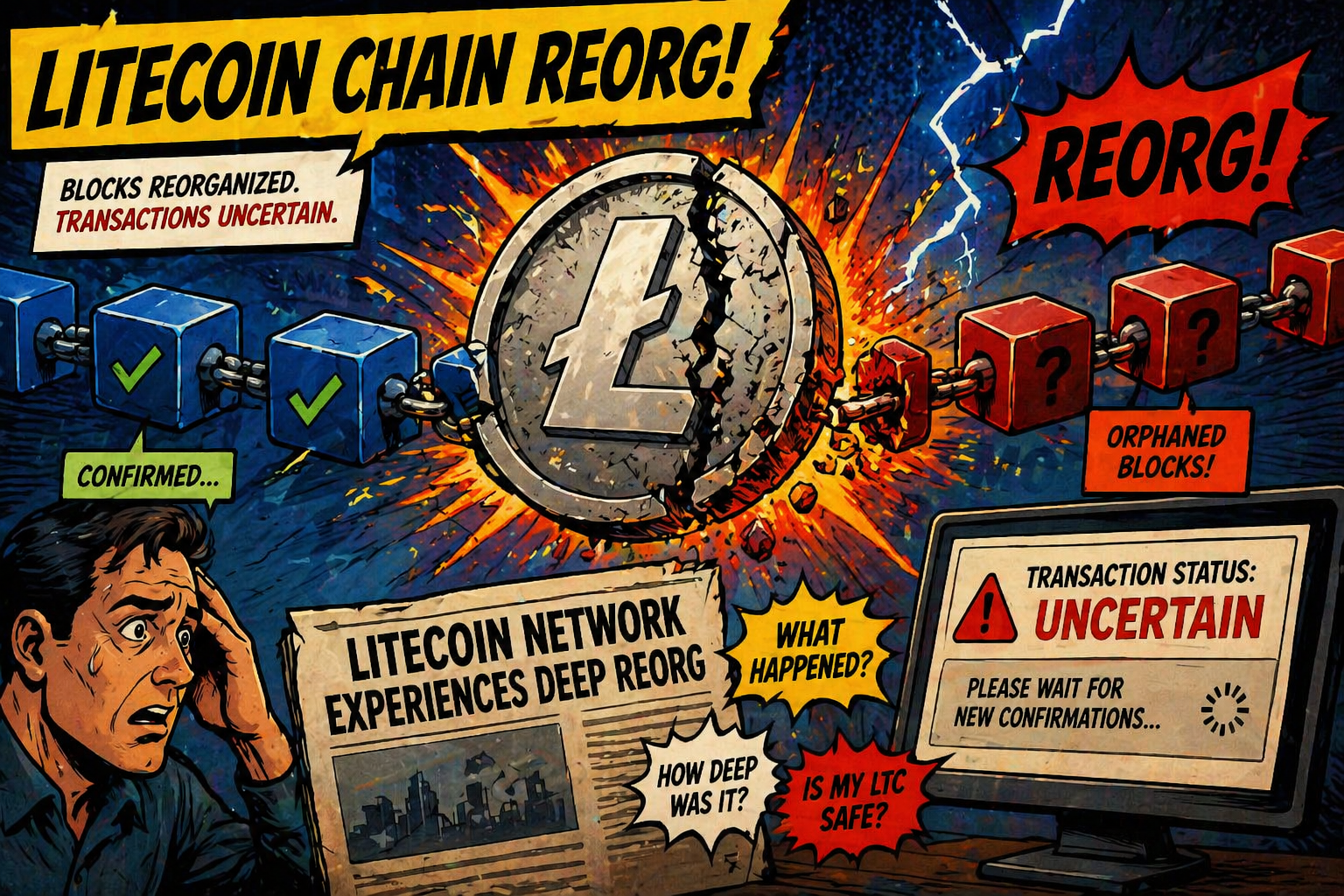
Litecoin’s Chain Rollback Shock: A Wake-Up Call for Crypto’s Security Assumptions

- Share
- Tweet /data/web/virtuals/383272/virtual/www/domains/theunhashed.com/wp-content/plugins/mvp-social-buttons/mvp-social-buttons.php on line 63
https://theunhashed.com/wp-content/uploads/2026/04/litecoin_reorg-1000x600.png&description=Litecoin’s Chain Rollback Shock: A Wake-Up Call for Crypto’s Security Assumptions', 'pinterestShare', 'width=750,height=350'); return false;" title="Pin This Post">
For a network often described as one of crypto’s most stable and battle-tested assets, Litecoin rarely finds itself at the center of controversy. That changed abruptly when reports of a chain rollback surfaced, raising uncomfortable questions about the resilience of even the most established blockchains. In an industry that prides itself on immutability, any hint of rewriting history is more than a technical hiccup—it’s a philosophical fault line.
The incident has triggered a deeper conversation across the crypto ecosystem: if a network like Litecoin can experience rollback-related concerns, what does that mean for the broader assumptions underpinning decentralized finance?
What Actually Happened
At its core, a chain rollback refers to a situation where previously confirmed transactions are effectively reversed due to a reorganization of the blockchain. This can occur naturally in proof-of-work systems when competing chains emerge and the network ultimately accepts the longest valid chain.
In the case of Litecoin, reports indicated an unusual reorganization event that appeared deeper than what users typically expect. While short reorganizations—one or two blocks—are relatively common and generally harmless, deeper rollbacks raise eyebrows because they imply a temporary breakdown in network consensus.
The key issue wasn’t just that a rollback happened, but the depth and implications of it. Transactions that users may have considered final were suddenly in question, challenging the long-standing assumption that confirmations equal certainty.
The Fragility of “Finality”
Finality has always been a nuanced concept in proof-of-work systems. Unlike some proof-of-stake networks that implement explicit finality mechanisms, Bitcoin-style chains—including Litecoin—operate on probabilistic finality. The more confirmations a transaction has, the less likely it is to be reversed.
But “less likely” is not the same as impossible.
This distinction is often overlooked in mainstream narratives around blockchain security. The Litecoin incident brings that reality back into focus. Even mature networks can experience edge cases where consensus temporarily fractures, leading to unexpected outcomes.
For traders, exchanges, and DeFi protocols, this is more than theoretical. It affects how risk is managed in real time. Confirmation thresholds, which are often treated as fixed rules, may need to become more dynamic.
Market Reaction and Sentiment
Interestingly, the market response to the incident was relatively muted. Unlike catastrophic failures or exploits, this event did not trigger widespread panic selling. That suggests a level of maturity among investors, who may view such घटन as technical anomalies rather than systemic threats.
However, beneath the surface, sentiment has shifted in more subtle ways. Institutional players and infrastructure providers are paying closer attention to edge-case scenarios that were previously dismissed as negligible.
In a market increasingly driven by algorithmic strategies and automated systems, even low-probability events can have outsized consequences. A rollback affecting high-value transactions or leveraged positions could cascade through interconnected platforms.
Security vs. Decentralization: An Old Trade-Off Revisited
The Litecoin rollback discussion inevitably circles back to a familiar tension in crypto: the balance between security and decentralization.
Highly decentralized networks rely on distributed consensus, which inherently introduces the possibility of temporary disagreement. This is a feature, not a bug—but it also means that perfect consistency is not guaranteed at every moment.
On the other hand, systems that prioritize faster or absolute finality often do so by introducing additional layers of coordination or trust. This can improve user experience but may compromise the core ethos of decentralization.
Litecoin’s situation highlights that even well-established networks are not immune to this trade-off. The question is not whether such events can happen, but how systems are designed to mitigate their impact.
Mining Dynamics and Network Health
Another dimension worth examining is the role of mining power distribution. In proof-of-work systems, the stability of the chain is closely tied to how hash power is allocated across the network.
If mining power becomes concentrated or temporarily shifts—due to economic incentives, mining pool behavior, or external factors—the likelihood of chain reorganizations can increase.
Litecoin, which shares its hashing algorithm with other networks, is particularly sensitive to these dynamics. Cross-chain mining strategies and fluctuations in profitability can lead to sudden changes in hash rate, creating conditions where deeper reorganizations become more plausible.
This doesn’t necessarily indicate malicious intent. In many cases, it’s simply the result of rational economic behavior by miners. But the outcome can still challenge network stability.
Lessons for the Broader Crypto Ecosystem
The implications of this event extend far beyond Litecoin. It serves as a case study for how even “reliable” systems can behave under stress.
For developers building on blockchain infrastructure, the takeaway is clear: assumptions about finality and immutability need to be stress-tested against real-world conditions. Systems should be designed with rollback scenarios in mind, even if they are statistically rare.
For exchanges and custodians, it may prompt a reevaluation of confirmation policies. Static thresholds may no longer be sufficient in a landscape where edge cases are gaining more attention.
And for investors, it’s a reminder that blockchain technology, while robust, is not infallible. Understanding the nuances of how these systems operate is becoming increasingly important as the market matures.
The Narrative Risk
Beyond the technical details, there is also a narrative dimension to consider. Crypto has long marketed itself on the promise of immutability—an unchangeable ledger that eliminates the need for trust.
Events like the Litecoin rollback complicate that narrative. While they don’t invalidate the core principles of blockchain, they expose the gap between idealized concepts and practical realities.
This gap is not necessarily a weakness. In many ways, it reflects the sophistication of the technology. But it does require more nuanced communication, especially as crypto continues to attract mainstream attention.
Where Litecoin Goes From Here
Despite the concerns raised, it’s important to maintain perspective. Litecoin remains one of the most established and widely used cryptocurrencies, with a long track record of stability.
The network’s ability to handle and recover from anomalies is part of what makes it resilient. In many ways, incidents like this serve as stress tests that ultimately strengthen the system.
What matters now is how the community responds. Increased transparency, deeper analysis, and potential adjustments to best practices will play a crucial role in reinforcing confidence.
Final Thoughts
The Litecoin chain rollback is not a crisis—but it is a signal. It underscores the importance of understanding the mechanics behind blockchain systems, rather than relying on simplified narratives.
As crypto continues to evolve, the conversation is shifting from “can this work?” to “how does this behave under pressure?” That’s a more sophisticated question—and one that events like this help answer.
For a market built on code and consensus, those answers are invaluable.















For the past several years, one company has stood above all others in shaping institutional demand for Bitcoin. Strategy, formerly known as MicroStrategy, transformed itself from an enterprise software company into the world’s largest corporate Bitcoin holder, inspiring dozens of firms to follow a similar path. Every major purchase by the company became a market event, fueling headlines and reinforcing the narrative that Bitcoin was entering corporate treasuries at an unprecedented pace.
But according to Bitwise Chief Investment Officer Matt Hougan, that era may be coming to an end.
Hougan believes Strategy is unlikely to remain Bitcoin’s dominant buyer following recent turmoil surrounding its STRC preferred stock. Instead, he expects a new class of investors—including banks, asset managers, pension funds, insurance companies, and sovereign wealth funds—to become the primary drivers of Bitcoin demand over the coming years.
If his prediction proves correct, Bitcoin’s next bull market could look fundamentally different from the last one.
Strategy Changed the Bitcoin Investment Playbook
Few companies have had a greater impact on Bitcoin adoption than Strategy.
Beginning in 2020, Executive Chairman Michael Saylor made the bold decision to convert significant portions of the company’s treasury into Bitcoin. What initially appeared to be a controversial corporate finance experiment gradually evolved into one of the largest institutional Bitcoin accumulation strategies ever seen.
Strategy repeatedly raised capital through debt offerings, convertible notes, equity sales, and preferred stock issuances to acquire even more Bitcoin.
Each new purchase reinforced investor confidence while encouraging other publicly traded companies to consider similar treasury strategies.
The company’s influence extended well beyond its own balance sheet.
For many institutional investors, Strategy became a proxy for Bitcoin exposure before spot Bitcoin exchange-traded funds were approved in the United States.
Its stock often traded as a leveraged Bitcoin investment, attracting investors seeking amplified exposure to the cryptocurrency’s price movements.
Few organizations have done more to normalize Bitcoin as a corporate treasury asset.
Why STRC Changed the Conversation
The latest debate surrounding Strategy stems from recent turbulence involving its STRC preferred stock.
While Strategy remains financially committed to Bitcoin, the market reaction highlighted the challenges associated with continually raising capital to finance additional purchases.
Preferred shares, debt financing, and equity offerings have allowed the company to expand its Bitcoin holdings far beyond what traditional cash flows would support.
However, these financing mechanisms are not without limits.
Investor appetite can fluctuate, borrowing costs can rise, and market sentiment can shift rapidly during periods of heightened volatility.
According to Hougan, those dynamics suggest Strategy’s ability to dominate Bitcoin purchases may gradually diminish.
Importantly, this does not imply that Strategy will stop buying Bitcoin.
Instead, Hougan expects the company to remain a consistent net buyer while exercising significantly less influence over overall market demand than it has during previous cycles.
The Next Buyers May Look Very Different
If Strategy’s relative influence declines, who replaces it?
Hougan’s answer is straightforward: traditional finance.
Banks, asset managers, pension funds, insurance companies, sovereign wealth funds, family offices, and large institutional allocators are increasingly entering the Bitcoin market.
Unlike corporate treasury buyers, these institutions manage enormous pools of capital.
Even relatively small portfolio allocations could generate demand that exceeds anything individual companies have previously contributed.
For example, a pension fund allocating just one percent of a multi-billion-dollar portfolio to Bitcoin could purchase more Bitcoin than many publicly traded companies have accumulated over several years.
The scale is simply different.
Rather than relying on highly visible corporate acquisitions, future demand may arrive through thousands of institutional allocation decisions spread across global financial markets.
Spot Bitcoin ETFs Changed Everything
One reason institutional demand is expected to accelerate is the growing success of spot Bitcoin exchange-traded funds.
Before ETFs, gaining Bitcoin exposure often required navigating cryptocurrency exchanges, private custodians, or specialized investment products.
Many institutional investors faced compliance restrictions that made direct ownership difficult or impossible.
Spot ETFs dramatically simplified the process.
Asset managers can now add Bitcoin exposure using familiar investment vehicles that fit within existing compliance, custody, and reporting frameworks.
Pension funds, registered investment advisers, wealth managers, and institutional portfolios no longer need to build entirely new operational systems to access Bitcoin.
That accessibility changes the investment landscape.
Instead of a handful of corporate buyers dominating headlines, demand may increasingly flow through diversified financial products managed by traditional institutions.
Sovereign Wealth Funds Could Become a Major Force
Among the most closely watched potential buyers are sovereign wealth funds.
These government-owned investment vehicles collectively manage trillions of dollars in assets.
Historically, sovereign funds have invested across equities, fixed income, real estate, infrastructure, commodities, and private markets.
Bitcoin has remained largely absent from most sovereign portfolios.
That could gradually change as digital assets become increasingly accepted within institutional finance.
Even modest allocations by a handful of sovereign funds would represent enormous inflows relative to Bitcoin’s fixed supply.
Unlike corporate treasury purchases, sovereign investments could also carry symbolic significance, signaling growing governmental acceptance of Bitcoin as a long-term reserve asset.
Although widespread sovereign adoption remains uncertain, many analysts view it as one of Bitcoin’s largest untapped sources of demand.
Pension Funds Are Slowly Entering the Market
Pension funds represent another potentially transformative group.
These institutions prioritize long-term capital preservation rather than speculative trading.
Their investment processes tend to be slow, deliberate, and highly regulated.
That cautious approach has delayed widespread Bitcoin adoption.
However, regulatory clarity, improving custody solutions, and the success of spot ETFs are gradually lowering barriers.
For pension managers, Bitcoin is increasingly being evaluated not as a speculative asset but as a potential portfolio diversifier with unique return characteristics.
Even if allocations remain relatively small, the sheer size of pension assets means incremental adoption could generate meaningful demand.
The pace may be slow, but the long-term impact could be substantial.
Why Strategy Still Matters
Although Hougan expects Strategy’s dominance to fade, the company remains uniquely positioned within the Bitcoin ecosystem.
It still holds one of the largest Bitcoin treasuries in the world and continues to view Bitcoin as its primary long-term strategic asset.
Michael Saylor has repeatedly emphasized that the company intends to continue acquiring Bitcoin whenever opportunities arise.
Strategy also remains an important symbol.
Its aggressive accumulation strategy demonstrated that public companies could successfully integrate Bitcoin into corporate finance.
Many firms considering similar treasury strategies continue looking to Strategy as a blueprint.
Even if its relative influence decreases, its historical role in institutional Bitcoin adoption is unlikely to be forgotten.
Bitcoin’s Demand Story Is Becoming More Diverse
One of the most important implications of Hougan’s outlook is diversification.
Previous Bitcoin cycles often depended heavily on specific categories of buyers.
Retail investors dominated early adoption.
Later cycles saw growing participation from hedge funds, venture capital firms, crypto-native institutions, and publicly traded companies.
The next cycle may involve a much broader coalition.
Banks may offer Bitcoin products to clients.
Asset managers may incorporate Bitcoin into diversified portfolios.
Insurance companies may allocate reserve assets.
Pension funds may introduce modest long-term positions.
Sovereign wealth funds could begin strategic allocations.
Corporate treasuries may continue purchasing Bitcoin, albeit at a slower pace than Strategy once did.
This diversification could make Bitcoin demand more resilient over time.
Instead of relying heavily on one class of buyer, the market would benefit from multiple independent sources of capital.
Institutional Adoption Is About More Than Buying
Institutional participation extends beyond simply purchasing Bitcoin.
Banks are developing custody services.
Asset managers are expanding digital asset investment products.
Financial advisers are educating clients about Bitcoin allocations.
Payment companies continue integrating digital assets into broader financial infrastructure.
Regulatory frameworks are becoming increasingly defined across major markets.
Each development contributes to Bitcoin’s growing legitimacy within traditional finance.
As infrastructure improves, barriers to institutional participation continue falling.
The result is a market that increasingly resembles traditional financial ecosystems while retaining Bitcoin’s decentralized foundation.
Could Strategy Regain Its Dominance?
While Hougan believes Strategy’s relative influence will diminish, that outcome is not guaranteed.
If capital markets remain supportive and investor demand for Strategy’s financing vehicles recovers, the company could continue expanding its Bitcoin holdings aggressively.
Michael Saylor has consistently demonstrated a willingness to pursue innovative financing structures in order to acquire additional Bitcoin.
Markets have repeatedly underestimated the company’s ability to raise capital.
It would therefore be premature to conclude that Strategy’s accumulation phase has ended entirely.
However, even if Strategy continues buying aggressively, it may simply be competing against much larger institutional flows than in previous years.
The market itself may be evolving beyond reliance on any single buyer.
A Sign of Bitcoin’s Maturity
Perhaps the most significant aspect of Hougan’s comments is what they imply about Bitcoin’s evolution.
Markets become more mature as participation broadens.
No single investor, company, or institution remains the defining source of demand indefinitely.
Bitcoin appears to be approaching that stage.
The conversation is shifting away from whether corporations should buy Bitcoin toward how large institutional investors will integrate digital assets into diversified portfolios.
That represents a meaningful transition.
Rather than depending on bold corporate treasury strategies, Bitcoin’s future may increasingly rest on steady allocations from some of the world’s largest financial institutions.
The Next Chapter Is Bigger Than One Company
Strategy helped rewrite the institutional narrative around Bitcoin. Its accumulation strategy inspired corporations, influenced investors, and demonstrated that Bitcoin could become a legitimate treasury reserve asset.
That legacy remains secure regardless of what happens next.
But every market eventually evolves.
Matt Hougan believes the next phase of Bitcoin adoption will be defined not by one company’s balance sheet but by the collective purchasing power of global finance.
Banks, pension funds, sovereign wealth funds, insurance companies, and asset managers oversee trillions of dollars in assets. If even a small fraction of that capital begins flowing into Bitcoin, Strategy’s purchases—even if they continue—could represent a much smaller share of overall demand.
If that transition unfolds as expected, it would mark more than the end of Strategy’s dominance as Bitcoin’s largest buyer.
It would signal that Bitcoin has entered a new era—one where institutional adoption is no longer driven by a single visionary company but by the mainstream financial system itself.
Bitcoin
Kash Patel’s Late MSTR Disclosure Puts Crypto-Linked Stock Trading Back Under Washington’s Microscope

FBI Director Kash Patel is facing fresh scrutiny after reporting a six-figure purchase of Strategy stock months after the legal disclosure deadline had passed, reviving one of Washington’s most persistent ethics debates: should senior government officials be allowed to trade individual stocks at all?
According to NOTUS, Patel disclosed a purchase of Strategy, the company formerly known as MicroStrategy, well after the deadline required under federal ethics rules. The trade reportedly involved a position worth between $100,001 and $250,000. Patel has said the late filing resulted from a miscommunication, but the explanation has done little to quiet critics who argue that the bigger issue is not merely one delayed form. It is the continued ability of powerful public officials to hold and trade assets that can be affected by government policy, regulation, investigations, contracts, and market-moving decisions.
The case is especially sensitive because Strategy is not an ordinary software stock anymore. It has become the most visible public-market proxy for Bitcoin exposure, with its share price closely tied to the company’s massive Bitcoin treasury strategy. That means Patel’s delayed filing sits at the intersection of three highly charged topics: government ethics, crypto-linked equities, and public trust in institutions.
Why the MSTR Trade Matters
Strategy, still widely known by its ticker MSTR, began as an enterprise software company. Over the past several years, however, its identity has been transformed by its aggressive Bitcoin accumulation strategy. Under Michael Saylor’s influence, the company became a kind of leveraged public-market bet on Bitcoin, using capital markets to build one of the largest corporate Bitcoin treasuries in the world.
That transformation is what makes MSTR politically and ethically interesting. It is not just another technology stock. It trades with the psychology of crypto markets, the leverage of public equities, and the scrutiny attached to companies whose fortunes rise and fall with digital assets.
For ordinary investors, buying MSTR is a market decision. For a senior federal law enforcement official, the optics are more complicated. The FBI is involved in cybercrime investigations, financial crime enforcement, fraud cases, sanctions-related investigations, and broader national security matters that can intersect with digital assets. That does not mean Patel’s trade was improper in substance. There is no public evidence from the delayed disclosure alone that he traded on nonpublic information. But ethics controversies rarely turn only on proof of insider trading. They also turn on perception, timing, and whether the public can reasonably trust that official decisions are insulated from private financial interests.
That is why late disclosures matter. Transparency rules are supposed to allow the public, watchdogs, journalists, and ethics officials to identify potential conflicts quickly. A delayed filing undermines that purpose, even if the underlying transaction turns out to be lawful.
The Disclosure Deadline at the Center of the Story
The relevant framework is the STOCK Act, the post-financial-crisis law designed to prevent government officials from using nonpublic information for personal financial gain. The law is best known for applying to members of Congress, but disclosure obligations also extend to many senior executive branch officials.
Covered officials are generally required to report qualifying securities transactions within 45 days. The rule exists because annual financial disclosures alone are not enough. If an official buys or sells a large position in a market-sensitive company, the public is supposed to know within weeks, not months.
Patel’s disclosure reportedly came far outside that window. That timing is the core issue now drawing scrutiny.
Patel’s stated explanation, according to the reporting, is that the omission was caused by a miscommunication. In Washington, such explanations are common. Officials often describe late filings as administrative errors, clerical oversights, misunderstandings with advisers, or failures by accountants or compliance staff. Sometimes those explanations are true. The problem is that the system depends on timely self-reporting, and the penalties for missing deadlines have often been viewed as too small to meaningfully deter violations.
This is why the Patel case is bigger than Patel. It reopens the question of whether the current disclosure regime is serious enough for an era in which stocks, crypto-linked assets, prediction markets, defense contractors, AI companies, and financial platforms can all react sharply to government action.
Why Critics Are Focused on Senior Officials
Public frustration over government stock trading has grown for years. The concern is simple: senior officials may have access to information that ordinary investors do not. Even when they do not trade directly on confidential information, they may understand policy direction, enforcement priorities, agency decisions, or geopolitical risks earlier than the public.
That creates a trust problem.
The FBI director is not a backbench official. The office carries enormous authority. It sits inside the national security and law enforcement apparatus. It touches cybercrime, terrorism, public corruption, financial fraud, ransomware, election security, and transnational crime. In a market increasingly shaped by regulatory decisions and enforcement signals, even the appearance of a conflict can be damaging.
That is why ethics advocates often argue that senior officials should not trade individual stocks at all. Disclosure, in their view, is a weak substitute for prevention. A filing tells the public what happened after the fact. A blind trust or a ban on individual stock trading would reduce the chance that personal financial interests could overlap with official responsibilities in the first place.
Supporters of the current system argue that disclosure rules, recusals, and ethics reviews can manage conflicts without forcing officials to give up ordinary investment rights. But the repeated pattern of late filings across government has made that argument harder to sustain politically.
The Crypto Angle Makes This Different
If Patel’s late disclosure involved a conventional blue-chip stock, the story would still matter. But MSTR adds a sharper edge because Strategy has become one of the defining symbols of Bitcoin’s migration into public markets.
MSTR is no longer valued solely like a traditional enterprise software company. Investors often treat it as a Bitcoin-linked vehicle. When Bitcoin rallies, MSTR can surge. When Bitcoin falls, MSTR can decline sharply. The stock also reflects expectations around capital raises, debt issuance, institutional demand, accounting treatment, and the sustainability of corporate Bitcoin treasury strategies.
That means an MSTR position can function as indirect exposure to Bitcoin, but with additional layers of equity-market leverage and company-specific risk.
For a senior law enforcement official, that matters because federal agencies are deeply involved in shaping the legal environment around crypto. The FBI investigates crypto thefts, hacks, ransomware payments, money laundering networks, sanctions evasion, and fraud schemes. The Department of Justice has brought major digital asset cases. Regulators and enforcement agencies can influence market sentiment through investigations, settlements, prosecutions, and public warnings.
Again, none of this proves wrongdoing in Patel’s case. But it explains why a delayed MSTR disclosure attracts more attention than a late filing involving a less politically sensitive stock.
Strategy’s Government-Contracting Dimension
NOTUS also reported that Strategy has had business connected to the Department of Justice. That detail adds another layer to the ethics debate because government contractors raise different concerns from ordinary public companies.
A stock holding in a company that does business with the government can create questions about procurement, agency relationships, internal influence, and whether an official’s financial interests overlap with companies receiving federal money. The existence of a contract does not automatically create a disqualifying conflict. Large technology firms, software vendors, cloud providers, cybersecurity companies, and data analytics firms often contract with federal agencies. Many are publicly traded, and many are held widely across investment portfolios.
But the closer the connection between an official’s agency and a company in their personal portfolio, the greater the need for clear disclosure and careful ethics review.
In Patel’s case, the controversy is not only that he reportedly owned MSTR stock. It is that the disclosure came late, preventing timely public scrutiny of any potential overlap.
A Familiar Washington Pattern
The Patel episode fits a broader pattern. Officials from both parties have faced criticism for late financial disclosures, stock trades made around major policy events, or portfolios that appear to overlap with their public duties. These controversies often follow the same cycle.
First, a filing appears late or a trade becomes public. Then the official describes it as an oversight or administrative mistake. Ethics experts criticize the delay. Political opponents amplify the story. Supporters argue that no evidence of insider trading has been shown. The story fades unless prosecutors, inspectors general, or ethics offices take further action. Then, months later, a similar controversy emerges involving someone else.
The repetition has weakened public confidence in the disclosure system.
The issue is not only whether officials are breaking the law. It is whether the law is designed strongly enough to prevent conflicts before they occur. In markets where information moves instantly and political decisions can create billions of dollars in value, delayed transparency can feel outdated.
The Case for Stronger Trading Rules
The strongest argument for reform is straightforward: senior government officials should not be picking individual stocks while serving in powerful public roles. They can hold diversified funds, retirement accounts, Treasury securities, or blind trusts, but not positions in companies that may be affected by their official work.
That approach would not eliminate every conflict, but it would simplify the system. It would reduce the need to determine whether an official knew something material at the time of a trade. It would also protect officials themselves from the appearance of impropriety.
The counterargument is that broad stock-trading restrictions could discourage qualified people from entering public service, especially those with complex financial lives. But that argument has become less persuasive to critics who note that public trust is also a cost. If citizens believe officials are using public office to build private wealth, confidence in institutions deteriorates.
The crypto era intensifies this problem. Digital assets and crypto-linked equities can move violently on enforcement actions, ETF approvals, sanctions news, tax policy, bank guidance, accounting rules, and court decisions. For officials with access to sensitive policy or investigative information, even indirect exposure can become controversial.
What Patel’s Explanation Does and Does Not Resolve
Patel’s miscommunication explanation may explain how the filing was missed. It does not resolve the broader issue of why the system allows such delays to happen with relatively limited consequences.
In compliance-heavy industries, timing matters. Public companies face strict disclosure obligations. Financial professionals operate under detailed reporting rules. Government officials, especially those in senior law enforcement roles, are expected to meet high standards because their decisions can affect markets, companies, and individuals.
A late filing may sound procedural, but procedure is the point. Disclosure deadlines exist to make oversight possible while the information is still timely. Once months have passed, the public loses the ability to evaluate the trade in real time.
That is why critics are unlikely to accept a simple administrative explanation as the end of the matter.
The Political Risk for Patel
For Patel, the controversy arrives at an awkward moment. As FBI director, he occupies one of the most scrutinized roles in government. Any ethics issue, even one framed as a paperwork failure, can become a proxy battle over judgment, transparency, and institutional credibility.
The political risk is not necessarily legal exposure. It is reputational drag.
Opponents will argue that a senior law enforcement official should be especially meticulous about disclosure rules. Supporters will likely argue that the issue is being inflated for partisan reasons and that a delayed filing does not amount to corruption. Both arguments will circulate, but the underlying facts remain uncomfortable: a six-figure stock purchase was reportedly disclosed months late, and the stock involved is tied to one of the most politically sensitive asset classes in modern finance.
That is enough to keep the story alive.
The Bigger Market Lesson
For crypto investors, the Patel controversy is a reminder that Bitcoin’s rise into public markets has created new forms of political exposure. MSTR is not just a stock followed by software analysts or Bitcoin bulls. It is now part of the broader debate over public officials, market access, conflicts of interest, and financial transparency.
As more companies become crypto treasury vehicles, and as more crypto-linked equities enter mainstream portfolios, these questions will become more common. A government official may not hold Bitcoin directly, but may own a stock whose value depends heavily on Bitcoin. A policymaker may not trade tokens, but may invest in companies exposed to mining, custody, exchanges, stablecoins, blockchain analytics, or digital asset infrastructure.
The line between traditional finance and crypto finance is disappearing. Ethics rules will need to catch up.
A Disclosure Fight That Is Bigger Than One Trade
The controversy surrounding Kash Patel’s late MSTR disclosure is not just about one official, one stock, or one missed deadline. It is about whether Washington’s transparency system is adequate for modern markets.
A six-figure Strategy purchase by the FBI director would have attracted attention under any circumstances. Reporting it months late made the story more damaging. The miscommunication explanation may reduce the appearance of intent, but it does not erase the concern that the public learned about the transaction long after the law said it should.
In a market where crypto-linked stocks can move on policy signals, enforcement actions, and regulatory sentiment, delayed disclosure is not a minor technicality. It is a failure of the basic transparency that makes public oversight possible.
The Patel case will likely strengthen calls for tighter rules on stock trading by senior officials. Whether those calls become law is another question. Washington has a long history of condemning trading controversies without changing the system that produces them.
But the direction of public sentiment is clear. Investors, voters, and watchdogs are increasingly unwilling to accept a regime where powerful officials can trade individual stocks, report late, pay minimal penalties, and move on. With MSTR now serving as a bridge between Wall Street and Bitcoin, this latest controversy shows how the old ethics debate has entered a new financial era.


Strategy has spent years building one of the most aggressive corporate Bitcoin positions in market history. Its identity became almost inseparable from accumulation: raise capital, buy Bitcoin, hold Bitcoin, repeat. That model turned Michael Saylor into the most visible corporate advocate for Bitcoin and made Strategy a proxy for investors who wanted leveraged exposure to the asset through public markets. Now, the company is adding a new and more complicated tool to its playbook.
Strategy has authorized a BTC Monetization Program that allows the company to sell Bitcoin under defined conditions, including raising up to $1.25 billion to support its USD Reserve, funding preferred stock dividends and interest expenses, and financing buybacks of preferred securities or MSTR common stock. The move does not mean Strategy is abandoning Bitcoin. Saylor says the company “remains committed to Bitcoin” as its primary treasury reserve asset. But it does mean Strategy is no longer treating its Bitcoin stack only as something to accumulate. It is now formally treating Bitcoin as balance-sheet capital that can be deployed when management decides the trade-off is better than issuing more equity.
A Major Shift From Pure Accumulation
The headline number is simple: Strategy’s board has authorized up to $1.25 billion in Bitcoin monetization capacity for reserve-building purposes. But the implications are larger than the number itself. For years, Strategy’s story was built around the idea that Bitcoin was the company’s ultimate treasury asset, not a source of ordinary liquidity. The company repeatedly used capital markets to acquire more Bitcoin, issuing stock, convertible debt, and preferred securities to finance its strategy.
This announcement changes the tone. Strategy is not saying it must sell Bitcoin immediately, and the authorization does not force management to execute sales. But the architecture is now in place. If market conditions make Bitcoin sales more attractive than issuing class A common stock or other securities, the company has board approval to use part of its BTC reserve to reinforce liquidity, fund obligations, or buy back securities.
That is a meaningful evolution. Strategy is moving from a one-directional Bitcoin accumulation strategy toward a more active capital-management model. The company still wants long-term Bitcoin exposure, but it is also acknowledging that a Bitcoin-heavy balance sheet needs liquidity tools, especially when preferred stock dividends, interest costs, market volatility, and investor confidence all matter at the same time.
The $2.55 Billion USD Reserve
The BTC Monetization Program is part of a broader Digital Credit Capital Framework that includes a board-approved USD Reserve policy. Strategy says its USD Reserve stands at approximately $2.55 billion as of June 28, 2026. That reserve is designed to support preferred stock dividends and interest on outstanding debt. Any other use requires board authorization.
This is important because Strategy’s capital structure has become more complex over time. The company is no longer simply a software business with a Bitcoin balance sheet. It is also a financial-engineering platform with multiple classes of preferred securities, debt obligations, and common equity investors all tied in different ways to the value of Bitcoin and Strategy’s ability to raise capital.
According to the company, the $2.55 billion USD Reserve represents about 17.4 months of coverage for current expected preferred stock dividend payments and interest expenses. When combined with the $1.25 billion of board-authorized Bitcoin monetization capacity, Strategy says it would have roughly $3.8 billion of liquidity coverage, equal to about 25.9 months of current expected obligations before future changes, taxes, transaction costs, market conditions, or buybacks.
In plain English, Strategy is trying to reassure the market that it can meet its obligations without being forced into distressed decisions during periods of Bitcoin weakness or capital-market pressure.
Why the Buybacks Matter
Alongside the BTC Monetization Program, Strategy authorized two separate $1 billion buyback programs. One is for its Digital Credit Securities, including its preferred stock instruments. The other is for MSTR class A common stock.
That gives the company another lever. If its preferred securities trade at steep discounts, Strategy may be able to buy them back at prices that reduce future dividend obligations and strengthen the capital structure. If MSTR common stock trades below what management views as intrinsic value, the company may also repurchase common shares.
This is a different kind of message from the old Strategy playbook. Previously, the company was best known for issuing securities to acquire more Bitcoin. Now it is saying it may repurchase securities when they trade at levels management views as attractive. CEO Phong Le described the company as moving from one-way capital issuance toward active capital management.
That phrase captures the entire shift. Strategy is no longer presenting itself only as a Bitcoin buyer. It is positioning itself as an active manager of Bitcoin exposure, liquidity, credit instruments, and common equity value.
Bitcoin as Capital, Not Just a Reserve Asset
Perhaps the most important line in the announcement came from CFO Andrew Kang, who said, “Bitcoin is capital.” That statement may prove to be the defining phrase of this new phase.
For Bitcoin purists, selling BTC can look like a retreat. Strategy’s brand has been built on conviction, and Saylor has spent years arguing that Bitcoin is superior treasury collateral. Any formal authorization to sell Bitcoin therefore risks being interpreted as a crack in the narrative.
But Strategy is framing the decision differently. In its view, Bitcoin is not being downgraded. It is being integrated into a more flexible treasury framework. If Bitcoin is capital, then it can be held, borrowed against, monetized, or redeployed when doing so improves the company’s financial position.
That is a more mature but less ideological approach. It recognizes Bitcoin as a strategic asset while also acknowledging the practical demands of running a publicly traded company with dividend obligations, debt, investors, and market pressure.
Why This Announcement Comes at a Sensitive Moment
The timing matters. Strategy’s model depends heavily on market confidence. When MSTR trades at a premium to the value of its Bitcoin holdings, the company can issue equity in a way that supports its strategy and potentially increases Bitcoin exposure per share. When that premium compresses, capital issuance becomes more difficult and potentially more dilutive.
The company’s preferred securities also require investor confidence. If those instruments trade under pressure, dividend yields rise, the cost of capital becomes more visible, and the market begins scrutinizing liquidity coverage more closely.
The new framework appears designed to answer those concerns directly. The USD Reserve reassures preferred investors that dividends and interest expenses are covered for a defined period. The BTC Monetization Program shows that the company has another liquidity source if capital markets become less attractive. The buyback programs give management a way to respond if its securities trade at distressed or overly discounted levels.
In other words, Strategy is trying to prove that its Bitcoin treasury model can survive a more difficult market environment.
A Signal to Common Shareholders
For MSTR common shareholders, the announcement cuts both ways. On one hand, the authorization to sell Bitcoin may worry investors who bought Strategy specifically because they wanted maximum exposure to Bitcoin accumulation. If the company sells BTC, even selectively, it reduces the purity of that story.
On the other hand, common shareholders may benefit if the program helps Strategy avoid excessive dilution. If the alternative is issuing common stock at unattractive prices, using limited Bitcoin monetization to fund obligations or repurchase discounted securities could be more favorable over the long term.
The common stock buyback authorization also sends a signal that management believes there may be moments when MSTR trades below intrinsic value. Whether the company actually repurchases shares will depend on market conditions, liquidity needs, and management’s assessment of value. Still, the existence of the program gives Strategy optionality it did not previously emphasize.
A Signal to Preferred Investors
Preferred investors may be the most direct audience for the announcement. Strategy’s preferred securities depend on confidence that the company can continue making dividend payments. By building a large USD Reserve and establishing a minimum reserve policy, Strategy is trying to make its preferred instruments look more durable.
The company also raised the regular dividend rate on its STRC preferred stock to 12% for semi-monthly periods with record dates on or after July 1, 2026. That move appears designed to support trading stability and align the yield with market expectations.
The buyback authorization for Digital Credit Securities adds another layer. If preferred securities trade at meaningful discounts, repurchases could reduce expected dividend obligations and potentially improve credit quality. This is why the framework is not just about Bitcoin sales. It is about defending the entire capital structure around Strategy’s Bitcoin thesis.
Not a Reversal, But a Stress Test
The most accurate way to read this announcement is not as a reversal of Saylor’s Bitcoin strategy. It is a stress test of that strategy entering a more complex phase.
Strategy is still publicly committed to Bitcoin as its primary treasury reserve asset. The company is still built around long-term Bitcoin exposure. But it now has to manage the reality that its capital structure has grown large, layered, and sensitive to market conditions.
A simple buy-and-hold narrative is easier when capital is abundant, the stock trades at a strong premium, and Bitcoin momentum is positive. It becomes harder when preferred dividends, debt interest, buyback opportunities, stock valuation, and liquidity coverage all need to be managed simultaneously.
The BTC Monetization Program is Strategy’s answer to that problem. It gives the company flexibility without formally abandoning its Bitcoin-first identity.
The Market Will Watch Execution
The next question is not whether Strategy has authorization to sell Bitcoin. It does. The question is how it uses that authorization.
If the company sells small amounts of Bitcoin strategically to strengthen reserves, reduce future obligations, or avoid issuing common shares at unattractive levels, investors may eventually view the program as prudent capital management. If sales become frequent or appear defensive, the market may interpret them as a sign that the treasury model is under pressure.
That distinction will be critical. Strategy’s credibility has always depended on conviction. But as the company matures, credibility may also depend on discipline.
The company now needs to show that Bitcoin monetization is a tool, not a panic button. It must convince investors that selling some BTC under strict conditions can protect long-term exposure rather than weaken it.
The Bigger Picture
Strategy’s announcement marks a new chapter in corporate Bitcoin treasury management. The company is no longer operating only as the most aggressive public-market accumulator of Bitcoin. It is now building a broader capital-management framework around that Bitcoin position.
The message is subtle but important: Bitcoin remains the core asset, but liquidity matters. Preferred investors need coverage. Common shareholders need protection from unnecessary dilution. Securities trading at discounts may create buyback opportunities. And Bitcoin, once treated almost exclusively as something to hold forever, can now be monetized under board-approved conditions.
This is not the end of Strategy’s Bitcoin story. But it may be the end of the simplest version of it.
Saylor’s company is still betting on Bitcoin as its central reserve asset. The difference is that Strategy is now admitting that even a Bitcoin-first balance sheet needs active management when billions of dollars in obligations, investor expectations, and market volatility collide.
-

 Cardano9 months ago
Cardano Breaks Ground in India: Trivolve Tech Launches Blockchain Forensic System on Mainnet
-

 Cardano7 months ago
Solana co‑founder publicly backs Cardano — signaling rare cross‑chain respect after 2025 chain‑split recovery
-

 Cardano9 months ago
Cardano Reboots: What the Foundation’s New Roadmap Means for the Blockchain Race
-

 Altcoins7 months ago
Crypto Goes Mainstream — Bitwise 10 Crypto Index ETF (BITW) Debuts on NYSE Arca
-

 News7 months ago
Crypto on Trial: The $5.5 Billion Pump.fun, Solana & RICO Lawsuit That Could Redefine On‑Chain Liability
-

 News7 months ago
From Memes to Courtrooms: Solana and Jito Execs Named in Explosive RICO Suit Over Pump.fun
-

 Altcoins7 months ago
Algorand’s 2027 Question: Can the Network Survive Without Foundation-Funded Rewards?
-
 Altcoins7 months ago
NYSE Arca Files to Launch Altcoin-Focused ETF