
Ethereum
Ethereum Foundation’s Resignation Wave Is Not Random. It Is a Stress Test for Ethereum’s Next Era

- Share
- Tweet /data/web/virtuals/383272/virtual/www/domains/theunhashed.com/wp-content/plugins/mvp-social-buttons/mvp-social-buttons.php on line 63
https://theunhashed.com/wp-content/uploads/2026/05/eth_research-1000x600.png&description=Ethereum Foundation’s Resignation Wave Is Not Random. It Is a Stress Test for Ethereum’s Next Era', 'pinterestShare', 'width=750,height=350'); return false;" title="Pin This Post">
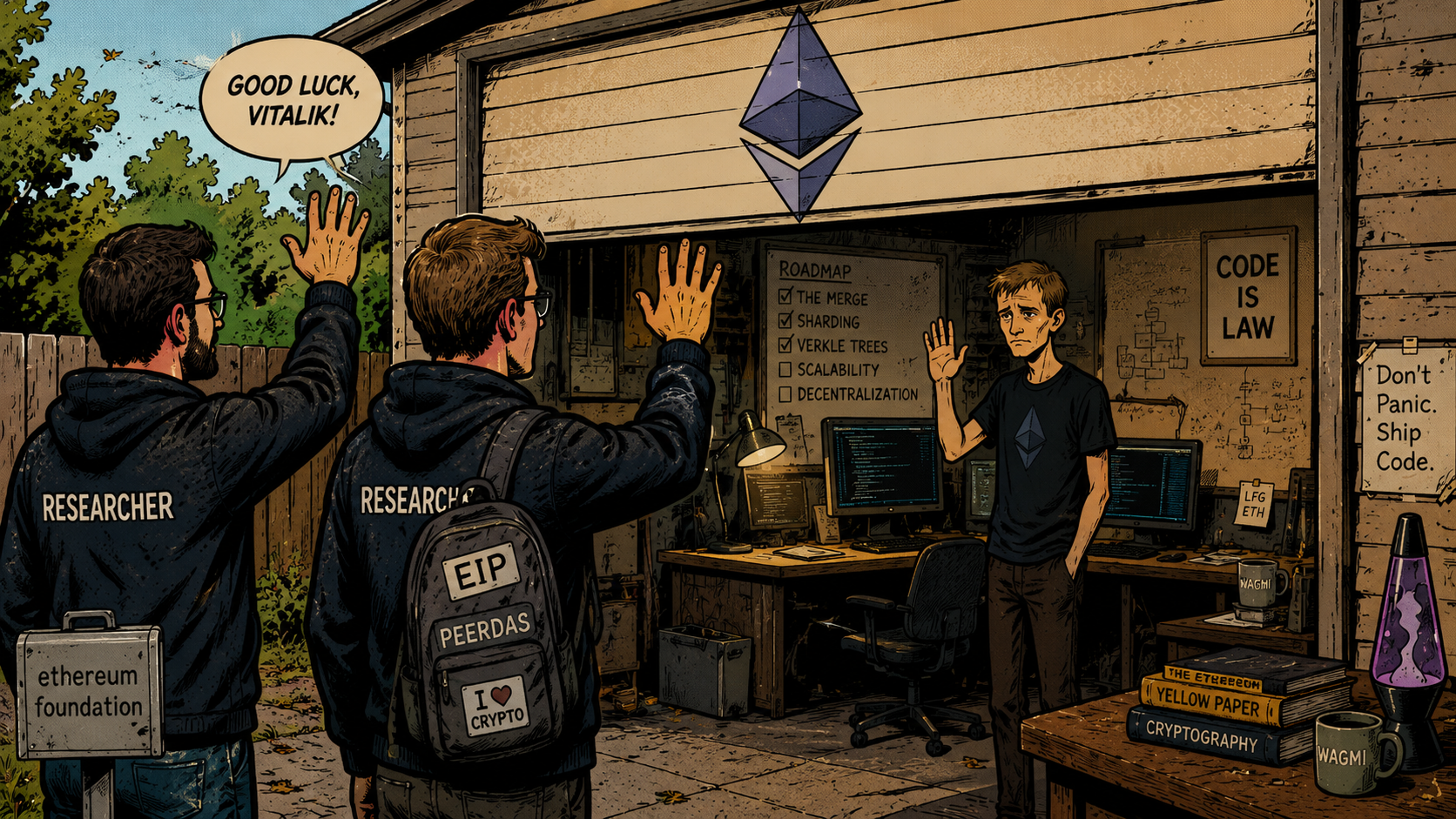
Ethereum has never been just a blockchain. It has always been a political experiment, a research lab, a financial settlement layer, and a cultural movement trying to pretend it is not governed by any single institution. That is why the latest wave of Ethereum Foundation resignations matters. Carl Beek and Julian Ma are now reportedly leaving the Foundation, joining a growing list of departures that includes Barnabé Monnot, Tim Beiko, Trent Van Epps, and Alex Stokes, who has stepped back for a sabbatical. On the surface, this looks like a personnel story. Underneath, it is something larger: Ethereum is trying to move from founder-era coordination to institutional-scale execution, and the people who carried the old model are burning out, moving on, or being replaced by a new operating structure.
The Latest Departures Add to a Bigger Pattern
Carl Beek and Julian Ma’s exits are important because they do not stand alone. Beek had reportedly spent seven years at the Ethereum Foundation, while Ma had been there for roughly four years. Their resignations follow a string of other high-profile moves across Ethereum’s research and protocol circles. Tim Beiko and Barnabé Monnot, two of the most visible names involved in Ethereum protocol coordination, are also moving on from the Foundation. Alex Stokes, another key Protocol figure, has announced a sabbatical. Trent Van Epps, closely associated with Protocol Guild, has also left the Foundation orbit as that initiative matured into a more independent structure.
The Ethereum Foundation has tried to frame at least part of this as an orderly transition rather than a collapse. In its May 2026 Protocol Cluster update, the Foundation said Beiko and Monnot are moving on, Stokes will be on sabbatical, and Will Corcoran, Kev Wedderburn, and Fredrik are stepping into Protocol leadership roles. The same update credited the outgoing team with helping ship Fusaka to mainnet in December 2025, introducing PeerDAS and raising the gas limit as part of Ethereum’s path toward much higher capacity.
That framing matters. This is not simply a story of people rage-quitting. It is a leadership handoff during a period when Ethereum’s technical roadmap is becoming more demanding, not less.
So Why Are They Leaving?
The honest answer is that there is probably no single reason. The resignation wave appears to be the result of several pressures converging at once: organizational restructuring, protocol burnout, Ethereum’s growing political tension, frustration over EF’s role, and a shift toward a more formalized operating model.
Ethereum’s core protocol work is unusually intense. Coordinating upgrades across multiple client teams, researchers, layer-2 ecosystems, validators, application developers, and competing ideological camps is not a normal software job. It is closer to air-traffic control for a global financial computer that cannot go down. People like Beiko, Monnot, Stokes, and others have been doing this work through several major upgrade cycles. After years of that pressure, departures and sabbaticals are not shocking.
But the timing is still significant. These exits are happening after the Ethereum Foundation underwent a major restructuring in 2025. The Foundation’s Protocol group was reorganized into a more united and leaner organization with more focused teams. That update emphasized higher expectations, clearer accountability, and a more concentrated structure for protocol research and development.
That kind of restructuring often creates turnover. Some people prefer the old model. Some are exhausted by the transition. Some may see the new structure as the right moment to hand over responsibilities. Some may simply want to work on Ethereum from outside the Foundation, where they can have more freedom and fewer internal constraints.
The Foundation Is Trying to Become Less Central While Still Being Blamed for Everything
The paradox at the heart of Ethereum is that the Ethereum Foundation is not supposed to control Ethereum, but everyone still looks at it when things go wrong.
When ETH underperforms, people blame the Foundation. When upgrades feel slow, people blame the Foundation. When layer-2 fragmentation frustrates users, people blame the Foundation. When Solana gains mindshare, people blame the Foundation. When institutional investors seem more excited about Bitcoin ETFs than Ethereum, people blame the Foundation.
This creates an impossible management problem. The EF is expected to be neutral, decentralized, technically rigorous, and non-controlling. At the same time, the market wants it to behave like a high-performance company with a product strategy, marketing department, investor relations machine, and ruthless execution culture.
That contradiction has been building for years. In 2025, Vitalik Buterin publicly pushed for leadership changes at the Foundation, saying the organization needed to improve technical expertise and better support Ethereum’s ecosystem while still avoiding centralization and political capture. The Foundation later moved through leadership changes and internal restructuring, including the appointment of new executive leadership and further turnover.
The current departures should be read against that backdrop. Ethereum is trying to professionalize without becoming corporate, decentralize without becoming directionless, and scale without losing the research culture that made it important in the first place.
Burnout Is Probably a Major Factor
Crypto often talks about developers as if they are permanent infrastructure. They are not. They are people.
Ethereum protocol contributors operate under brutal conditions. Their work is public, technically complex, politically charged, and financially consequential. A wrong call can affect billions of dollars. A delay can trigger months of criticism. A roadmap decision can anger validators, DeFi teams, rollup builders, app developers, and ETH holders all at once.
Tim Beiko’s role is a perfect example. For years, he acted as one of Ethereum’s most visible upgrade coordinators, helping translate messy technical debate into actual network changes. That kind of role requires not only technical fluency but emotional endurance. It means absorbing criticism from every direction while keeping independent teams aligned.
Barnabé Monnot’s work on mechanism design and Ethereum economics also sat near the center of some of Ethereum’s hardest questions: staking incentives, validator behavior, block construction, MEV, and long-term protocol security. These are not abstract academic problems anymore. They shape the economics of a live settlement network.
When people in those positions step away, the simplest explanation may also be the most human one: after years of high-stakes coordination, they may need a different rhythm.
Ethereum’s Roadmap Is Entering a Harder Phase
The timing is also tied to Ethereum’s technical transition. The easy narrative upgrades are gone. The Merge was clean and historic. EIP-1559 was simple enough for the market to understand. But the next phase of Ethereum is more complex: data availability, PeerDAS, enshrined proposer-builder separation, gas-limit expansion, zero-knowledge infrastructure, censorship resistance, faster confirmations, and security at trillion-dollar scale.
These are not easy to explain, and they are not easy to coordinate. They also create real trade-offs. Ethereum wants to scale, but not by sacrificing decentralization. It wants better user experience, but not by centralizing block production. It wants layer-2 growth, but not an ecosystem so fragmented that users feel lost. It wants institutional adoption, but not capture by banks, regulators, or political factions.
The Foundation’s May 2026 Protocol update shows this shift clearly. The incoming leadership is tied to areas such as zkVM proving, post-quantum consensus, zkEVM work, protocol security, and the Trillion Dollar Security initiative. That is a very different flavor of work from the earlier Ethereum era. It is more specialized, more security-focused, and more execution-heavy.
In that sense, the resignations may mark the end of one protocol-coordination generation and the beginning of another.
The Market Will Read This as a Confidence Problem
Even if the departures are orderly, the market will not treat them as neutral.
Ethereum is already under pressure. Bitcoin has won the institutional store-of-value narrative. Solana has captured much of the speed and consumer-app narrative. Ethereum remains the largest smart-contract ecosystem, but it is also fighting a perception problem: too slow, too fragmented, too academic, too dependent on layer-2s, and too poor at telling its own story.
A wave of Ethereum Foundation exits feeds that anxiety. Investors will ask whether key people are leaving because they see internal dysfunction. Developers will wonder whether protocol leadership is stable. Competing ecosystems will use the resignations as marketing ammunition. ETH holders will worry that the Foundation is losing institutional memory exactly when Ethereum needs sharper execution.
That does not mean the fears are fully justified. Ethereum is much bigger than the Foundation. Its client teams, researchers, rollup builders, app developers, and infrastructure companies are spread across the world. The network does not depend on one office or one leadership team.
But perception matters. Ethereum’s decentralization is real, yet the EF still has symbolic weight. When respected researchers leave in clusters, people notice.
This Is Not Necessarily Bearish for Ethereum
The mistake would be to assume every resignation is a death signal.
Healthy open-source ecosystems often evolve through contributor rotation. People leave foundations and continue contributing elsewhere. Some move into startups. Some focus on research independently. Some take breaks and return. Some move from formal roles into looser ecosystem roles. Ethereum has always benefited from this porous boundary between the Foundation and the broader community.
There is also a positive interpretation. The Foundation may be becoming less personality-dependent. If the new Protocol leadership can execute well, these changes could show that Ethereum is mature enough to survive major contributor turnover. That would be a sign of institutional resilience, not weakness.
The question is whether the transition is managed cleanly. Ethereum needs continuity on upgrades, clarity on priorities, and better communication with the community. It cannot afford months of confusion over who owns which decisions, what the roadmap really prioritizes, or whether protocol work is drifting.
The Real Issue Is Governance
The resignation wave points to Ethereum’s biggest unresolved question: who actually leads Ethereum?
The easy answer is “no one.” The more accurate answer is “many people, unevenly.” Vitalik Buterin still has enormous moral authority. The Ethereum Foundation still has funding power and symbolic legitimacy. Core developers shape the protocol through research and client implementation. Rollup teams shape the user experience. Wallets shape access. Validators shape security. Large apps shape demand. Institutional players increasingly shape narratives.
That messy governance model has advantages. It makes Ethereum harder to capture. But it also makes Ethereum harder to steer.
The Foundation’s challenge is to become less of a bottleneck without becoming irrelevant. It must support the ecosystem without acting like a CEO. It must fund public goods without choosing winners too aggressively. It must help coordinate protocol upgrades without turning Ethereum into a foundation-led chain.
That balance is exhausting. It may explain why so many people eventually choose to step away.
Why It Matters Now
The resignations matter because Ethereum is entering a decisive period. The network has to prove that its rollup-centric roadmap can deliver a better user experience. It has to prove that ETH has strong value capture in a layer-2 world. It has to prove that its base layer can scale without centralizing. It has to prove that it can remain the preferred settlement layer for DeFi, stablecoins, tokenized assets, and institutional on-chain finance.
At the same time, its rivals are not waiting. Bitcoin dominates the institutional narrative. Solana is pushing hard on performance and consumer crypto. New modular and app-specific chains are competing for developers. Traditional finance is entering the space with its own infrastructure ambitions.
Ethereum can still win this next phase. But it cannot win by assuming its early lead is permanent.
The Bottom Line
Carl Beek and Julian Ma’s resignations are not isolated HR events. They are part of a broader Ethereum Foundation transition that has been building since the 2025 restructuring. The reasons appear to be structural rather than simple: burnout, leadership rotation, internal reform, decentralization pressure, roadmap complexity, and the burden of coordinating a network that the world treats as both public infrastructure and an investable asset.
The bullish reading is that Ethereum is maturing. The old guard is handing the protocol to a more specialized, focused leadership structure. The Foundation is becoming leaner, clearer, and less dependent on individual personalities.
The bearish reading is that Ethereum’s most important institution is struggling with morale, direction, and internal cohesion at exactly the wrong moment.
Both readings may be partly true.
What happens next will matter more than who left. If Ethereum ships, scales, communicates better, and keeps attracting serious builders, the resignation wave will look like a difficult but normal transition. If upgrades slow, narratives weaken, and the community keeps arguing about the Foundation’s role, these exits will be remembered as an early warning.
Ethereum does not need the Ethereum Foundation to control it. But it does need the Foundation to function. Right now, the market is asking whether it still can.










Bitcoin
Billionaire Investor Jeremy Grantham Says Crypto Is “Useless.” Has the Market Already Proven Him Wrong?


Jeremy Grantham has built a reputation as one of Wall Street’s most respected bubble spotters. The veteran investor correctly warned about Japan’s asset bubble in the late 1980s, the dot-com collapse, and the U.S. housing market before the 2008 financial crisis. When Grantham labels an asset class a speculative bubble, investors tend to pay attention.
His latest target is cryptocurrency.
Speaking in a recent interview, Grantham dismissed crypto as a “useless speculative” asset and predicted that it will eventually disappear “not with a bang, but a whimper.” He argued that cryptocurrencies fail as stable stores of value, see little genuine use in everyday commerce, and derive much of their appeal from speculation rather than practical utility. His sharpest criticism came when discussing illicit finance, claiming that crypto’s main function is allowing criminals to move money without leaving a trace.
Coming from an investor with Grantham’s track record, those comments deserve attention. But they also arrive at a time when the cryptocurrency market looks very different from the one that existed just a few years ago.
Grantham’s Longstanding Skepticism
Grantham’s criticism of crypto is consistent with his broader investment philosophy. Throughout his career, he has focused on assets with measurable intrinsic value, whether through cash flows, productive businesses, farmland, timber, or real estate. In his view, long-term investment returns eventually converge with underlying economic value.
Cryptocurrencies have always challenged that framework. Bitcoin does not generate earnings. Ethereum’s valuation is difficult to compare with traditional financial assets. Many digital tokens depend largely on market demand rather than discounted future cash flows.
From that perspective, Grantham sees crypto as an asset driven primarily by investor psychology. Prices rise because buyers expect future buyers to pay more, creating a cycle that resembles previous speculative episodes he has spent decades studying.
His criticism also reflects crypto’s extraordinary volatility. Assets that can gain or lose 50% within months struggle to function as stable stores of value, particularly for households or businesses seeking predictable purchasing power.
Those concerns are not unique to Grantham. Many traditional investors have questioned whether cryptocurrencies can ever fulfill the monetary role that early supporters envisioned.
The Payments Argument
Grantham also argues that cryptocurrencies have failed to become meaningful payment systems.
In some respects, the data supports his position. Despite years of development, relatively few consumers purchase groceries, pay rent, or receive salaries directly in Bitcoin or most other cryptocurrencies. Traditional payment systems still dominate global commerce, while credit cards, bank transfers, and digital wallets process vastly more everyday transactions.
Bitcoin itself has gradually evolved away from its original vision as peer-to-peer electronic cash. Today it is more commonly viewed as a long-term investment asset or digital reserve rather than an everyday payment network.
However, the broader crypto ecosystem has evolved considerably.
Stablecoins have emerged as one of blockchain’s fastest-growing sectors, processing trillions of dollars in annual transaction volume. They have become increasingly important for international settlements, remittances, institutional trading, treasury management, and cross-border payments. Unlike highly volatile cryptocurrencies, stablecoins maintain relatively stable values while retaining blockchain’s programmability.
That distinction complicates the argument that blockchain technology lacks practical payment use cases. While Bitcoin may not have become everyday money, digital dollars operating on blockchain networks are increasingly being used for real financial activity.
Is Crypto Really “Useless”?
The usefulness of cryptocurrency depends largely on which part of the industry is being evaluated.
If the discussion focuses on thousands of speculative tokens created primarily for trading, Grantham’s criticism resonates with many observers. A significant portion of the crypto market has produced little lasting value beyond speculation.
But blockchain technology has expanded into several areas that extend beyond price speculation alone.
Decentralized finance allows users to borrow, lend, trade, and provide liquidity without traditional financial intermediaries. Tokenization projects are bringing stocks, bonds, real estate, and other assets onto blockchain networks. Stablecoins have become an increasingly important component of international finance. Major financial institutions are experimenting with blockchain settlement systems, while governments continue exploring central bank digital currencies.
None of these developments guarantee long-term success, but they suggest that the ecosystem has evolved beyond the narrow use cases that existed during previous crypto cycles.
The challenge is separating genuine infrastructure from speculative excess.
The Crime Question
Grantham’s most controversial claim is that crypto primarily exists to help criminals move money without leaving a trace.
That criticism has been part of the crypto debate since Bitcoin’s earliest years. Darknet marketplaces, ransomware attacks, sanctions evasion, and certain forms of money laundering have all involved cryptocurrency.
However, blockchain transactions are generally far from invisible.
Public blockchains record transactions permanently, allowing blockchain analytics firms and law enforcement agencies to trace fund movements with increasing sophistication. Numerous criminal investigations have relied on blockchain analysis to recover stolen assets, identify suspects, and dismantle illicit financial networks.
Privacy-focused cryptocurrencies offer stronger anonymity features than Bitcoin, but they represent only a small portion of the overall crypto market.
Ironically, many investigators now argue that blockchain’s transparent ledger can make financial crimes easier to trace than cash-based transactions under certain circumstances.
That does not mean cryptocurrencies are free from criminal misuse. Like cash, bank accounts, and payment platforms, they can be abused. The debate centers on whether criminal activity defines the technology or represents one of many possible uses.
The Institutional Shift
One reason Grantham’s comments have generated attention is the dramatic change in institutional participation.
Just a few years ago, many large asset managers refused to engage with cryptocurrencies altogether. Today, regulated Bitcoin exchange-traded funds have attracted billions of dollars from institutional investors. Major banks are expanding digital asset services, while publicly traded companies increasingly hold Bitcoin on their balance sheets.
Institutional adoption does not prove that crypto is fundamentally valuable. Financial history contains many examples of institutions participating in overvalued markets.
However, it does suggest that cryptocurrencies have become more integrated into mainstream financial markets than many early critics anticipated.
Instead of remaining a niche experiment, digital assets have gradually become another investable asset class for many professional investors.
Bubble or New Asset Class?
Grantham’s reputation naturally raises another question: could he be right again?
History shows that technological innovation and speculative bubbles often occur simultaneously. Railroads, electricity, automobiles, and the internet all experienced periods of excessive speculation before becoming transformative industries.
The collapse of countless dot-com companies did not invalidate the internet itself.
Likewise, thousands of cryptocurrencies have disappeared over the past decade. Many projects failed, investors lost money, and speculative manias repeatedly inflated unsustainable valuations.
Yet blockchain development continued.
Bitcoin survived multiple bear markets. Ethereum became the foundation for decentralized applications. Stablecoins evolved into major payment infrastructure. Tokenization, decentralized finance, and institutional blockchain initiatives continued expanding despite repeated market downturns.
The important question may no longer be whether speculation exists. It clearly does. The more relevant question is whether speculation overshadows genuine technological progress.
A Different Investment Philosophy
Part of the disagreement ultimately comes down to investment philosophy.
Grantham evaluates assets primarily through the lens of intrinsic value and long-term cash generation. Crypto supporters often argue that blockchain networks should instead be viewed as digital infrastructure, decentralized computing platforms, or monetary networks rather than traditional productive assets.
These frameworks naturally produce different conclusions.
If Bitcoin is viewed strictly as a non-productive asset, it becomes difficult to justify using conventional valuation methods.
If it is viewed as digital monetary infrastructure competing with gold or global settlement systems, supporters argue that different valuation approaches become appropriate.
Neither framework has achieved universal acceptance.
That uncertainty explains why cryptocurrencies continue to divide experienced investors more sharply than almost any other modern asset class.
The Debate Is Far From Over
Jeremy Grantham has earned credibility by identifying speculative excess long before markets recognized it. His warnings therefore carry weight, particularly during periods of investor enthusiasm.
At the same time, the cryptocurrency industry he criticizes has changed substantially since Bitcoin’s early years. Stablecoins process enormous transaction volumes, institutions have embraced regulated digital asset products, blockchain infrastructure continues expanding, and new applications—particularly around tokenization and artificial intelligence—are emerging at a rapid pace.
Whether those developments ultimately justify today’s valuations remains an open question.
Grantham believes crypto’s story will end quietly, fading as investors eventually abandon assets that lack lasting economic value.
Crypto supporters believe the opposite. They argue that blockchain technology is gradually becoming financial infrastructure, and that today’s volatility resembles the early stages of previous technological revolutions rather than their end.
The market has not yet delivered a final verdict.
For now, Grantham’s criticism serves as a reminder that even as digital assets become increasingly mainstream, the fundamental debate surrounding their long-term value remains as intense as ever.
Ethereum
Polygon’s $80 Billion Stablecoin Milestone Signals a Bigger Shift: AI Could Soon Outpace Humans Onchain


Polygon’s latest network figures point to a major shift in how blockchain infrastructure may be used over the next few years. In May, the network processed around $80 billion in stablecoin volume and, according to Polygon, led all blockchains in total transaction count, surpassing both Solana and BNB Chain. On the surface, those numbers reinforce Polygon’s role as one of the busiest blockchain ecosystems in the market. But the bigger story is what Polygon believes comes next: within five years, AI agents could execute more onchain transactions than humans.
That prediction captures one of the most important emerging intersections in technology. Stablecoins are becoming the default payment layer of crypto, while AI agents are moving from passive assistants toward autonomous software capable of taking action. If those two trends converge, blockchains may no longer be used mainly by people trading tokens, minting NFTs, or interacting manually with decentralized applications. They may become settlement networks for machines.
Stablecoins Are Becoming Blockchain’s Real Utility Layer
For years, the crypto industry searched for a mainstream use case that could move beyond speculation. Stablecoins have increasingly become that use case. They combine the price stability of traditional currency with the programmability and global reach of blockchain networks, making them useful for payments, remittances, trading, treasury operations, and cross-border settlement.
Polygon’s reported $80 billion in stablecoin volume during May suggests that the network is no longer just a platform for decentralized applications. It is functioning as payment infrastructure. That distinction matters because payment activity tends to be more durable than speculative activity. NFT cycles can disappear quickly, memecoin trading can collapse overnight, and DeFi yields can shift with market conditions. Stablecoin usage, by contrast, reflects a more practical demand: users and businesses need fast, low-cost movement of digital dollars.
This is why stablecoin volume has become one of the most important metrics in crypto. It shows where value is actually moving, not just where attention is going. If a blockchain can support large stablecoin flows while keeping fees low and transaction settlement reliable, it becomes more attractive to businesses, developers, and payment applications that care less about market hype and more about infrastructure performance.
Transaction Count Matters as Much as Volume
Polygon’s claim that it led all blockchains in transaction count during May adds another layer to the story. High stablecoin volume shows that large amounts of value are moving across the network, but high transaction count suggests that activity is broad and frequent. A network can process a few large transfers and still produce impressive volume. Leading in transaction count implies something different: many users, applications, or automated systems are interacting with the chain repeatedly.
That matters because the future of blockchain adoption may depend less on occasional large transactions and more on constant, low-cost digital activity. Payments, gaming, decentralized finance, tokenized assets, loyalty platforms, identity systems, and machine-to-machine commerce all require networks that can handle frequent transactions without making each interaction expensive. Polygon’s design has long focused on scalability and lower fees, which makes it well suited for applications where users may perform many small actions rather than a few high-value transfers.
Surpassing Solana and BNB Chain in transaction count is also strategically important because both are known for high-throughput, low-cost blockchain activity. Solana has built a strong reputation around speed and consumer-facing crypto applications, while BNB Chain has historically benefited from massive retail usage and exchange-linked liquidity. If Polygon is outperforming both in raw transaction activity, it signals that the network remains highly competitive in one of crypto’s most crowded infrastructure battles.
Why AI Agents Could Change the Equation
The most forward-looking part of Polygon’s message is not about what happened in May, but about who will be using blockchains in the future. Polygon believes AI agents will generate more onchain transactions than humans within five years. That may sound aggressive, but the logic is clear. Human users are limited by attention, time, and convenience. AI agents are not. Once autonomous software begins making payments, buying services, managing digital assets, and interacting with applications on behalf of users or businesses, transaction volume could expand dramatically.
Today’s AI tools mostly generate text, code, images, analysis, and recommendations. The next stage is agentic AI: systems that can complete tasks across software environments with limited human supervision. An AI agent might book travel, purchase cloud computing, pay for data access, manage a crypto wallet, rebalance a treasury position, subscribe to APIs, compensate another agent for a service, or execute a business workflow automatically. Each action could require a payment, authorization, verification, or settlement event.
Blockchains are naturally suited for this type of environment because they allow programmable value transfer. A software agent does not need a bank branch, office hours, or a traditional payments account in the same way a human or company does. It needs a settlement system that is always available, globally accessible, and compatible with code. Stablecoins provide the currency layer, while networks like Polygon provide the transaction layer.
Stablecoins Fit Machine-to-Machine Payments
AI agents are likely to prefer digital money that behaves predictably. Volatile crypto assets are useful for speculation and network incentives, but they are poorly suited for everyday autonomous payments. An AI agent purchasing compute resources or paying for a data query needs a unit of account that does not swing wildly in value between the time a task begins and the time settlement occurs. Stablecoins solve that problem by giving agents access to blockchain-native money with relatively stable pricing.
The real advantage is not just stability. It is programmability. Stablecoins can be moved by software according to predefined rules, smart contracts, wallet permissions, or automated workflows. That allows businesses to design payment systems where AI agents have controlled authority to spend within limits, settle invoices, pay vendors, or execute microtransactions without constant manual approval.
Traditional payment rails were built around human behavior. People authorize card payments, approve invoices, sign into bank accounts, and initiate transfers during business processes designed for human decision-making. AI agents operate differently. They may need to transact at any hour, across borders, with counterparties they discover dynamically. For that kind of activity, onchain stablecoins offer a more flexible foundation than legacy payment systems.
Microtransactions Become More Practical With AI
One of the longest-running promises in crypto has been microtransactions. In theory, blockchain networks could support tiny payments for content, data, bandwidth, storage, compute, or digital services. In practice, humans do not want to approve hundreds of tiny payments every day. Even when fees are low, the experience is inconvenient.
AI agents change that behavior pattern. A human may not want to pay a fraction of a cent for every data request, but an AI agent can do so automatically if the process improves performance or efficiency. A business could authorize an agent to spend within a budget, compare service providers, purchase the cheapest available resources, and settle payments instantly. The agent does not experience payment fatigue, and it can evaluate thousands of small decisions faster than a person.
This is where high transaction count becomes especially relevant. If AI agents become major blockchain users, the winning networks may not be those that process only the largest dollar volume. They may be the networks that can support enormous numbers of inexpensive, reliable transactions. In that environment, transaction count could become a proxy for machine activity, automation, and real-time digital commerce.
Polygon’s Infrastructure Strategy Comes Into Focus
Polygon has spent years positioning itself as scalable infrastructure for Ethereum-compatible applications, enterprise use cases, gaming, payments, and tokenization. The network’s stablecoin growth fits neatly into that strategy. Rather than relying only on crypto-native speculation, Polygon is trying to become a practical execution layer for digital value transfer.
That approach may prove important as blockchain adoption moves into less visible but more useful areas. Many future users may not know they are interacting with Polygon or any other blockchain. They may simply use an application that settles payments, verifies ownership, or processes rewards in the background. If AI agents accelerate this trend, blockchain infrastructure could become even more invisible. The user may only see the outcome: a task completed, a service purchased, a payment settled, or a workflow executed.
This is also why the AI-agent thesis is so powerful for blockchain networks. Human onboarding has been one of crypto’s biggest problems. Wallets, seed phrases, gas fees, bridges, and transaction approvals are still confusing for mainstream users. AI agents could abstract much of that complexity away. Instead of asking users to interact directly with blockchain rails, software could manage those interactions on their behalf.
The Competitive Race Is Getting Sharper
Polygon’s reported lead over Solana and BNB Chain comes at a time when blockchain infrastructure competition is intensifying. Every major network wants to become the preferred home for stablecoins, tokenized assets, decentralized finance, consumer applications, and enterprise workflows. The arrival of AI agents could add another competitive category: machine-native transaction infrastructure.
Solana has strong momentum in high-speed consumer crypto and payments experimentation. BNB Chain has deep retail liquidity and a large global user base. Ethereum remains the dominant settlement and developer ecosystem, while Layer-2 networks compete to make Ethereum cheaper and faster. Polygon’s challenge is to prove that it can remain relevant in this crowded field by delivering not only scale, but also real usage.
Its May performance gives the network a strong talking point. Processing around $80 billion in stablecoin volume while leading transaction count suggests meaningful activity across both value transfer and usage frequency. The next test is whether Polygon can convert that activity into durable ecosystem growth as AI, payments, and tokenization continue to converge.
The Five-Year Prediction Is Bold but Plausible
Polygon’s belief that AI agents could outnumber humans in onchain transactions within five years should be treated as a forecast, not a certainty. Several things must happen first. AI agents need to become more reliable. Businesses need to trust them with limited financial authority. Wallet infrastructure must improve. Regulation around autonomous payments needs to mature. Blockchains must continue scaling without sacrificing security or usability.
Still, the direction is plausible because AI agents scale differently from humans. There are only so many people willing to manually use crypto applications every day. But there could eventually be millions or billions of software agents operating continuously across the internet. Even if each agent handles small-value transactions, their combined activity could dwarf human transaction count.
That does not mean AI agents will immediately generate more economic value than humans. Transaction count and transaction volume are different metrics. A million AI-driven microtransactions may represent less value than a few large institutional stablecoin transfers. But from an infrastructure perspective, high-frequency machine activity could reshape how networks are designed, priced, and optimized.
The Bigger Picture
Polygon’s May numbers matter because they connect two narratives that are often discussed separately. The first is the rise of stablecoins as blockchain’s most practical financial use case. The second is the emergence of autonomous AI agents as a new class of internet users. Put together, they point toward a future where blockchains are not just places where humans trade digital assets, but rails where software systems exchange value automatically.
If Polygon is right, the next phase of onchain growth will not be driven only by retail traders, DeFi users, or institutions moving large sums. It will be driven by autonomous systems that need fast, cheap, programmable settlement. In that world, the most important blockchain users may not look like users at all. They may be agents working quietly in the background, executing payments, purchasing services, managing resources, and creating a constant stream of machine-generated transactions.
Polygon’s $80 billion stablecoin month is impressive on its own. But the larger signal is that blockchain infrastructure is preparing for a different kind of demand. The next major wave of onchain activity may not come from humans entering crypto. It may come from AI agents discovering that blockchains are the easiest way for machines to pay each other.

The Ethereum Foundation is entering a new era of financial discipline, and according to Vitalik Buterin, the transition will come with difficult but necessary sacrifices.
In a candid statement, Buterin revealed that the Ethereum Foundation is reducing its annual budget by approximately 40% this year, marking one of the most significant organizational shifts in the foundation’s history. The decision follows the implementation of a new Treasury Management Policy designed to transform the Foundation from a relatively high-spending organization into a long-term endowment-style institution capable of supporting Ethereum development for decades.
The announcement has sparked debate across the crypto industry. While some view the cuts as a prudent move that strengthens Ethereum’s long-term sustainability, others have focused on the human cost as experienced engineers and contributors leave the organization.
Unlike many corporate restructuring announcements that emphasize efficiency gains and optimism, Buterin openly acknowledged the reality that some of Ethereum’s most talented contributors are departing as part of the transition.
From High Spending to Long-Term Sustainability
For years, the Ethereum Foundation has operated with a spending model that reflected the rapid pace of blockchain innovation.
The organization was spending roughly 15% of its treasury annually, funding research, protocol development, ecosystem growth, grants, and community initiatives. While that strategy helped Ethereum evolve from an experimental blockchain into the dominant smart contract network, it was never intended to continue indefinitely.
Last year, the Foundation introduced a Treasury Management Policy aimed at creating a more sustainable financial structure.
The long-term objective is ambitious but straightforward: gradually reduce spending until annual expenditures stabilize at approximately 5% of the Foundation’s treasury after 2030.
The model resembles the approach used by university endowments and long-term institutions that seek to preserve capital while generating consistent funding over extended periods.
For Ethereum supporters, the move reflects growing institutional maturity.
Rather than assuming that future market cycles will always replenish reserves, the Foundation appears to be planning for a future where financial sustainability becomes as important as technological innovation.
Vitalik Addresses the Human Cost
Perhaps the most striking aspect of Buterin’s comments was his willingness to discuss the impact on the people affected.
Layoffs are rarely popular, especially within open-source communities where contributors often dedicate years of their careers to mission-driven work. Rather than downplaying the situation, Buterin highlighted the value of those leaving the organization.
He described affected employees as brilliant and dedicated engineers, including individuals who have spent nearly a decade working on Ethereum’s protocol development.
These are not newcomers or peripheral contributors. Many helped build the technical foundations that transformed Ethereum into the second-largest blockchain network by market capitalization.
The acknowledgement resonated with many community members because it contrasted sharply with the language often used during corporate downsizing.
There was no claim that fewer people would somehow accomplish more work.
There was no suggestion that the transition would be painless.
Instead, Buterin framed the cuts as deliberate strategic sacrifices made to ensure Ethereum can continue pursuing ambitious goals over the long term.
Why the Ethereum Foundation Is Changing
The decision reflects a broader evolution occurring throughout the cryptocurrency industry.
During previous bull markets, many crypto organizations operated under assumptions that rapid growth and rising token prices would continue indefinitely. Treasury reserves expanded dramatically, and spending followed.
The market cycles of recent years have encouraged a more conservative approach.
Organizations increasingly recognize that long-term success depends not only on technological leadership but also on financial resilience.
For the Ethereum Foundation, the challenge is particularly unique.
Unlike traditional companies, the Foundation does not exist to maximize profits. Its mission centers on supporting Ethereum’s development and decentralization.
That means treasury management decisions must balance current ecosystem needs with the responsibility to fund future innovation.
Reducing spending today may ultimately allow Ethereum to maintain strong development support decades into the future.
Ethereum’s Roadmap Remains Intact
Importantly, Buterin emphasized that the budget reductions do not signal a retreat from Ethereum’s long-term ambitions.
The Foundation plans to continue work on what has been described as the Ethereum Strawmap, the third major iteration of Ethereum’s evolving roadmap.
Several key areas remain priorities.
Consensus development continues to play a central role as Ethereum refines the mechanisms that secure the network.
Zero-knowledge proofs remain one of the ecosystem’s most promising technologies, with the potential to improve scalability, efficiency, and privacy simultaneously.
Privacy itself is receiving increasing attention as developers seek ways to preserve user confidentiality without compromising transparency and security.
The roadmap also includes continued exploration of network architecture improvements, research initiatives, and ecosystem support programs.
The message from leadership appears clear: spending may be decreasing, but Ethereum’s ambitions are not.
The Expanding Role of the Access Layer
Another area highlighted by Buterin is the Foundation’s growing focus on what is known as the Access Layer.
While Ethereum discussions often center on scaling, transaction throughput, and protocol upgrades, user access remains one of the network’s most important challenges.
The Access Layer refers to the systems and infrastructure that allow users to interact with Ethereum effectively.
This includes wallets, interfaces, identity systems, user experience improvements, and tools that simplify blockchain participation.
As Ethereum seeks broader adoption, improving accessibility may prove just as important as technical innovations occurring at the protocol level.
The Foundation’s increased focus on this area suggests a recognition that mass adoption requires more than sophisticated technology.
Users need intuitive ways to access and utilize that technology.
A Reflection of Ethereum’s Maturity
The budget reduction can also be viewed as a sign of Ethereum’s evolution.
In its early years, Ethereum depended heavily on centralized coordination and direct Foundation support. Today, the ecosystem is vastly larger and more decentralized.
Thousands of developers contribute across independent teams.
Research organizations, infrastructure providers, layer-2 networks, venture-backed startups, and community initiatives now perform work that once relied more heavily on Foundation resources.
As the ecosystem matures, the Foundation’s role naturally changes.
Rather than acting as the primary engine of innovation, it increasingly serves as a steward of long-term research, protocol coordination, and strategic development.
This transition allows the broader ecosystem to shoulder more responsibility while reducing dependence on a single organization.
Community Reactions Are Mixed
Predictably, reactions to the announcement have been divided.
Supporters argue that the Foundation is demonstrating responsible financial management. They view the move as evidence that Ethereum’s leadership is thinking decades ahead rather than focusing solely on current market conditions.
From this perspective, a sustainable spending model strengthens Ethereum’s resilience and reduces long-term risk.
Critics, however, worry about losing experienced talent during a period of intense competition among blockchain ecosystems.
Ethereum faces growing challenges from rival smart contract platforms, emerging infrastructure projects, and rapidly evolving blockchain technologies.
Some community members question whether now is the right time to reduce staffing and spending.
Others worry that institutional knowledge accumulated over years of protocol development could be difficult to replace.
These concerns are understandable, particularly given the complexity of Ethereum’s technology and the importance of experienced researchers and engineers.
The Bigger Picture
The Foundation’s decision arrives at a time when Ethereum itself is undergoing a broader transformation.
The network has largely completed its transition to proof-of-stake, layer-2 ecosystems continue expanding rapidly, and research into scaling and privacy technologies is accelerating.
At the same time, blockchain organizations across the industry are adapting to a new reality in which sustainability often takes precedence over aggressive expansion.
The crypto sector is no longer defined solely by rapid growth and experimentation.
Increasingly, it is about building institutions capable of surviving multiple market cycles while continuing to innovate.
The Ethereum Foundation’s budget cuts reflect that shift.
Looking Beyond 2030
The most important takeaway from Buterin’s announcement may be the timeframe involved.
Many crypto projects operate with horizons measured in months or years.
The Foundation’s Treasury Management Policy is being designed around a vision extending beyond 2030.
That perspective reflects confidence that Ethereum will remain relevant for decades and that its development infrastructure must be built accordingly.
The transition will undoubtedly be difficult for those directly affected by layoffs and restructuring.
Yet from the Foundation’s perspective, the sacrifices being made today are intended to preserve Ethereum’s ability to fund research, security, and innovation long into the future.
Whether the strategy ultimately succeeds will become clear over time.
For now, the message from Buterin is unmistakable: Ethereum is entering a more disciplined phase, one focused not only on technological advancement but also on ensuring that the resources needed to support that advancement remain available for generations of developers still to come.
-

 Cardano9 months ago
Cardano Breaks Ground in India: Trivolve Tech Launches Blockchain Forensic System on Mainnet
-

 Cardano7 months ago
Solana co‑founder publicly backs Cardano — signaling rare cross‑chain respect after 2025 chain‑split recovery
-

 Cardano9 months ago
Cardano Reboots: What the Foundation’s New Roadmap Means for the Blockchain Race
-

 News7 months ago
Crypto on Trial: The $5.5 Billion Pump.fun, Solana & RICO Lawsuit That Could Redefine On‑Chain Liability
-

 Altcoins7 months ago
Crypto Goes Mainstream — Bitwise 10 Crypto Index ETF (BITW) Debuts on NYSE Arca
-

 News7 months ago
From Memes to Courtrooms: Solana and Jito Execs Named in Explosive RICO Suit Over Pump.fun
-

 Altcoins7 months ago
Algorand’s 2027 Question: Can the Network Survive Without Foundation-Funded Rewards?
-
 Altcoins7 months ago
NYSE Arca Files to Launch Altcoin-Focused ETF