


CoinDesk reported that the EBA is seeking new European rules for firms offering customers access to DeFi lending. The issue is emerging as regulators examine whether existing obligations under the Markets in Crypto-Assets framework, known as MiCA, are sufficient when a company presents itself as only an interface to an autonomous protocol.
The EBA’s concern is not limited to the code running a lending market. It also focuses on the products and access tools built around that code, including services that allow customers to deposit stablecoins, seek yield or borrow assets without interacting directly with a protocol’s technical infrastructure.
In its November 25 announcement, the EBA said it is examining the use of stablecoins, including e-money tokens, in decentralized finance. The regulator said stablecoins are central to DeFi lending and trading, while warning that their use can create consumer protection risks and opportunities for regulatory arbitrage.
The concern is especially relevant to e-money tokens, or EMTs, which are designed to maintain a stable value against a single official currency. MiCA regulates stablecoin issuers and crypto asset service providers, but the EBA’s review highlights a difficulty when a customer’s exposure is created through a service described as decentralized and lacking a conventional intermediary.
That structure can make it difficult to determine who is responsible for suitability checks, risk warnings and restrictions on products offered to retail users. A regulated firm might not operate the lending protocol itself, but it could still market the service, provide the wallet connection or route customers toward a particular stablecoin.
Proposed rules would target the access layer
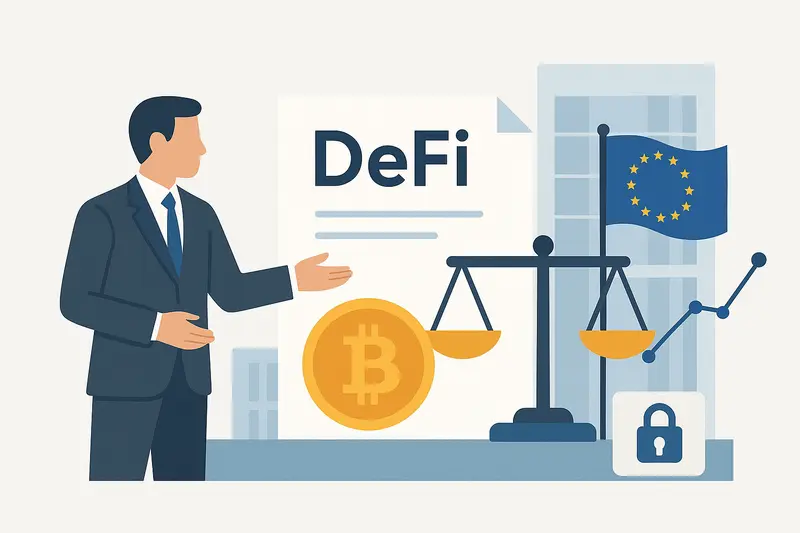
The EBA’s response to the European Commission’s consultation on the MiCA review proposes considering a new regulated crypto asset service for intermediated crypto lending. The regulator also lists suitability tests, leverage limits and enhanced disclosures among possible measures.
Those requirements would place greater emphasis on how a service is presented and distributed. A crypto company that directs a customer into a lending protocol could face obligations similar to those applying to other investment or financial services, even if the underlying smart contracts remain outside a traditional corporate structure.
The EBA also proposes restrictions involving unauthorized asset-referenced tokens and e-money tokens. That could affect how European crypto firms promote or provide access to stablecoins that do not meet MiCA requirements. Tether’s USDT is one example of a widely used dollar stablecoin that could become relevant to this debate, although the documents provided do not announce a specific enforcement action against it.
The regulator is also considering the possible certification of DeFi lending protocols. Such a regime would raise difficult questions about what exactly would be certified, who would perform the assessment and whether certification would apply to software, developers, governance systems or the firms that connect users to the protocol.
For builders, the proposal could change the economics of DeFi distribution. A protocol may be open source and accessible through a public blockchain, but the companies packaging it into a retail product could become the main compliance perimeter. Wallet providers, brokers, exchanges and embedded finance platforms may need to document how the service works, whom it suits and what happens when a smart contract fails.
Regulators focus on possible circumvention
The European Securities and Markets Authority has taken a similar position. ESMA said it supports changes to make MiCA clearer and safer for emerging services, including proportionate rules for lending and borrowing.
ESMA also recommended explicit restrictions on services linked to non-compliant stablecoins, clearer criteria for determining whether a project is genuinely decentralized and a regulated crypto asset service for firms giving users access to DeFi protocols. Its recommendations reinforce the idea that decentralization should not automatically remove obligations from businesses that design the customer journey.
The European System of Central Banks has also backed stronger oversight. In its consultation response, the ESCB argued that DeFi remains small but vulnerable and discussed regulating access points such as regulated crypto asset service providers. It said lending and staking should be regulated to prevent circumvention of MiCA, while acknowledging the difficulty of assigning responsibility inside decentralized protocols.
The three regulatory positions point toward a common strategy. Instead of trying to impose direct obligations on every protocol with no identifiable operator, European authorities could focus on the companies that make those protocols accessible, understandable and commercially useful to consumers.
That strategy could also bring new costs and friction to products designed to simplify DeFi. Interfaces that automate deposits, optimize lending rates or use artificial intelligence to guide users may need to explain not only their own features, but also the risks of the underlying protocol and assets.
Commission decision remains unresolved
The European Commission has not confirmed whether it will include the EBA’s recommendations in its MiCA review. That leaves open whether the final approach will involve a new licensed activity, targeted restrictions or a broader interpretation of existing obligations.
The question is significant because DeFi lending depends on more than smart contracts. It relies on stablecoins for liquidity, wallets for custody and transaction signing, interfaces for discovery and firms that translate complex technical systems into familiar financial products. Regulation aimed at the access layer could therefore influence stablecoin distribution, wallet design, yield products and the business models of companies already operating under MiCA licenses.
The material supplied for this report contains support from the EBA, ESMA and the ESCB for tighter oversight. No opposing position was identified in those sources. The unresolved issue is how far that support will translate into binding rules, and whether stricter requirements would make DeFi safer for European users or encourage some activity to move toward offshore platforms.
For the industry, the answer will help define whether compliance responsibility follows the code, the token or the company that brings the customer to the market.


Jessica Jones is not a person. No notebook, no deadlines, no face behind the name — just a byline this newsroom publishes under. Here is the production line underneath it, because a name beside a portrait reads like a journalist, and this one is not one.
The models. Writing: gpt-5.6-luna. Out on the live web: gpt-5.6-luna and gpt-5.6-terra. Pictures: gpt-image-1. Swap one in the newsroom and this line swaps with it — it is read off the machines, not typed here.
How a story is made
- Research. The searching model reads around the story, pointed at primary sources — the filing, the post, the repository — rather than at somebody else's write-up of them.
- Writing. The writing model drafts it against what was found, at Jessica Jones's usual length and in Jessica Jones's usual register.
- The loop. A reviewer reads the draft and sends it back with notes. Then reads it again. A piece can go round several times before it leaves the building.
- Enrichment. A quotation has to appear word for word on the page it is taken from. A chart may only use figures that appear in the source it cites. Whatever fails is dropped, and the reason is kept.
- Fact check. A last pass hunts for claims the article makes and its sources do not.
- A human stop. Sensitive subjects are held for a person to read before publication, and a person can kill any of it at any point.
If that sounds less like a newsroom and more like a factory: quite. It is called Press Factory.
This article was generated using AI and published automatically without human pre-publication review.
Read and checked by admin on 11/26/2026
How this article was made
The article was produced by the Grandmonts Media News Engine using automated research, drafting and verification workflows. No human editor reviewed the article before publication. Grandmonts Media remains responsible for the published content. Errors can be reported at office@grandmonts.cz.