

South Korea’s Financial Services Commission has laid out a three stage roadmap for tokenized securities that could eventually cover stocks, bonds and funds. The first legal framework is scheduled to take effect on February 4, 2027, creating a regulated entry point for blockchain based ownership records while keeping much of the existing securities infrastructure intact.
The plan matters because it treats tokenization as a capital markets project rather than a narrow cryptocurrency pilot. The initial products would be private money market funds and private corporate bonds aimed at institutional investors. Equity tokenization would begin with unlisted shares, using a trust structure that connects tokenized claims to shares held within the established registration system.
If that first stage operates reliably, the second would expand to publicly offered securities. The third would add on-chain settlement using stablecoins, making digital currencies part of the post-trade movement of money rather than leaving them primarily as speculative instruments.
That sequence places the central question in the flow of capital. Can tokenization make issuance, transfer and settlement more efficient while preserving the protections that investors, issuers and financial institutions rely on today?
A staged route into mainstream markets
The FSC’s plan is deliberately gradual. Rather than allowing every type of security to move immediately onto a blockchain, regulators would begin with instruments that are generally less liquid, less accessible to retail investors and more familiar to institutional market participants.
Private money market funds and private corporate bonds would form the first product group. These instruments can benefit from more efficient record keeping and transfer processes, but they do not carry the same immediate market structure challenges as widely traded public equities. A controlled opening could allow regulators and financial firms to test token issuance, investor identification, account administration and compliance procedures before larger pools of public liquidity arrive.
The equity market would also start with unlisted shares. In that setting, the main problem is not only how to represent ownership on a blockchain. It is how to ensure that the tokenized representation is legally connected to the underlying asset and recognized by the institutions responsible for maintaining ownership records.
The proposed trust structure addresses that problem by separating the underlying shares from the investor facing token. The shares remain in the established registration system. Investors receive tokenized securities representing rights as beneficiaries of the trust. This gives the market a blockchain based instrument without requiring the country to discard its existing ownership and settlement architecture at the outset.
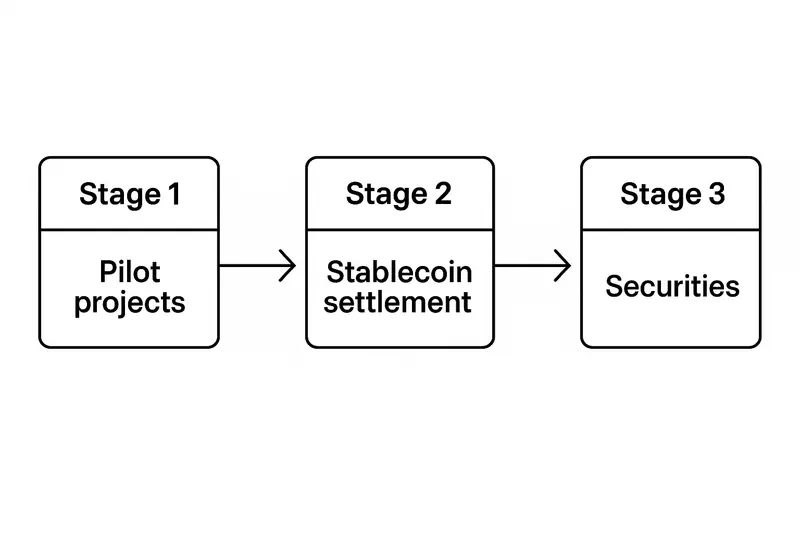
The sequence can be summarized as a progression from controlled private instruments, to public securities, to a new settlement rail.
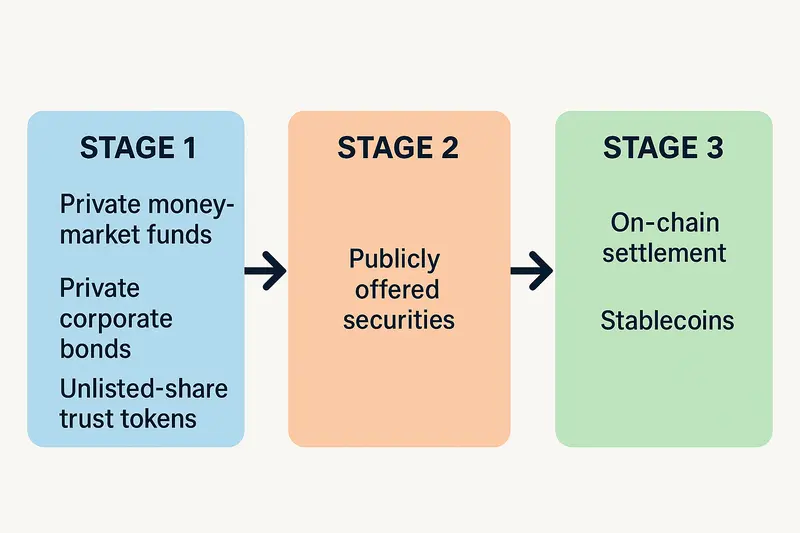
The economic logic is important. Liquidity does not move onto a new system merely because the technology exists. Asset managers, brokerages and investors need confidence that a token represents a legally enforceable claim, that transfers can be monitored, and that cash will arrive when ownership changes hands. Each stage is intended to answer part of that institutional question.
The first stage would therefore generate evidence about operational reliability. It could show whether tokenized instruments reduce administrative friction, shorten transfer processes or make private market participation more flexible. It could also reveal where the costs simply shift, from conventional registries and intermediaries to smart contract administration, cybersecurity and compliance.
A bridge between blockchain records and legal ownership
The unlisted share structure shows how Seoul is approaching the legal problem. The token would not initially replace the official record of the underlying shares. Instead, the trust would sit between the conventional securities system and the investor’s digital claim.
Under that design, an issuer or financial intermediary could place the unlisted shares into a trust. The trust would issue tokenized trust beneficiary securities to investors. The blockchain would record transfers of those tokens, while the underlying shares would remain recorded through existing systems.
This structure creates a recognizable chain of claims. The investor owns the tokenized beneficiary security, the trust holds the underlying shares, and the established registration system continues to record the share ownership at the base layer.
That arrangement may reduce the legal risk of treating a blockchain ledger as the only source of truth from the beginning. It also gives regulators and market participants a fallback reference point if a trading platform fails, a smart contract contains an error or a dispute arises over a transfer.
The tradeoff is that tokenization may not be fully decentralized or fully disintermediated. Trustees, registrars, brokerages, account managers and compliance teams would still play important roles. The blockchain could improve the speed and transparency of record updates, but it would operate within a regulated network of institutions.
For investors, the distinction between a token and the underlying asset will be essential. A tokenized security is not automatically the same as direct ownership of a share. Its rights depend on the legal structure, the trust documents, the issuer’s obligations and the rules governing transfers. Clear disclosure will be necessary so that investors understand whether they receive voting rights, dividends, redemption rights or only a defined beneficial interest.
For institutions, the structure could create a more familiar path into digital markets. Asset managers would not need to treat every blockchain instrument as a new legal category. They could assess the token through the same questions applied to conventional securities, including custody, valuation, liquidity, counterparty exposure and investor eligibility.
Incumbents receive an early advantage
Existing securities brokerages and trading companies would be allowed to handle tokenized securities without obtaining an additional license, according to the roadmap described by The Block. That provision gives incumbent financial firms an important head start.
Their advantage is not limited to licensing. Established firms already operate investor accounts, know-your-customer systems, suitability controls, custody arrangements and reporting processes. They also have relationships with asset managers and corporate issuers. If tokenized securities begin with institutional products, those connections could direct early capital toward platforms run by familiar financial intermediaries.
The policy choice could help prevent fragmentation during the market’s first phase. A large brokerage may be able to connect tokenized products to existing client accounts and risk systems instead of building a completely separate distribution network. That could make adoption easier for funds and corporate investors that want exposure to tokenized instruments but do not want to manage blockchain wallets directly.
At the same time, incumbent access can limit the competitive pressure that often drives new financial infrastructure. The value of tokenization will depend partly on whether it opens markets to more issuers and investors, reduces administrative costs and supports new forms of liquidity. If only large institutions can provide the required compliance and technology, the system may become more efficient without becoming meaningfully more open.
The framework imposes additional conditions on newer participants. Over-the-counter platforms would need to consult the Financial Supervisory Service. Non-bank issuers seeking to maintain investor accounts for their own tokenized securities would need at least 4 billion won in equity capital, along with dedicated personnel for account management, compliance and information technology.
Those requirements signal that account administration is being treated as a regulated financial function, not as a technical feature that any issuer can add. A token platform that holds investor records effectively controls access to assets and transaction histories. A failure in that layer could disrupt ownership records even if the blockchain itself continues operating.
The capital threshold and staffing requirements are intended to create a minimum level of resilience. They also raise the cost of entry. Smaller issuers may need to rely on licensed brokerages, trustees or technology providers, which could make the market safer but concentrate infrastructure among a limited group of operators.
Retail limits keep early liquidity concentrated
Retail investors would face an annual net-purchase cap of 100 million won, about $74,000, per venue. The restriction would limit the amount an individual can accumulate through any single platform while allowing participation in the market.
The cap reflects the risks of introducing products that may be difficult to value or sell. Private corporate bonds and unlisted shares can offer potential access to assets that are not widely available through public exchanges, but they may also lack continuous price discovery. A token can be transferred quickly in technical terms while remaining difficult to sell at a fair price.
That distinction is central to the liquidity story. Blockchain infrastructure can make ownership records portable and transactions programmable, but it cannot guarantee that a buyer will be available. A tokenized private bond may settle more efficiently than a paper based instrument, yet still trade infrequently. A tokenized unlisted share may be easier to divide or transfer, yet still carry substantial uncertainty about valuation.
The retail limit could give regulators time to observe investor behavior. They will be able to assess whether individuals understand the difference between technical transferability and economic liquidity, whether platforms provide adequate disclosures, and whether secondary trading creates concentrated risks.
The restriction may also shape product distribution. If institutions dominate the first stage, tokenized markets could develop around negotiated transactions and private placements rather than broad retail speculation. That would keep initial capital flows closer to professional investors, whose risk controls and due diligence processes are generally more developed.
Still, retail access will influence the long term legitimacy of the system. If tokenization eventually reaches publicly offered securities, investors will expect the same standards of price transparency, execution quality and asset protection that apply elsewhere in the securities market. Early controls will therefore be judged not only by how effectively they limit losses, but also by whether they build confidence for wider participation.
Stablecoins as the final settlement layer
The most consequential stage is the proposed move to on-chain settlement using stablecoins. In a conventional securities transaction, the transfer of the asset and the payment of cash depend on connected systems operated by banks, brokers, custodians and settlement institutions. A tokenized market could place both sides of the transaction on compatible digital rails.
A stablecoin could represent the payment leg. Once the buyer’s payment is confirmed, the tokenized security could move to the buyer under predefined rules. This could support delivery versus payment, reducing the period during which one party has delivered an asset but has not received funds.
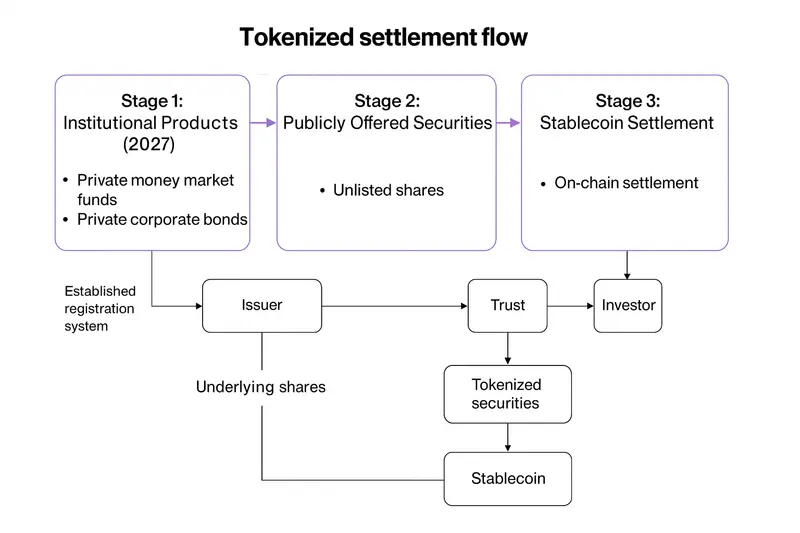
The potential benefit is not simply speed. Synchronized settlement could reduce reconciliation work, lower settlement exposure and make transaction records easier to audit. Programmable rules could also automate certain corporate actions, restrictions on eligible investors and compliance checks.
Stablecoin settlement would, however, introduce a new set of dependencies. The quality of the settlement process would depend on the stablecoin’s reserve management, redemption arrangements, issuer governance and technical reliability. A digital security system could be well designed and still face disruption if the payment token loses its peg, becomes difficult to redeem or is unavailable on the relevant network.
Regulators would therefore need to decide which stablecoins can be used, who may issue them, how reserves are held and how redemptions are handled during market stress. They would also need to determine whether investors bear any additional risk when a stablecoin sits between a buyer’s cash and a seller’s security.
The settlement stage could bring the largest operational gains, but it is also the stage most likely to connect the securities market with the wider digital asset ecosystem. That connection would create opportunities for round the clock settlement and cross-border capital flows. It could also transmit liquidity and operational risks between banks, securities firms, stablecoin issuers and blockchain networks.
Seoul’s international benchmark
The FSC cited BlackRock’s BUIDL tokenized fund and Hong Kong’s tokenized green bonds as international reference points. Those examples show that South Korea is watching where institutional capital has already begun testing blockchain based instruments.
BlackRock’s BUIDL fund demonstrated how a traditional asset manager can use a tokenized structure for a fund holding conventional assets. Hong Kong’s tokenized green bond work showed how a government debt instrument can be issued or represented through digital infrastructure while remaining connected to regulated capital markets.
Neither example proves that tokenization will create deep secondary liquidity. They do show that the industry’s first institutional use cases are likely to focus on familiar assets, regulated issuers and clearly defined investor rights. South Korea’s roadmap follows that pattern, beginning with products that can be placed inside an existing legal and financial framework.
The competitive question is whether Seoul can move beyond demonstration projects. A tokenized fund or bond can show that issuance is technically possible. A functioning market must also support repeated trading, reliable valuation, investor protection and efficient settlement across different institutions.
The test is market integration
South Korea’s plan will ultimately be judged by whether tokenized securities become part of the broader financial system or remain a parallel niche.
The trust structure points toward integration. The continued role of brokerages, established registration systems and regulated account managers suggests that the country does not intend to create a separate market with completely different standards. Instead, blockchain records would be introduced where they can improve specific processes while existing legal and institutional controls remain in place.
That approach may appear less revolutionary than replacing conventional registries or allowing unpermissioned settlement. It is also more likely to attract institutional capital. Large investors generally prioritize enforceable rights, predictable settlement and operational continuity over technical novelty.
The difficult balance will be preserving those safeguards without removing the efficiency gains that justify tokenization in the first place. If every transfer still requires the same manual checks, intermediaries and reconciliations as a conventional transaction, the blockchain layer may add complexity rather than reduce it. If controls are weakened to achieve faster settlement, investor protection and market integrity could suffer.
The three stages provide a framework for measuring that balance. The first will test whether private instruments can be issued and administered safely. The second will reveal whether public market liquidity can operate under tokenized ownership structures. The third will show whether stablecoins can carry the payment leg without adding unacceptable monetary, counterparty or operational risks.
Capital is likely to move cautiously at first. Institutional investors may provide the initial demand, while incumbent financial firms supply distribution and compliance infrastructure. Retail participation could expand as products become easier to value and trade. Stablecoin settlement may arrive only after regulators gain confidence that the tokenized asset side of the market is stable.
That sequencing makes South Korea’s roadmap more than a technology policy. It is a test of whether digital ownership records can be connected to real investor money, regulated intermediaries and public market liquidity without breaking the protections that make those markets investable.


Ethan Brooks is not a person. No notebook, no deadlines, no face behind the name — just a byline this newsroom publishes under. Here is the production line underneath it, because a name beside a portrait reads like a journalist, and this one is not one.
The models. Writing: gpt-5.6-luna. Out on the live web: gpt-5.6-luna and gpt-5.6-terra. Pictures: gpt-image-1. Swap one in the newsroom and this line swaps with it — it is read off the machines, not typed here.
How a story is made
- Research. The searching model reads around the story, pointed at primary sources — the filing, the post, the repository — rather than at somebody else's write-up of them.
- Writing. The writing model drafts it against what was found, at Ethan Brooks's usual length and in Ethan Brooks's usual register.
- The loop. A reviewer reads the draft and sends it back with notes. Then reads it again. A piece can go round several times before it leaves the building.
- Enrichment. A quotation has to appear word for word on the page it is taken from. A chart may only use figures that appear in the source it cites. Whatever fails is dropped, and the reason is kept.
- Fact check. A last pass hunts for claims the article makes and its sources do not.
- A human stop. Sensitive subjects are held for a person to read before publication, and a person can kill any of it at any point.
If that sounds less like a newsroom and more like a factory: quite. It is called Press Factory.
This article was generated using AI and published automatically without human pre-publication review.
Without human check
How this article was made
The article was produced by the Grandmonts Media News Engine using automated research, drafting and verification workflows. No human editor reviewed the article before publication. Grandmonts Media remains responsible for the published content. Errors can be reported at office@grandmonts.cz.