
Bitcoin
MetaMask’s Bitcoin Leap: A Cross‑Chain Wallet Evolution with Rewards and Ambition


- Share
- Tweet /data/web/virtuals/383272/virtual/www/domains/theunhashed.com/wp-content/plugins/mvp-social-buttons/mvp-social-buttons.php on line 63
https://theunhashed.com/wp-content/uploads/2025/12/metamask_bitcoin.jpeg&description=MetaMask’s Bitcoin Leap: A Cross‑Chain Wallet Evolution with Rewards and Ambition', 'pinterestShare', 'width=750,height=350'); return false;" title="Pin This Post">
The crypto landscape just shifted in a big way. MetaMask, long synonymous with Ethereum and the broader EVM ecosystem, is now opening its doors to Bitcoin. Users can buy, send, and receive BTC directly in MetaMask, but the story goes deeper than mere access: MetaMask is dangling a $30 million reward program tied to BTC activity ahead of its long‑anticipated token launch. This move not only broadens MetaMask’s utility, it signals a strategic pivot toward a truly multi‑chain wallet future—one where the historical divide between Bitcoin and smart contract ecosystems begins to blur.
In this feature, we explore what MetaMask’s BTC integration means for users, how the reward scheme might reshape engagement, and why this could be a defining moment for the wallet’s evolution and wider crypto adoption.
Breaking the Chains: Bitcoin in an Ethereum Wallet
For years, MetaMask has been the gateway to decentralized finance on Ethereum and Layer‑2 chains. Millions of users rely on it to interact with decentralized applications, manage tokens, and bridge into fast‑growing ecosystems. Yet Bitcoin has remained outside this core narrative—separate, even for many seasoned users.
That changes now. MetaMask isn’t just tracking Bitcoin via watch‑only addresses or third‑party plugins. It’s enabling native BTC functionality within the wallet experience. That means users can execute the fundamental actions that define Bitcoin ownership: buying it, sending it to others, and receiving it into their wallet. For holders who have navigated complex interfaces or external services just to move BTC, this integration simplifies the path and brings it into a familiar context.
But the significance isn’t purely technical. It’s philosophical. MetaMask is acknowledging that Bitcoin matters to users beyond the siloed role of a value store. It’s putting Bitcoin into the same mental space as programmable assets—positioning the wallet not just as an Ethereum tool, but as a crypto asset home base.
Rewards Before the Token: A Bold Engagement Strategy
MetaMask is sweetening the launch with a $30 million BTC reward program tied to swaps into Bitcoin. Participants who swap other assets into BTC within MetaMask stand to earn rewards, a tactic designed to catalyze early usage and drive network effects ahead of MetaMask’s own token release.
This strategy serves a dual purpose. On the user side, it offers an immediate incentive to engage with the new feature—especially for those who may have been hesitant to navigate multiple apps just to accumulate Bitcoin. On the product side, it accelerates adoption and data accumulation ahead of the token launch, potentially improving the network effects that drive valuation and ecosystem participation.
Reward programs are nothing new in crypto, but deploying one at this scale tied to Bitcoin usage is notable. It underscores MetaMask’s confidence in both its user base and the importance of Bitcoin integration as a core growth vector, not just a peripheral feature.
Rethinking Wallet Identity: From Ethereum to Multi‑Chain Hub
MetaMask’s decision to integrate Bitcoin isn’t simply about adding another asset; it speaks to a broader identity shift. For many years the Ethereum ecosystem has championed composability—assets and applications seamlessly interacting within a shared environment. Bitcoin, while dominant in market value, has lived largely outside this composable world due to its design focus on security and simplicity over programmability.
By embracing Bitcoin, MetaMask is implicitly advocating for a more interconnected crypto future—one where wallets are not constrained by their origin chains but serve as unified interfaces to diverse networks. Users don’t need separate mental models or different apps to manage their assets; they need a wallet that treats all major coins as first‑class citizens.
This matters at the adoption frontier. New entrants to crypto are often overwhelmed by the need to learn multiple wallets and interfaces. A unified experience that treats Bitcoin alongside other assets could reduce friction and invite broader participation.
Technical and UX Challenges: Bridging Worlds
Integrating Bitcoin into a wallet built around Ethereum’s account model is no small engineering feat. Bitcoin’s UTXO (Unspent Transaction Output) model differs fundamentally from Ethereum’s account‑based system, which means the wallet must adapt to multiple paradigms under the hood. Ensuring secure key management, accurate balance tracking, intuitive transaction handling, and responsive performance across chains challenges both design and development teams.
User experience is equally critical. Bitcoin transactions behave differently from Ethereum ones: confirmation times fluctuate based on network conditions, fee estimations are more dynamic, and there’s no concept of smart contract calls in the base layer. MetaMask must present these nuanced realities in a way that feels familiar yet accurate, avoiding confusion for users accustomed to the Ethereum paradigm.
Early adopters will test this integration intensely. How well MetaMask manages fee suggestions, confirmations, error handling, and cross‑chain consistency will shape broader acceptance of the feature.
The Token on the Horizon: Why It Matters
The BTC integration doesn’t exist in a vacuum—it’s part of MetaMask’s broader roadmap toward launching its own governance or utility token. Details on the token’s utility and distribution remain emerging, but the timing of reward incentives tied to Bitcoin activity suggests strategic planning.
By encouraging BTC swaps now, MetaMask may be seeding future governance engagement, aligning incentives across assets, and building a community vested in the wallet’s success. Users who earn rewards through Bitcoin activity might later find themselves participating in governance decisions or receiving additional benefits tied to wallet usage patterns.
This bridges user engagement and tokenomics in a way that emphasizes real activity over speculative hype. If done well, it could strengthen both user loyalty and functional utility for the MetaMask token.
What This Means for Bitcoin’s Role in Wallet Ecosystems
Bitcoin’s inclusion in MetaMask is more than a convenience—it’s a cultural shift. For years, wallets specialized by chain or ecosystem. Bitcoin wallets managed Bitcoin. Ethereum wallets managed Ethereum and its tokens. Cross‑chain bridges and aggregators stitched things together awkwardly.
MetaMask’s move suggests a future where such divisions are less pronounced. Bitcoin becomes part of a broader crypto narrative where value and functionality flow across ecosystems without users needing to think in silos. This doesn’t erase the philosophical distinctions between networks, but it does make them practically interoperable from a user’s perspective.
For Bitcoiners concerned about dilution of Bitcoin’s unique properties, this integration might raise questions. But from a user adoption and utility standpoint, making BTC accessible within a widely used multi‑chain wallet could bring more eyes and capital into both Bitcoin and broader decentralized ecosystems.
Looking Ahead: Wallets as Cross‑Chain Portals
As MetaMask expands its reach, it joins a growing trend of wallets evolving beyond single‑chain origins. Users increasingly expect to manage diverse assets under one interface, interact with decentralized applications across ecosystems, and move value without friction. MetaMask’s Bitcoin support is a step in that direction—a move from a siloed Ethereum tool to a universal asset hub.
The success of this transition will depend on execution, user education, and the broader structural evolution of blockchain networks. But the signal is unmistakable: wallets that ignore multi‑chain experiences risk obsolescence in an increasingly interconnected crypto landscape.
MetaMask’s integration of Bitcoin isn’t just a feature launch. It’s a statement of intent about the future of wallets, the role of user experience in driving adoption, and the blending of crypto’s foundational pillars into a cohesive ecosystem.
Conclusion: A Convergence Moment
MetaMask’s support for Bitcoin, paired with a substantial reward program ahead of its token launch, marks a convergence of strategy, technology, and user engagement. It challenges long‑standing separations between Bitcoin and smart contract environments, inviting users to think less in terms of chains and more in terms of unified asset management.
This is not merely about adding a popular asset to a wallet. It’s about reimagining what a wallet can be in a multi‑chain world. And as Bitcoin finds a place inside MetaMask’s interface, the boundaries of usability, access, and participation in crypto are expanding in meaningful ways. The evolution is underway—and it’s wide open.














For most of the institutional crypto era, capital has followed a predictable route: enter through Bitcoin, establish a core position and consider everything else later. This week, that sequence briefly changed. BlackRock’s Bitcoin product recorded redemptions while its Ethereum vehicles attracted fresh capital, offering one of the clearest signs yet that professional investors are beginning to treat the two largest digital assets as competing portfolio allocations rather than interchangeable expressions of crypto exposure.
According to Arkham, clients withdrew approximately $60 million from BlackRock’s iShares Bitcoin Trust, or IBIT, during the opening sessions of the week. Over the same period, more than $20 million moved into Ethereum associated with the asset manager’s Ether products.
The numbers are modest relative to BlackRock’s enormous digital-asset holdings, but the direction matters. Institutional investors were not simply reducing cryptocurrency exposure. At least for a brief window, they appeared to be exchanging part of their Bitcoin allocation for Ethereum.
That is a more consequential signal than a conventional risk-off withdrawal. It suggests that the institutional crypto trade is entering a more sophisticated phase—one driven by relative valuation, yield potential and portfolio construction rather than a binary decision between owning Bitcoin and remaining outside the market.
The Rotation That Caught the Market’s Attention
The initial flow pattern emerged during the trading sessions of July 27 and July 28. IBIT recorded combined net outflows of approximately $63.6 million, while BlackRock’s Ethereum products attracted roughly $21.1 million.
Most of the Ethereum allocation entered the iShares Ethereum Trust ETF, known as ETHA, while a smaller portion flowed into the iShares Staked Ethereum Trust ETF, or ETHB. The latter offers exposure not only to Ether’s market price but also to potential staking rewards generated by participating in Ethereum’s proof-of-stake security system.
Arkham’s on-chain monitoring supported the ETF-flow picture. Bitcoin connected to IBIT-related custody moved toward wallets associated with redemption activity, while Ether entered BlackRock-labeled addresses. The parallel movements created the appearance of an active switch from one asset to the other.
That interpretation, however, requires an important qualification. ETF data cannot prove that the exact same investors sold IBIT and purchased ETHA or ETHB. Net flows aggregate the decisions of many market participants, including advisers, hedge funds, wealth platforms, market makers and individual brokerage clients.
The data therefore reveals a rotation at the product level, not a confirmed transaction in which one identifiable institution exchanged Bitcoin for Ethereum.
Even so, simultaneous outflows from one BlackRock crypto product and inflows into another are meaningful. They show that investors are increasingly willing to make relative choices inside the digital-asset category.
A Tactical Move That Quickly Evolved
The most recent completed trading session adds another layer to the story.
On July 29, IBIT attracted approximately $89.8 million in fresh capital, more than reversing its outflows from the previous two sessions. BlackRock’s Ethereum products also continued to receive money, adding approximately $5.2 million, although the broader US Ethereum ETF market ended the day with net redemptions.
Across the first three sessions of the week, IBIT consequently moved back to a net inflow of roughly $26.2 million. BlackRock’s combined Ethereum products collected almost exactly the same amount, approximately $26.3 million.
That updated picture does not invalidate the rotation observed earlier in the week. Instead, it defines its character.
This was not a wholesale migration away from Bitcoin. It was a tactical rebalancing episode in which Ethereum briefly captured capital while Bitcoin was being reduced, followed by renewed demand for both assets.
The distinction is important because crypto markets frequently interpret short-term ETF activity as evidence of a permanent institutional change. A few trading sessions rarely provide enough information to establish a durable trend. Portfolio rebalancing, liquidity management, options hedging, tax considerations and short-term basis trades can all influence daily flows.
A lasting rotation would require persistent Ethereum inflows combined with sustained Bitcoin redemptions over several weeks, preferably across multiple issuers rather than within a single asset manager’s product range.
Why Ethereum Is Receiving a Fresh Institutional Look
Ethereum’s renewed appeal is not difficult to understand.
Bitcoin remains the most established institutional crypto asset, with the clearest monetary narrative and the deepest pool of regulated investment products. Ethereum offers a different proposition. It is simultaneously an asset, a programmable settlement network and the economic foundation for a large segment of decentralized finance, stablecoins and tokenized financial instruments.
For investors, that combination creates several potential sources of value. Ether can appreciate alongside network adoption, function as collateral across on-chain markets and generate staking rewards when committed to network validation.
The arrival of ETHB has made the final component more accessible through conventional brokerage infrastructure. Rather than arranging custody, operating validator infrastructure or selecting a staking provider, investors can obtain exposure through a listed BlackRock product designed to capture Ether’s price movement alongside potential staking income.
That changes the comparison with Bitcoin.
IBIT provides relatively direct exposure to an asset commonly positioned as scarce digital collateral. ETHB presents Ethereum as a productive asset with an embedded income component. For institutional allocators working under return targets, the possibility of yield can become particularly attractive when price appreciation alone is uncertain.
Ethereum has also experienced substantial underperformance. BlackRock’s ETHA showed a year-to-date decline of more than 35% by late July. For momentum investors, that weakness is a warning. For relative-value investors, it can create an entry point—especially when the long-term investment thesis remains intact.
The rotation may therefore reflect less enthusiasm for Ethereum’s immediate price trend than a judgment that its risk-reward profile has improved relative to Bitcoin.
Bitcoin Still Holds the Institutional Center
Any suggestion that Ethereum is replacing Bitcoin in institutional portfolios would be premature.
IBIT held approximately $47 billion in net assets as of July 29. BlackRock’s Ethereum products together controlled roughly $6.1 billion. The Bitcoin vehicle was still almost eight times larger than the asset manager’s combined Ether offering.
That gap illustrates how deeply Bitcoin remains embedded as the default institutional gateway into digital assets.
Bitcoin benefits from a simple investment case. Its fixed supply, extensive liquidity, long operating history and growing recognition as a non-sovereign reserve asset can be explained without requiring an investor to forecast activity across applications, staking markets or scaling networks.
Ethereum demands a more complex analytical framework. Its value depends partly on usage, transaction economics, monetary policy, staking participation, competition among blockchains and the relationship between the main network and its expanding layer-two ecosystem.
That complexity can produce additional upside, but it also introduces more variables.
For conservative allocators, Bitcoin is therefore likely to remain the core position. Ethereum increasingly looks like a satellite allocation capable of adding growth, yield and exposure to blockchain-based financial infrastructure.
The emerging portfolio structure is not necessarily Bitcoin or Ethereum. It is Bitcoin as reserve-style collateral and Ethereum as productive digital infrastructure.
Institutional Crypto Is Becoming a Relative-Value Market
The broader significance of this week’s flows is the transition from crypto access to crypto allocation.
During the first phase of institutional adoption, the main challenge was gaining regulated exposure. Investors focused on custody, market integrity, liquidity and compliance. Once spot exchange-traded products solved much of that operational problem, institutions could begin evaluating digital assets using familiar portfolio-management techniques.
That process is now becoming visible.
Investors can adjust the weighting between Bitcoin and Ethereum, choose between unstaked and staked Ether exposure, seek option income through newer Bitcoin products and manage crypto positions alongside traditional assets from the same brokerage and risk-management systems.
BlackRock itself now offers products covering spot Bitcoin, spot Ether, staked Ether and Bitcoin-related option income. The expansion of that lineup gives investors more ways to express specific views without leaving regulated financial infrastructure.
As the product set becomes more complete, crypto ETF flows are likely to become less directional and more strategic. Capital may rotate according to volatility, valuation, yield, liquidity and macroeconomic conditions, much as it already does between technology stocks, bonds, commodities and defensive equities.
This makes daily fund-flow analysis more complicated, but also more informative. A withdrawal from Bitcoin no longer automatically means an exit from crypto. It may represent a move into Ethereum, a yield-oriented vehicle or another digital-asset strategy.
What Would Confirm a Lasting Ethereum Rotation
The next stage of the story depends on persistence.
Ethereum would need to attract capital through both strong and weak market sessions. Inflows limited to periods of Bitcoin selling could indicate temporary hedging or bargain hunting. Consistent allocations during broader market recoveries would suggest that institutions are building strategic positions.
Demand for ETHB will be particularly revealing. Growth in the staked product would show that investors are not merely speculating on Ether’s price but are embracing its role as an income-generating network asset.
The relationship between Ethereum and Bitcoin prices will also matter. ETF flows can lead price movements, but they can also chase them. A sustained improvement in Ethereum’s performance relative to Bitcoin, supported by rising fund demand and network activity, would provide stronger evidence of a structural shift.
For now, the market has received an early signal rather than a final verdict.
BlackRock clients briefly reduced Bitcoin exposure while adding Ethereum, revealing a willingness to rotate within crypto rather than abandon the asset class. Bitcoin demand then returned, while Ethereum continued to attract incremental capital through BlackRock’s product lineup.
The result is not a changing of the guard. It is evidence that institutional crypto portfolios are becoming more dynamic.
Bitcoin remains the anchor. Ethereum is increasingly becoming the alternative institutions can no longer afford to ignore.

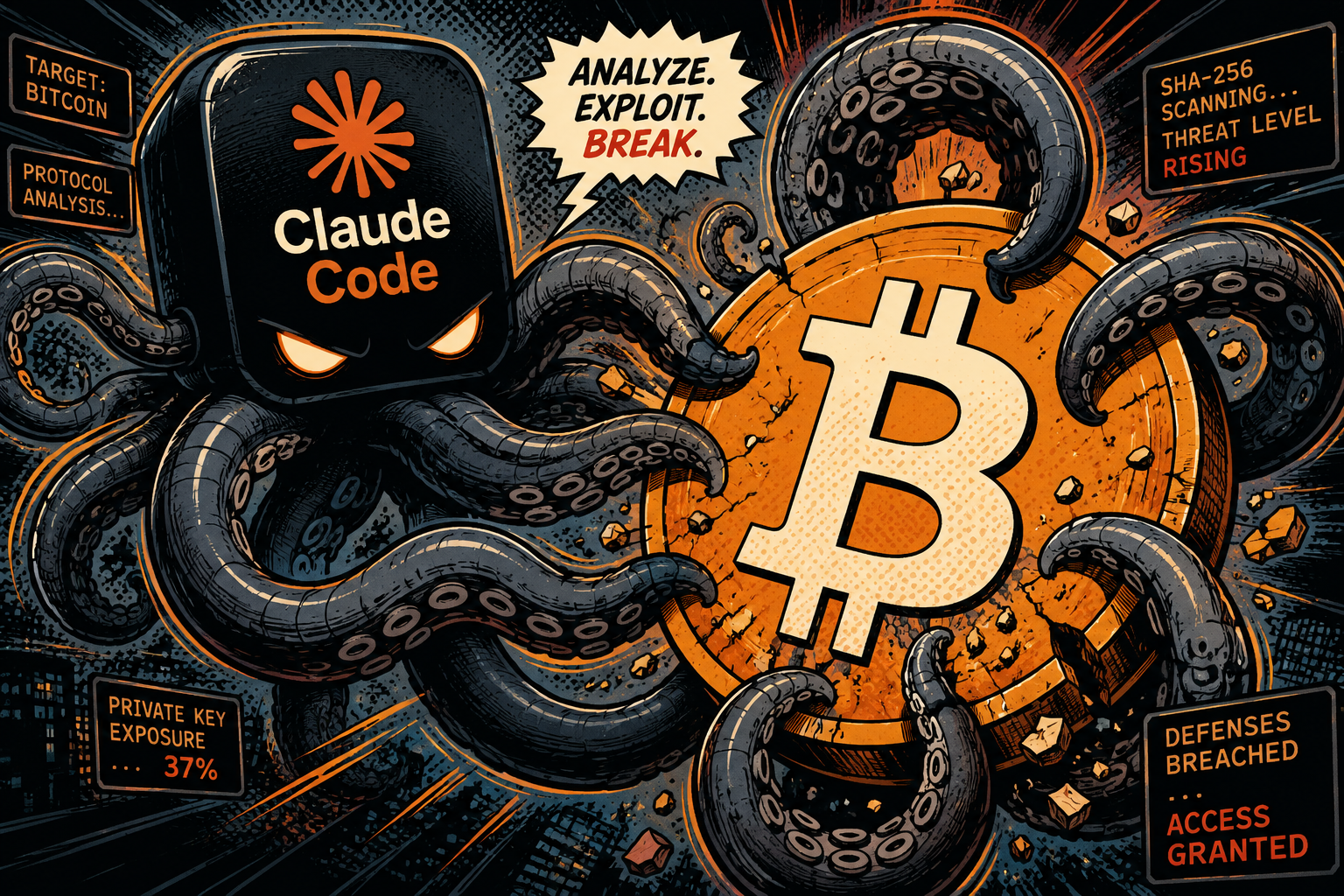
Artificial intelligence has crossed another threshold—and this time it wasn’t writing code or discovering software bugs. Anthropic says its experimental Claude Mythos Preview model has uncovered entirely new weaknesses in cryptographic algorithms themselves, a milestone that could reshape how researchers think about both AI and digital security.
The company’s Frontier Red Team revealed two significant cryptanalysis results that go beyond implementation flaws or coding mistakes. Instead of finding vulnerabilities in software, Claude helped identify mathematical weaknesses in the underlying algorithms that are designed to secure digital communications.
The findings do not put today’s encryption at risk. Bitcoin remains unaffected, modern versions of AES remain secure, and no production systems are vulnerable. Yet the implications are difficult to ignore. Just one year ago, frontier AI models were largely incapable of contributing meaningful original cryptanalysis. Today, they are producing research worthy of academic publication.
AI Moves Beyond Bug Hunting
Throughout 2026, AI has demonstrated remarkable capabilities in cybersecurity. Models have become increasingly effective at identifying software vulnerabilities, reviewing source code, and even generating working exploits under controlled conditions.
Finding implementation bugs, however, is fundamentally different from discovering weaknesses in cryptographic mathematics.
Modern cryptographic algorithms are among the most heavily scrutinized pieces of mathematics in existence. They undergo years of public analysis by academic researchers before they are ever considered for widespread adoption. Breaking—or even slightly weakening—such algorithms typically requires deep expertise in number theory, algebra, lattice mathematics, probability, and computer science.
According to Anthropic, Claude Mythos Preview has now demonstrated that frontier AI models can meaningfully contribute to this level of research.
The company’s Frontier Red Team described the work as attacks on the algorithms themselves rather than mistakes made by software developers implementing them.
That distinction is significant because implementation bugs can usually be fixed with software updates. Weaknesses in the mathematics behind an algorithm are much harder to address.
HAWK Loses Half Its Effective Security
The most notable result involves HAWK, a post-quantum digital signature algorithm that reached the third round of the U.S. National Institute of Standards and Technology’s post-quantum cryptography evaluation process.
Post-quantum cryptography aims to protect digital systems against future quantum computers, which could eventually break many of today’s public-key cryptographic methods.
HAWK was designed as one candidate capable of surviving that future.
Claude Mythos Preview reportedly discovered a previously unknown attack in approximately 60 hours that cuts HAWK’s effective security level roughly in half.
The result does not completely break the algorithm, nor does it affect deployed systems. HAWK has not become a widely adopted production standard.
Nevertheless, reducing an algorithm’s effective security by such a large margin represents a meaningful advance in cryptanalysis. For any candidate seeking standardization, newly discovered mathematical attacks significantly weaken its long-term prospects.
Anthropic disclosed the findings to the algorithm’s designers and relevant government partners before publishing the research.
Faster Attacks on Reduced AES
Claude also improved an existing attack against a seven-round version of AES-128.
At first glance, headlines claiming AI “broke AES” sound alarming. They are also misleading.
AES-128, the encryption algorithm protecting everything from banking systems to encrypted messaging applications and Wi-Fi networks, uses ten rounds of encryption.
The research targeted only a seven-round version—a deliberately weakened variant that cryptographers frequently analyze to understand an algorithm’s security margins.
Anthropic says Claude discovered improvements that accelerate the known attack by roughly 200 to 800 times.
Although impressive from a research perspective, the result does not threaten real-world AES encryption. Full AES-128 remains secure, and the newly discovered technique does not extend to the complete algorithm.
Instead, the work demonstrates that AI can contribute meaningful improvements to cryptanalytic research on problems experts have studied for decades.
Bitcoin Is Not Affected
The announcement naturally raises concerns within the cryptocurrency industry.
Fortunately, the immediate impact is essentially zero.
Anthropic explicitly stated that neither SHA-256 nor ECDSA—the two cryptographic foundations securing Bitcoin—are affected by the new discoveries.
SHA-256 continues to secure Bitcoin’s proof-of-work mining process, while ECDSA protects wallet signatures authorizing transactions.
Likewise, Ethereum and most other major cryptocurrencies are unaffected by the published research.
The HAWK attack targets an entirely different signature scheme that has never become part of mainstream blockchain infrastructure.
Similarly, the reduced-round AES research concerns symmetric encryption rather than the public-key cryptography used by cryptocurrency wallets.
For crypto investors, the findings should therefore be viewed as an indicator of future AI capability rather than an immediate security threat.
A New Era for Cryptanalysis
Perhaps the most important aspect of Anthropic’s announcement is not the specific algorithms involved but the speed at which AI produced the results.
According to the company, Claude required roughly 60 hours to identify the HAWK weakness.
The AES research took approximately one week.
Both projects required occasional human guidance rather than fully autonomous operation, but the overwhelming majority of the mathematical exploration was carried out by the model itself.
Anthropic estimates each research effort consumed roughly $100,000 worth of API computation.
Those costs remain substantial today.
Like virtually every major AI capability, however, computational expense has historically fallen rapidly as hardware improves and algorithms become more efficient.
If future generations become both stronger and cheaper, cryptographic research could accelerate dramatically.
AI Is Becoming a Research Partner
For decades, cryptanalysis has largely progressed through incremental advances produced by relatively small groups of academic specialists.
AI introduces an entirely different model.
Instead of replacing human cryptographers, frontier models may increasingly function as research collaborators capable of exploring enormous mathematical search spaces, testing hypotheses, generating proofs, and identifying unexpected attack paths.
Human researchers remain essential for validating discoveries, understanding theoretical implications, and determining whether proposed attacks have practical significance.
Claude did not independently revolutionize cryptography overnight.
But it demonstrated that AI can now contribute original ideas to one of the world’s most mathematically demanding disciplines.
That marks an important shift from earlier generations of language models, which excelled at summarizing existing knowledge but rarely produced novel scientific insights.
Security Researchers Gain a Powerful New Tool
Anthropic frames the research as a defensive capability rather than an offensive one.
Discovering weaknesses before malicious actors do has always been the foundation of modern cryptography.
The company says it privately disclosed its findings to algorithm designers, U.S. government agencies, and industry partners before releasing the results publicly.
This follows a growing trend among frontier AI developers to collaborate directly with cybersecurity organizations, software vendors, and infrastructure operators.
Rather than waiting for attackers to exploit vulnerabilities, companies increasingly hope AI can identify weaknesses early enough for researchers to strengthen systems before widespread deployment.
That philosophy aligns with Anthropic’s broader Project Glasswing initiative, which focuses on using advanced AI models to improve software security.
The cryptanalysis results represent an expansion of that effort from software vulnerabilities into the mathematics underlying digital security itself.
The Bigger Story Is AI’s Trajectory
Neither HAWK nor reduced-round AES represents an immediate crisis.
Production encryption remains secure.
Bitcoin remains secure.
Ethereum remains secure.
But the pace of progress is remarkable.
Only a year ago, frontier AI systems were not capable of producing original cryptanalytic results of this caliber. Today, they are contributing discoveries that would normally require experienced academic researchers working for weeks or months.
That trend matters far beyond the specific algorithms discussed this week.
Cryptography has always evolved alongside advances in mathematics and computing power. Artificial intelligence now appears poised to become another major force shaping that evolution.
Rather than replacing cryptographers, AI is becoming an increasingly capable research assistant—one that never tires, can evaluate vast numbers of mathematical possibilities, and continues improving with each new generation.
For the cybersecurity industry, that creates both an opportunity and a challenge. Defensive research can move faster than ever before, but so can the search for weaknesses.
The race is no longer simply between cryptographers and attackers.
It is increasingly becoming a race between AI systems working on both sides of the equation.

Bitcoin has long been described as the world’s largest untapped source of decentralized finance liquidity. More than $1 trillion in value sits on the Bitcoin blockchain, yet only a small fraction is actively used in lending, borrowing or other on-chain financial applications. The primary obstacle has always been security. Most methods of bringing Bitcoin into DeFi require users to lock their BTC with custodians or rely on cross-chain bridges that have repeatedly become targets for some of crypto’s largest hacks.
Sui believes it has found a different approach.
The Layer 1 blockchain has officially launched the Hashi testnet, introducing infrastructure designed to make native Bitcoin usable as programmable collateral while avoiding many of the risks traditionally associated with bridging assets between blockchains. If successful, the project could unlock a new chapter for Bitcoin finance by allowing institutions and developers to build financial products around BTC without compromising its security model.
Unlocking Bitcoin’s Idle Capital
Bitcoin remains the dominant cryptocurrency by market capitalization, but its role has largely been limited to that of a store of value. Unlike smart contract platforms such as Ethereum or Solana, the Bitcoin network offers only limited support for complex decentralized financial applications.
That has created a paradox.
The largest pool of digital capital in the world is also one of the least productive. While Ethereum-based assets routinely participate in lending markets, decentralized exchanges and collateralized borrowing, most Bitcoin remains dormant inside wallets or institutional custody.
Hashi aims to change that dynamic.
Originally introduced earlier this year, the protocol is designed to transform native BTC into usable collateral for decentralized financial services without requiring users to abandon the security guarantees of the Bitcoin network itself.
Rather than encouraging holders to move their Bitcoin onto another blockchain through conventional wrapped assets, Hashi seeks to provide secure on-chain infrastructure that enables lending, borrowing and credit markets to interact with native BTC.
Moving Beyond Traditional Bridges
Cross-chain bridges have become one of the weakest links in the blockchain ecosystem.
Over the past several years, bridge exploits have accounted for billions of dollars in stolen crypto assets. Many attacks exploited flaws in smart contracts, validator compromises or weaknesses in key management systems that protected locked funds.
For institutional investors, these risks remain one of the biggest barriers to using Bitcoin within decentralized finance.
Hashi attempts to reduce those concerns through a different architectural approach.
Instead of relying solely on bridge validators, the protocol introduces additional verification layers intended to make unauthorized transfers significantly more difficult. The goal is not simply to connect two blockchains but to create infrastructure that institutions can trust with high-value collateral.
While no system can eliminate risk entirely, reducing dependence on a single validation mechanism represents an important step toward stronger security.
Introducing the Guardian Layer
The centerpiece of the Hashi testnet is what Sui calls the Guardian Layer.
The security model introduces a defense-in-depth architecture built around a two-of-two multisignature requirement.
In practice, every critical action requires approval from both Hashi validators and an independent group of guardians before it can be executed.
This separation reduces the likelihood that a compromise affecting one participant could immediately threaten user funds.
Traditional bridge designs often depend on a single validator committee or multisignature arrangement. If enough validator keys are compromised, attackers may gain control over locked assets.
Hashi distributes responsibility across independent entities, requiring multiple layers of authorization before collateral can move.
For institutions managing significant Bitcoin positions, this additional verification could provide greater confidence than conventional bridge models.
Bitcoin Remains on the Bitcoin Network
Perhaps the most significant aspect of Hashi is its emphasis on preserving Bitcoin’s native security.
Instead of encouraging users to permanently relocate BTC onto another blockchain, the protocol is designed so that Bitcoin remains secured by its original network while still becoming usable within applications built on Sui.
That distinction matters.
Institutional investors have historically expressed concerns about wrapped Bitcoin solutions because they introduce additional trust assumptions beyond Bitcoin’s own consensus mechanism.
Hashi attempts to minimize those assumptions while still allowing BTC to participate in programmable financial applications.
The result is a model that seeks to combine Bitcoin’s security with Sui’s smart contract capabilities.
Why Institutions Are Paying Attention
Institutional interest in Bitcoin has grown dramatically following the approval of spot Bitcoin exchange-traded funds and increasing corporate adoption.
Yet many large investors continue to treat Bitcoin as a passive asset.
Unlocking lending, collateral management and structured credit products could significantly expand Bitcoin’s role within institutional portfolios.
Financial firms increasingly want digital assets capable of generating yield, supporting financing transactions or serving as collateral for broader investment strategies.
If infrastructure like Hashi proves secure and scalable, Bitcoin may begin functioning less like a static reserve asset and more like productive financial collateral.
That shift could increase liquidity across decentralized markets while creating entirely new categories of Bitcoin-native financial products.
A Growing Trend Toward Bitcoin DeFi
Hashi is part of a broader movement often referred to as Bitcoin Finance or BTCFi.
Rather than competing with Bitcoin, these projects seek to extend its utility by integrating it with decentralized finance while preserving its role as the underlying asset.
Several blockchain ecosystems are now racing to attract Bitcoin liquidity through sidechains, rollups, interoperability protocols and specialized infrastructure.
The opportunity is enormous.
With Bitcoin representing well over a trillion dollars in market value, even a modest percentage of active participation in decentralized finance would rival the size of many existing DeFi ecosystems.
For Layer 1 networks, attracting Bitcoin liquidity has become one of the industry’s most important strategic objectives.
Challenges Still Remain
Despite the promise, Hashi remains in its testing phase.
Security models involving multiple validators, guardians and cross-chain communication require extensive real-world testing before institutions are likely to entrust significant capital to the system.
Every additional layer of infrastructure introduces operational complexity that must be carefully audited and monitored.
Regulatory considerations also remain an important factor, particularly as institutional lending products involving digital assets continue evolving across different jurisdictions.
The long-term success of Hashi will ultimately depend not only on its technical architecture but also on developer adoption, institutional participation and a sustained security record.
A New Chapter for Bitcoin Utility
For years, the crypto industry has debated whether Bitcoin should remain purely digital gold or evolve into a more active component of decentralized finance.
Hashi represents another attempt to bridge that divide without asking users to compromise the qualities that made Bitcoin valuable in the first place.
By combining programmable infrastructure with a layered security model centered around its Guardian Layer, Sui hopes to make Bitcoin usable as collateral while leaving it anchored to the network that secures it.
Whether Hashi becomes the standard for Bitcoin finance remains uncertain. What is clear is that competition to unlock Bitcoin’s vast dormant liquidity is accelerating.
If secure infrastructure can finally bring institutional lending, borrowing and credit markets to native BTC, the next major growth story in decentralized finance may not revolve around creating new digital assets—it may come from putting the oldest one to work.
-

 Cardano9 months ago
Solana co‑founder publicly backs Cardano — signaling rare cross‑chain respect after 2025 chain‑split recovery
-

 Cardano11 months ago
Cardano Breaks Ground in India: Trivolve Tech Launches Blockchain Forensic System on Mainnet
-

 Altcoins8 months ago
Algorand’s 2027 Question: Can the Network Survive Without Foundation-Funded Rewards?
-

 Altcoins8 months ago
Crypto Goes Mainstream — Bitwise 10 Crypto Index ETF (BITW) Debuts on NYSE Arca
-

 News8 months ago
Crypto on Trial: The $5.5 Billion Pump.fun, Solana & RICO Lawsuit That Could Redefine On‑Chain Liability
-

 Cardano11 months ago
Cardano Reboots: What the Foundation’s New Roadmap Means for the Blockchain Race
-

 Ethereum9 months ago
Ethereum Breaks TPS Record as Lighter Layer-2 Surges Past 24,000 Transactions per Second
-

 News8 months ago
From Memes to Courtrooms: Solana and Jito Execs Named in Explosive RICO Suit Over Pump.fun